


The gambling industry has become adept at measuring engagement. Understanding what makes the engagement valuable to both operator and player is a challenge.
As personalisation becomes more sophisticated and gamification moves deeper into product design, the old measures of sessions, deposits and time spent are beginning to look incomplete. The question for operators is shifting from how to generate more interaction to how to create experiences players actively choose to return to, without losing sight of responsible gaming.
Ahead of the Player Experience Academy at SBC Summit, Harrison Barrett, VP of Business Development at Soft2Bet, discusses why player behaviour is often misunderstood where personalisation stool falls short and why the next phase of gamification will rethink the product around the individual player.
Harrison Barrett: I think we’ve spent too long asking, “How do we keep the player?” when the more important question is, “Why would the player choose to come back?” Those are two very different questions.
Retention isn’t something you do to a player. It’s the outcome of an experience that continues to earn their attention. And that distinction matters because players have changed. They are not comparing one gaming operator with another anymore. They are comparing every digital experience they have be it gaming, streaming, social media, entertainment or ecommerce. The benchmark is no longer the casino or sportsbook next door; it is the best digital experience in their pocket.
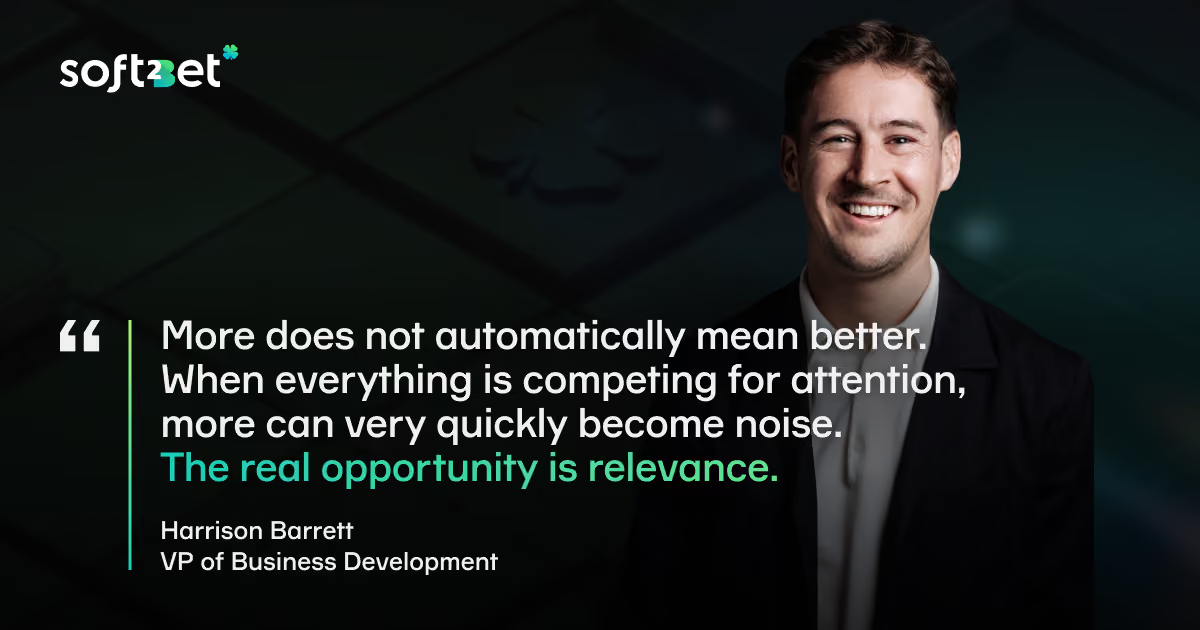
Where I think the industry sometimes gets it wrong is in treating engagement as a volume equation: more messages, more bonuses, more promotions, more touchpoints. But more does not automatically mean better. In fact, when everything is competing for attention, more can very quickly become noise. The real opportunity is relevance.
Does the experience recognise what players enjoy? Does it evolve with them? Does it give Players something worth returning to rather than simply another reason to transact? That is where personalisation, behavioural design and gamification become powerful, not as mechanisms for keeping somebody on a platform for longer, but as tools for making the experience more immersive and intuitive and of course ultimately more enjoyable.
And we also need to become much better at understanding why people leave. Players rarely wake up one morning and suddenly decide they are no longer engaged. Usually, we have lost them gradually: through friction, repetition, irrelevant communication, a lack of novelty, or simply because something else, somewhere else, has become more interesting.
So the future of retention isn't about finding increasingly sophisticated ways to hold attention. It is about building experiences that deserve it.
Harrison Barrett: I think we need to be careful with the word personalisation, because the industry uses it a lot and sometimes what we really mean is segmentation with better technology.
Putting a layer’s name on something isn’t personalisation. Showing a layer a game because people who are similar played it isn’t necessarily personalisation either.
For me, the real question is: does the experience understand what the layer wants right now?
And “right now” is important, because the same player is not in the same frame of mind during every visit.
Think about music. We’ve moved from playlists to the beginnings of experiences that can understand tempo, mood, genre, listening behaviour and even context. I might want high-energy music when I’m training, something completely different on the commute home, and something different again on a Sunday morning. Same person. Three different moments, different moods and therefore different references.
That’s where player experience needs to go.
Imagine an iGaming platform that doesn't just know what games you've played before, but begins to understand how you like to play, what you respond to, when your behaviour changes, what creates friction and when the experience should actually become simpler rather than busier.
Suddenly we’re not talking about, “this player likes slots, therefore show this player more slots.” We’re talking about understanding intent. And commercially, that changes everything.
Because the companies that win the next phase of digital entertainment will be the ones that are best at orchestrating content around the individual.
That means bringing together behavioural data, AI, product design, gamification and responsible gaming in a much more intelligent way. And importantly, personalisation shouldn't always mean more. Sometimes the smartest personalised decision is fewer recommendations, less friction, a different experience or recognising that this isn't the moment to push another interaction.
That, to me, is where it becomes genuinely individual. We’ve spent years building platforms that ask: “Which player segment are you?”
The next generation of platforms should be asking: “Who are you in this moment and what would make this experience better for you?” That’s the leap. From personalising the product for a player, to creating an experience that can genuinely adapt with the player.
Harrison Barrett: Because you can sit through a hundred presentations about gamification and still not know what to do when a real player problem lands in front of you. And that’s the gap we wanted to close.
We talk a lot in this industry about engagement, retention, personalisation, gamification. We know the terminology. We know the frameworks. But knowing something and being able to apply it are two completely different things.
Think about how people learn. You can memorise the theory, study the diagrams, listen to the expert, but until you're put into a situation where you have to make a decision, weigh competing signals and explain why you've made that choice, you haven't really tested your understanding.
Player experience is exactly the same. A player doesn't arrive as a PowerPoint slide. They arrive with behaviours, motivations, frustrations, preferences and context. And sometimes those signals contradict each other.
So Helen and I wanted to put people into that situation. Here is your player. Here is the problem. What do you do?
Because gamification isn't about adding points, badges and leaderboards to everything. That's what I would call decoration! Good gamification starts with understanding human behaviour: What is this player trying to achieve? What motivates them? What makes the experience rewarding? And what would make them walk away?
That's where the workshop becomes interesting. People have to debate. They have to challenge assumptions. They have to connect the dots. And they're doing it alongside people from product, commercial, compliance and player experience who may look at exactly the same player and see something completely different.
That tension is valuable. Because ultimately, the real world doesn't hand you the answer at the bottom of a slide.
The future of player experience will be built by people who can take technology, data, behavioural insight and creativity and turn them into better decisions for the individual player.
So we don't want people leaving the Academy simply knowing more about gamification.
We want them to leave after they have contributed and participated. They will leave thinking differently about the player.
Harrison Barrett: Absolutely. Because the most dangerous question in player experience innovation is, “What can this technology do?” The better question is, “What does this player actually need?”
We have extraordinary technology now: AI, real-time data, personalisation, increasingly sophisticated gamification. But capability isn't the same as value. Just because we can build something doesn't mean a player will care about it.
That's why we start with the persona: motivation, behaviour, friction, context. Then we ask where technology can make that experience better. Start with the player. Find the problem. Then earn the right to introduce the technology.
Harrison Barrett: Absolutely. If gamification is something you bolt onto a product at the end to improve a retention metric, you’re already thinking too narrowly.
What’s interesting is that gamification was one of the big management and marketing ideas of the early 2010s. We talked very visibly about points, badges and leaderboards. Today, we talk about it less, yet it has quietly become part of the architecture of some of the world’s most successful digital products. Progress, achievement, challenge, competition, mastery: users experience these mechanics constantly without necessarily calling them gamification.
The real opportunity is to move from gamification as a retention tool to gamification as product design. It should influence how a player discovers, progresses and experiences value not simply give them another incentive to return.
Because ultimately, the best gamification doesn’t feel like a mechanism designed to retain you.
Harrison Barrett: There is an obvious commercial tension here when iGaming: operators want players to engage more, while responsible gaming requires them to recognise when engagement should stop.
Good product design has to genuinely reconcile these two objectives because sustainable engagement and maximum engagement are not the same thing.
Responsible gaming makes us ask what good engagement actually looks like for individual players.
That changes the role of product design. The same data and technology we use to personalise an experience can also recognise changes in behaviour, introduce friction when it matters, surface limits and make stepping away as intuitive as continuing.
And commercially, I don’t see that as a contradiction. A player relationship built on trust, transparency and control is ultimately more sustainable than one designed simply to maximise the next session.
Harrison Barrett: The difference is whether you’re creating value for the player or simply extracting another action from them.
Players are much more sophisticated about digital systems than we sometimes give them credit for. They know algorithms shape what they see, that certain behaviours trigger offers, and that platforms are competing for their attention. They’ve learned to work the system too,choosing when to engage, when to wait and when to walk away.
So another click or deposit can tell you what somebody did. It doesn't necessarily tell you how they feel about the experience.
That’s why loyalty is a much higher bar. It comes from relevance and consistency. When players feel the experience respects their time, understands what they value and gives them genuine agency, you begin to build trust and loyalty.
Harrison Barrett: We’ve become very good at measuring activity: sessions, deposits, frequency, time spent, GGR. They matter, but on their own they can tell you that a player is doing more, not whether the relationship is getting better.
We should be looking at the quality and sustainability of that engagement: cohort retention, changes in player behaviour over time, use of limits and responsible-gaming tools, friction and complaints, the impact of interventions, and ultimately lifetime value viewed alongside player wellbeing.
Because a spike in deposits might look fantastic and tell you something very different six months later.
A stronger way to judge success is whether engagement created enough genuine value for the player to choose to return, and to do so sustainably. That is harder to measure than a spike in activity, but it is a far better indicator of the strength of the business.
Harrison Barrett: The biggest one is that past behaviour automatically tells us what a player wants next.
We’re very good at turning people into segments such as high value, casual, sportsbook, casino but a segment is a useful data point, not a complete human being. Motivation changes. Context changes. What somebody valued six months ago may be irrelevant today.
I’d also challenge the assumption that more engagement is always better, or that every friction point needs removing. Sometimes friction protects the player; sometimes the right experience is actually less.
The teams that interest me most will be the ones willing to challenge their own assumptions before they try to change the player’s behaviour.
Harrison Barrett is VP of Business Development at Soft2Bet, bringing 10 years of experience from industry giants such as DraftKings and Gaming Innovation Group. Harrison has successfully led revenue-critical initiatives for premier operators and lotteries worldwide. From supporting IPO transitions in the US to delivering €15M+ annual revenue streams in Europe, he specializes in identifying and scaling high-growth opportunities. At Soft2Bet, Harrison focuses on applying data-driven decision-making to expand the company’s global footprint and strengthen its Tier-1 partnerships.
Harrison will lead the interactive workshop together with Helen Walton, Co-Founder of G Games, at the Player Experience Academy on Tuesday 29 September at SBC Summit from 13.30 - 17.00.
.svg)
.svg)



.png)



.jpg)
.png)