
Discover the thrill of MEGA Clawee and experience the fun first-handed at our stand
.webp)


By Yoel Zuckerberg, CPO at Soft2Bet
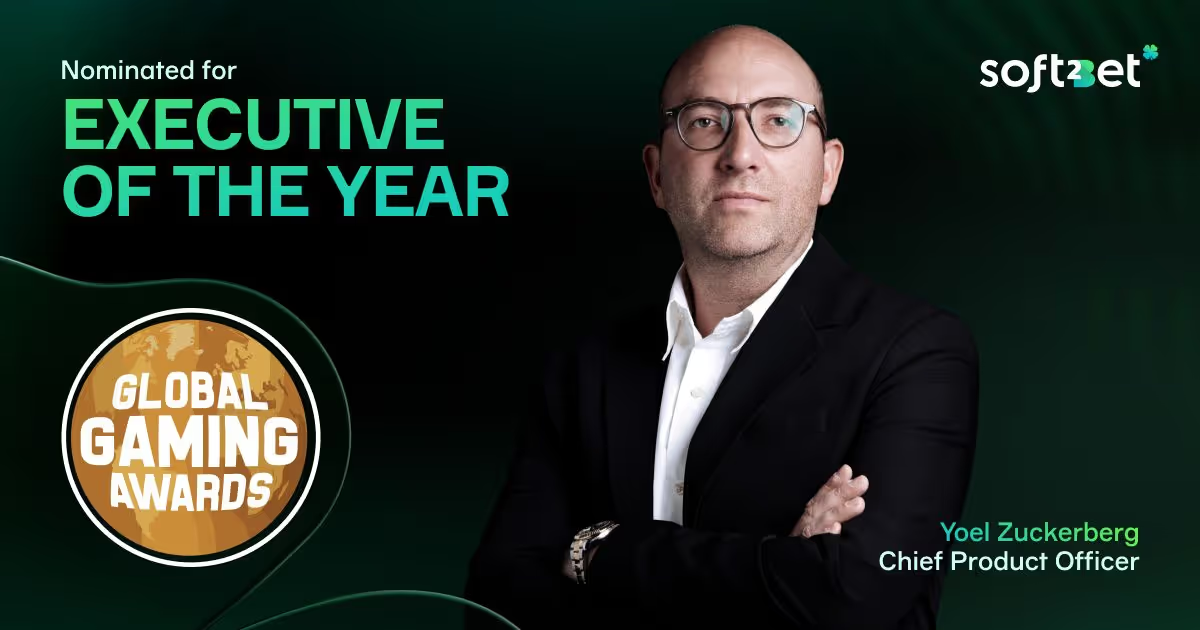
Being nominated as an "Executive of the Year" at Global Gaming Awards is a tremendous personal honor, but in the fast-moving world of iGaming, individual accolades are rarely just about the individual. They are a reflection of a philosophy, a team, and a direction. As we look toward 2026, this recognition validates the "Product-First" mindset we have cultivated at Soft2Bet - a mindset that I believe is no longer optional for operators who wish to survive, but essential for those who intend to lead.
As we close another year and look ahead, I want to share my vision on the evolution of the Chief Product Officer role, the trends that will define our sector, and why the willingness to stumble is the only way to eventually sprint.
The role of the CPO is undergoing a radical shift. Historically, in many organisations, product development was viewed as a functional necessity - a way to keep the lights on. Today, if a product is not at the absolute core of your company’s vision, you are already falling behind.
To be a successful CPO in 2026, you cannot simply look at what your direct competitors are doing. If you only look at other iGaming companies, you will only achieve parity, never innovation. The modern CPO must be a student of the wider digital ecosystem. We must look at the social gaming industry, the progress of mobile apps, and the retention mechanics of major entertainment platforms.
Innovation does not come "out of the box." It comes from cross-industry pollination. We have to identify user behaviours in other sectors and ask, "How do we translate this engagement into iGaming?"
We are moving into an era where being "business-oriented" without being "product-obsessed" is a liability.
In the past, you could survive by having a generic offering. Today, especially in markets where compliance and competition are fierce, differentiation is key. I often use this analogy: If you do not have a unique product-first mindset, you become just another book in the library. Maybe someone will pick you up, maybe they won't. You are passive.
To be active, to be the book everyone wants to read - operators must invest in platform technologies that allow for deep differentiation. This is the only path to success in the current landscape.
When operators ask me what they need to incorporate to stay ahead, the answer boils down to three distinct pillars: AI, localisation, and gamification.
1. Artificial Intelligence as an Enabler. We need to move past the fear of AI and embrace it as a tool for efficiency. AI is critical for removing the manual, repetitive workload from our teams. When we automate the mundane, we free up our talent to focus on what actually matters: strategy, creativity, and user experience.
2. True Localisation. Localisation is no longer just about language translation; it is about cultural curation. Creating a unique experience that feels native to the user in a specific market is critical. It evolves the product from a global template to a local favorite.
3. The Gamification Imperative. This is perhaps the most significant opportunity. In iGaming, we are still at the very beginning of the gamification journey. Some operators still view basic leaderboards or small tournaments as "gamification," but that is merely scratching the surface.
We need to look at the "Social Games" model, progression systems, achievements, social interaction, and immersive narratives. This is not just a buzzword; it is a proven metric driver. A fully gamified experience directly correlates to increased retention and higher Lifetime Values (LTV). If you aren't building a gamified layer on top of your core offering, you are leaving engagement on the table.
Finally, I am often asked what advice I have for aspiring Product Managers who want to sit in the C-suite one day. My answer is: Make mistakes. Make as many as possible.
This is my mantra. We do not strive for failure, but we must strive for the kind of innovation that carries the risk of failure. The only way to learn, to refine a product, and to grow as a leader is to test boundaries. If you aren't making mistakes, you aren't pushing hard enough.
To the leaders of tomorrow: Bring your stakeholders to the table, align your vision, find mentors, and don't be afraid to break things in the pursuit of building something better.
Here is to a bold, product-led 2026.

By Yoel Zuckerberg, CPO at Soft2Bet
Being nominated as an "Executive of the Year" at Global Gaming Awards is a tremendous personal honor, but in the fast-moving world of iGaming, individual accolades are rarely just about the individual. They are a reflection of a philosophy, a team, and a direction. As we look toward 2026, this recognition validates the "Product-First" mindset we have cultivated at Soft2Bet - a mindset that I believe is no longer optional for operators who wish to survive, but essential for those who intend to lead.
As we close another year and look ahead, I want to share my vision on the evolution of the Chief Product Officer role, the trends that will define our sector, and why the willingness to stumble is the only way to eventually sprint.
The role of the CPO is undergoing a radical shift. Historically, in many organisations, product development was viewed as a functional necessity - a way to keep the lights on. Today, if a product is not at the absolute core of your company’s vision, you are already falling behind.
To be a successful CPO in 2026, you cannot simply look at what your direct competitors are doing. If you only look at other iGaming companies, you will only achieve parity, never innovation. The modern CPO must be a student of the wider digital ecosystem. We must look at the social gaming industry, the progress of mobile apps, and the retention mechanics of major entertainment platforms.
Innovation does not come "out of the box." It comes from cross-industry pollination. We have to identify user behaviours in other sectors and ask, "How do we translate this engagement into iGaming?"
We are moving into an era where being "business-oriented" without being "product-obsessed" is a liability.
In the past, you could survive by having a generic offering. Today, especially in markets where compliance and competition are fierce, differentiation is key. I often use this analogy: If you do not have a unique product-first mindset, you become just another book in the library. Maybe someone will pick you up, maybe they won't. You are passive.
To be active, to be the book everyone wants to read - operators must invest in platform technologies that allow for deep differentiation. This is the only path to success in the current landscape.
When operators ask me what they need to incorporate to stay ahead, the answer boils down to three distinct pillars: AI, localisation, and gamification.
1. Artificial Intelligence as an Enabler. We need to move past the fear of AI and embrace it as a tool for efficiency. AI is critical for removing the manual, repetitive workload from our teams. When we automate the mundane, we free up our talent to focus on what actually matters: strategy, creativity, and user experience.
2. True Localisation. Localisation is no longer just about language translation; it is about cultural curation. Creating a unique experience that feels native to the user in a specific market is critical. It evolves the product from a global template to a local favorite.
3. The Gamification Imperative. This is perhaps the most significant opportunity. In iGaming, we are still at the very beginning of the gamification journey. Some operators still view basic leaderboards or small tournaments as "gamification," but that is merely scratching the surface.
We need to look at the "Social Games" model, progression systems, achievements, social interaction, and immersive narratives. This is not just a buzzword; it is a proven metric driver. A fully gamified experience directly correlates to increased retention and higher Lifetime Values (LTV). If you aren't building a gamified layer on top of your core offering, you are leaving engagement on the table.
Finally, I am often asked what advice I have for aspiring Product Managers who want to sit in the C-suite one day. My answer is: Make mistakes. Make as many as possible.
This is my mantra. We do not strive for failure, but we must strive for the kind of innovation that carries the risk of failure. The only way to learn, to refine a product, and to grow as a leader is to test boundaries. If you aren't making mistakes, you aren't pushing hard enough.
To the leaders of tomorrow: Bring your stakeholders to the table, align your vision, find mentors, and don't be afraid to break things in the pursuit of building something better.
Here is to a bold, product-led 2026.