
SIGMA | ROME
Play with us. Win with us.
NOVEMBER 4-6
Stand 6035
ITALY
ROME

Discover the thrill of MEGA Clawee and experience the fun first-handed at our stand

Fill in the form
Thank you! Your submission has been received!
We'll get back to you soon!
Oops! Something went wrong while submitting the form.
Back to all news

Sustainable iGaming Practices

March 2, 2026
5 Minutes reading
Sustainable iGaming Practices
No items found.

The iGaming industry is undergoing a profound transformation in 2026. What was once a sector defined solely by digital entertainment and rapid growth is now being reshaped by a new, non-negotiable imperative: sustainability.

Sustainability in iGaming is no longer just a corporate social responsibility (CSR) initiative or consumer-friendly marketing slogan and has become a core business necessity that covers everything from companies’ environmental impact to their player protection policies and marketing strategies. 

Driven by a competitive global market and the relentless march of technological innovation,  iGaming operators are evolving to better serve both society and the planet.This article explores how ‘sustainable iGaming’ is evolving from a concept into a comprehensive operational standard that ensures long-term business resilience and ethical leadership.

Drivers of change

The shift toward sustainable iGaming practices is fuelled by several market drivers. First, growing competition levels in the global gambling market have made brand differentiation more difficult than ever. As products become increasingly similar, a company’s ethical stance and sustainability profile serve as key deciders for a new generation of socially conscious customers and players.

Second, technological development acts as both a challenge and an enabler. While the massive data requirements of modern gaming increase energy demands, innovations like AI and cloud computing provide the tools necessary to monitor environmental impact and protect players more effectively.

Finally, investor and stakeholder expectations have reached a tipping point. Institutional investors now prioritise environmental, social and governance (ESG) metrics as indicators of a company’s risk management and long-term viability. While there are currently no iGaming-specific environmental laws, the sector is already being shaped by broader frameworks like the EU’s Corporate Sustainability Reporting Directive (CSRD) and the Energy Efficiency Directive (EED).
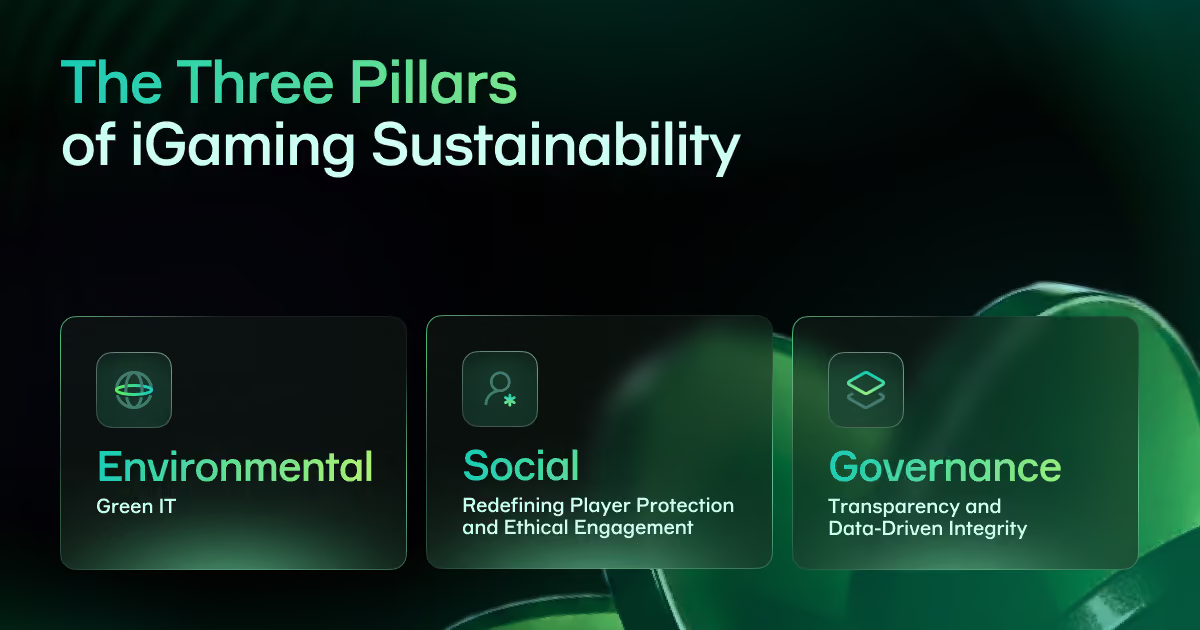
The three pillars of iGaming sustainability

Sustainability in this sector is traditionally viewed through the lens of the ESG framework: environmental, social and governance.

Environmental: Green IT

The environmental impact of online gambling is often misunderstood because it lacks the physical visibility of traditional land-based casinos. While bricks-and-mortar establishments have a clear footprint in terms of lighting, heating, and physical waste, the iGaming environmental impact is primarily digital, hidden within vast networks of servers and data centres. As the demand for high-definition streaming and real-time data processing grows, so does the energy consumption required to sustain these services. Consequently, the industry is seeing a significant shift toward "green IT" as a pillar of iGaming corporate sustainability.

Energy-efficient infrastructure and cloud migration

Leading firms are no longer relying on outdated, physical, on-premise servers which are often inefficient and difficult to cool. Instead, there is a massive migration toward energy-efficient data centres and cloud-based solutions. These modern facilities are designed with advanced cooling systems and high-density hardware that significantly reduce the electricity required per gigabyte of data processed. By moving to the cloud, operators can share resources more effectively, reducing the total amount of hardware that needs to be manufactured, powered, and eventually recycled.

The shift to renewable energy

There is a marked transition toward hosting services powered by 100% renewable energy. Many sustainable gaming operators now prioritise partnerships with providers who use wind, solar, or hydroelectric power to run their operations. By switching to "green" hosting partners, some operators have reported a carbon footprint reduction of up to 50%. This shift is often driven by investor-driven sustainability goals, as stakeholders demand clear evidence of a reduced reliance on fossil fuels.

Server optimisation through AI

Technology is also being used to refine how power is consumed at a granular level. Through server optimisation, operators are utilising AI and machine learning for dynamic scaling. This ensures that server capacity automatically adjusts to meet player demand in real-time. During off-peak hours, unnecessary server power is scaled down, virtually eliminating idle energy waste. This blend of tech-driven sustainability and operational efficiency not only lowers the environmental impact but also reduces overhead costs, contributing to long-term iGaming resilience.

Social: Redefining player protection and ethical engagement

In the context of sustainability in iGaming, the "social" pillar is arguably the most critical for long-term survival. While environmental efforts protect the planet, social initiatives protect the very heart of the business: the player. A sustainable industry is one where entertainment does not come at the cost of human wellbeing. This has led to a transition from traditional, reactive safety nets to proactive responsible gaming frameworks that are deeply embedded in the user experience.

Proactive responsible gambling and player protection

The modern approach to responsible iGaming has moved far beyond simply providing a link to a helpline. Operators are now deploying data-driven player monitoring systems that work in real-time. By utilizing analytics-driven responsible gaming tools, companies can establish a baseline for "healthy" play. When a player’s behaviour deviates — such as increased session frequency or chasing losses — the system identifies these as "markers of harm." This allows for the early detection of risky behaviour, enabling the operator to intervene with personalized "nudges" or temporary cooling-off periods before a problem escalates.

Protecting vulnerable players through technology

Sustainability also involves a commitment to vulnerable player protection. Advanced AI algorithms are now capable of identifying patterns associated with problem gambling with high accuracy. These systems can automatically adjust marketing triggers, ensuring that individuals showing signs of distress do not receive promotional offers or "bonus-chasing" incentives. This level of tech-driven sustainability ensures that the platform remains a safe space for recreation rather than a site of financial or emotional harm.

Ethical marketing and community integrity

An ethical iGaming operator understands that sustainability requires a transparent relationship with its audience. Ethical marketing practices are becoming the industry standard, moving away from aggressive acquisition tactics toward informative and transparent communication. This involves clearly stating the odds of winning, avoiding "gamified" financial risks that target younger demographics, and ensuring all promotional content is socially responsible.

Furthermore, social sustainability extends to internal policies, such as fostering diversity, equity, and inclusion (DEI) within the workforce and engaging in meaningful community investment. By building a reputation for integrity and care, operators strengthen their iGaming business resilience, creating a brand that stakeholders, partners, and players can trust for the long term.

Governance: Transparency and data-driven integrity

In the era of sustainable iGaming, governance has evolved from a passive compliance checklist into the structural backbone of business resilience. While the "Environmental" and "Social" pillars focus on impact, "Governance" ensures that these efforts are measurable, transparent, and accountable. For modern operators, operator transparency is the primary currency for building trust with regulators, investors, and players alike.

Transparency and ESG reporting

As we progress through 2026, ESG reporting and internal policies are becoming standard for industry leaders. This shift is partly driven by voluntary frameworks, such as the MGA ESG Code of Good Practice, which provides a structured reporting model for disclosing environmental and social impacts.

By publishing annual sustainability reports, operators provide hard data on their iGaming corporate sustainability progress, including gender pay gaps, carbon emission reductions, and the efficacy of their responsible gaming frameworks. This transparency is not just for public relations; it is essential for investor-driven sustainability, as financial institutions increasingly rely on these metrics to assess a company’s long-term risk profile.

Data-driven monitoring and compliance

Governance is also being revolutionised by the convergence of AI and real-time monitoring. High-tech operators now use integrated data pipelines to oversee every aspect of their business, from anti-money laundering (AML) procedures to KYC (Know Your Customer) protocols. These "intelligent compliance" systems allow for data-driven monitoring that detects anomalies or fraudulent activities within milliseconds.

By automating these processes, companies can ensure a consistent application of internal ESG policies across multiple jurisdictions. This reduces the risk of human error and helps avoid the regulatory fines. Furthermore, compliance and sustainability are now linked through audit-ready logging; every decision made by an AI or a human agent is recorded, creating a tamper-proof trail that demonstrates the operator's commitment to fair-play gambling.
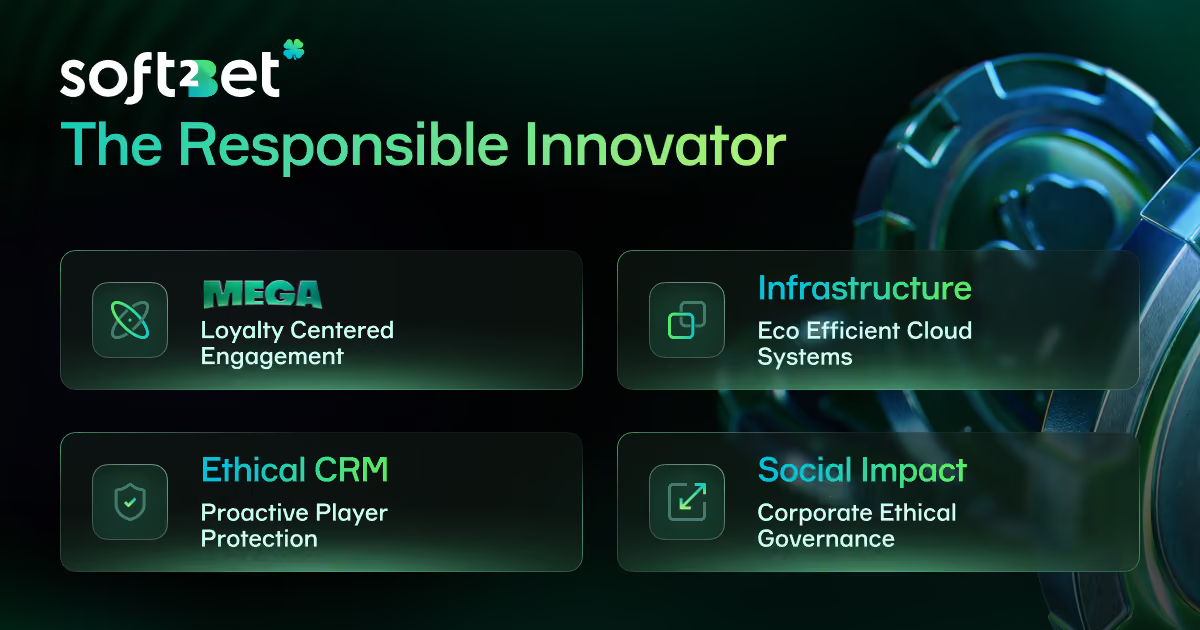
Soft2Bet and the sustainability trend: A case study in responsible innovation

Soft2Bet has positioned itself at the forefront of the sustainable iGaming future by proving that business growth and social responsibility are mutually beneficial. The company's journey is a practical example of how a responsible iGaming technology provider can set a new industry benchmark.

  • Integration of Responsible Gaming Frameworks: Soft2Bet has built a proprietary compliance ecosystem that goes beyond the basics. Through their Motivational Engineering (MEGA) gamification suite, they don't just offer games; they design player journeys that proactively surface control tools like reality checks and deposit limits at the exact moments they are most needed.
  • Analytics-Driven Early Detection: AI behaviour analytics system tracks millions of transactions to identify markers of harm. When a risky pattern is detected, the system triggers timely, empathetic interventions—ranging from automated messages to duty-of-care calls from specialized human support teams.
  • Environmental Footprint Reduction: On the "E" side of ESG, Soft2Bet has reported a 30% reduction in energy consumption by migrating to cloud-based infrastructure with dynamic scaling. Additionally, by partnering with green hosting providers powered by renewable energy, the company  has achieved a 50% carbon footprint reduction in IT operations.
  • Commitment to Transparent Governance: Soft2Bet aligns its operations with stringent jurisdictions like Sweden, and Denmark. The "single cohesive unit" approach ensures that legal, compliance, and product teams work together to maintain operator transparency and audit-ready accountability, reinforcing their reputation as an ethical iGaming operator.

As the industry matures, the transition to green iGaming is becoming the ultimate sorting mechanism. The companies that thrive will be those that, like Soft2Bet, view sustainability as a driver of operational excellence rather than a regulatory compliance. By combining energy-efficient data centres with proactive player protection and transparent governance, the iGaming sector can secure its place in a socially and environmentally conscious future.

Examples of sustainable practices

To understand what sustainability looks like in practice, one must look at the operational level. Many operators have adopted Virtualization and Cloud Computing, which allows multiple "virtual" servers to run on a single physical machine, drastically cutting hardware requirements and e-waste.

In the realm of player safety, the use of AI-driven "Nudges" is another good example. Instead of waiting for a player to self-exclude, systems now send real-time notifications if a user’s betting pattern deviates from their norm, encouraging a "reality check". Furthermore, many firms are now engaging in Green Procurement, where they only sign contracts with technology providers who can prove their own ESG credentials.

Soft2Bet and sustainability 

Soft2Bet meanwhile has positioned itself as a "Responsible Innovator" in the industry and integrated sustainability into its core business approach through several key initiatives:

  • Motivational Engineering Gaming Application (MEGA): While primarily a gamification engine, Soft2Bet uses this technology to create sustainable business models that focus on long-term player engagement rather than bonus-led promotions and marketing.
  • Cloud-based infrastructure: By transitioning to cloud infrastructure, Soft2Bet has reduced its energy consumption and demonstrates that high-performance tech can be eco-conscious.
  • Responsible gambling through ethical CRM: The approach involves using data analytics for the early detection of problematic behaviour, moving the needle from reactive to proactive player protection.
  • Social responsibility: Soft2Bet’s commitments extend to social causes and charitable contributions, which help build a culture of ethical governance and inclusion.

Legal Landscape 

Currently there is no global environmental law related to iGaming, but a patchwork of regional mandates and voluntary frameworks is quickly solidifying into a mandatory standard. For operators, navigating this area requires a proactive approach to ensure that current infrastructure does not become a future liability. And while there isn’t a set of overarching ESG regulations, a number of measures and focus on specific subject areas can help operators address these challenges in a constructive manner.   

EU rules and the energy mandate: Operators that work in European markets are increasingly feeling the weight of the EU Energy Efficiency Directive (EED). While initially targeted at heavy industries, the EED now explicitly includes digital services. As of 2026, data centres with an installed IT power demand of at least 500kW are required to report detailed energy performance metrics to a central European database.

  • This means large-scale iGaming platforms must now disclose their total energy consumption, power utilisation effectiveness (PUE) and even their water usage. 
  • For EU-headquartered groups, the Corporate Sustainability Reporting Directive (CSRD) adds another layer of complexity, requiring "double materiality" reporting; explaining not only how sustainability issues affect the company's finances but also how the company’s digital activities impact the environment.

Voluntary codes as a competitive "seal of approval": In the absence of rigid global statutes, leading regulators are using "soft law" to drive change. The Malta Gaming Authority (MGA) has successfully pioneered this with its ESG Code of Good Practice. Launched as a voluntary initiative, it allows licensees to report across 19 key environmental, social and governance topics.

  • Although technically optional, the code has become a de facto requirement for tier-one operators. Achieving the MGA ESG Code Approval Seal serves as a powerful "seal of approval" that streamlines interaction with banks, insurance firms, and B2B partners who are themselves "in-scope" for strict EU sustainability reporting. In 2026, possessing this seal is often what makes the difference during competitive license renewals or when entering new, highly regulated markets.

Moving from a voluntary system to a mandatory set of regulations: The direction of travel is clear. It is widely expected that by the end of the decade "environmental impact" and "sustainability performance" will become standard criteria assessments in the licensing process, mirroring Anti-Money Laundering (AML) or Know Your Customer (KYC) protocols.

  • Indeed, the industry is moving toward a "Green Licensing" model where an operator’s ability to prove a carbon-neutral target or demonstrate strong responsible gambling tools will be as important as their technical security. 
  • The choice is clear for iGaming companies: adapt to these emerging standards now or face significantly higher costs of compliance and potential financial penalties or, worse, licence suspensions or even exclusions.

Outlook

The trajectory of the global gambling market suggests that the coming years will be defined by a "flight to quality", where the most successful firms are those that embrace ESG principles. As the digital economy matures, the industry is moving away from a volume-based growth model toward one rooted in long-term iGaming resilience. In this landscape, sustainability will not be a separate department but a key component of operators’ strategies.

This is likely to result in the following substantive shifts:

  • Sustainability as a competitive edge: In an increasingly crowded market, companies with verified iGaming ESG strategies will gain a distinct financial and operational advantage. These sustainable operators will likely benefit from lower insurance premiums and more favourable banking relationships, as financial institutions move to de-risk their portfolios. Furthermore, players are becoming more discerning; a commitment to being an ethical iGaming operator will foster higher levels of player loyalty.
  • Tech-driven safety and innovation: The next generation of responsible gaming frameworks will be powered by cutting-edge hardware. The use of integrated biometric wearables or AI-driven "emotion recognition" software will only keep growing in the coming years. These tools can help with early detection of risky behaviour. This tech-driven sustainability will move the industry from reactive intervention to real-time, preventative care.
  • Increased transparency and digital accountability: Hidden environmental costs will not be tolerated and corporate entities will be expected to be transparent, trustworthy and, importantly, deliver on their ESG commitments. The industry will likely see the introduction of mandatory digital product passports for software and platform providers that detail the iGaming environmental impact of every product. As carbon-neutral targets become standard, operators will be required to provide high levels of operator transparency, reporting on everything from the energy efficiency of their green IT infrastructure to the diversity of their governance boards.

Conclusion

A sustainable iGaming future will be defined by a deeper integration of compliance, technology and ethics. For iGaming leaders like Soft2Bet, the focus is already shifting toward analytics-driven responsible gambling tools and efficient tech infrastructures. As the legal landscape evolves to include stricter energy and social reporting, the companies that thrive will be those that view sustainability not as a regulatory burden, but as the ultimate engine for innovation and trust.

FAQs 

To provide a deeper understanding of the shift toward a sustainable gambling industry, it is necessary to look beyond the surface of these common questions. As the sector matures in 2026, the intersection of iGaming corporate sustainability and operational efficiency has become a primary focus for industry leaders.

1. Does "Green iGaming" mean a reduction in game variety or performance?

Absolutely not. Transitioning to green iGaming is about "how" the games are powered, not "how many" are available. In fact, sustainability often drives innovation in game performance. By adopting green IT infrastructure, developers create leaner code that requires less processing power.

When games are hosted on energy-efficient data centres, the carbon footprint per spin or hand is drastically reduced. Furthermore, cloud gaming technology allows for massive scalability without the need for bloated local hardware. For the player, this translates to faster load times and less battery drain on mobile devices, proving that sustainable online gambling is synonymous with a high-quality user experience.

2. Is sustainability just about the environment, or does it cover player safety?

While the "Green" label highlights environmental efforts, iGaming sustainability is a three-dimensional framework. In this sector, the Social pillar—specifically responsible gaming frameworks—is often considered the most vital component.

A business cannot be sustainable if its customer base is being harmed. Therefore, responsible iGaming involves moving beyond reactive helplines to early detection of risky behaviour through data-driven player monitoring. By protecting vulnerable players and ensuring ethical marketing, operators build iGaming business resilience, ensuring a healthy, loyal community that can enjoy entertainment safely for years to come.

3. Why have investor expectations shifted toward iGaming ESG strategies?

Investors and stakeholders now view ESG in iGaming as a proxy for high-quality management. A company that ignores its iGaming environmental impact or fails to implement robust responsible gambling tools is seen as a high-risk asset.

In the modern financial climate, investor-driven sustainability is about risk mitigation. High ESG scores signal that a company is prepared for future regulatory changes, tax hikes on high-carbon industries, or shifting public sentiment. Essentially, a strong iGaming ESG strategy proves that an operator is built for the long term, rather than seeking short-term, unsustainable profits.

4. Can small-to-mid-sized operators afford to implement these changes?

The misconception that sustainability is expensive is rapidly fading. Many sustainable iGaming practices are actually cost-saving measures. For example, server optimisation reduces monthly overhead costs for hosting, and adopting hybrid work models reduces the need for large, energy-hungry office spaces.

Furthermore, tech-driven sustainability—like using AI for early detection of problematic player behaviour—reduces the administrative burden of manual compliance checks. For smaller firms, being an ethical iGaming operator also improves "Employer Branding," making it easier to attract top-tier talent in a competitive market without needing to offer the highest salaries.

5. What does the future of iGaming environmental regulation look like?

While we do not yet have a "Global Green Gambling Act," the net is closing. In the EU, the Corporate Sustainability Reporting Directive (CSRD) already sweeps up large iGaming firms, requiring them to report on their carbon footprint reduction and energy usage.

Today’s iGaming industry is moving towards a future where "Green Certification" may become a prerequisite for obtaining a license in prestigious jurisdictions. Regulators are increasingly looking at sustainable gaming operators as the gold standard, and voluntary ESG codes are likely to become mandatory benchmarks. Staying ahead of these sustainability trends in iGaming is no longer a choice; it is a prerequisite for market access.

Share to:
Sustainable iGaming Practices

The iGaming industry is undergoing a profound transformation in 2026. What was once a sector defined solely by digital entertainment and rapid growth is now being reshaped by a new, non-negotiable imperative: sustainability.

Sustainability in iGaming is no longer just a corporate social responsibility (CSR) initiative or consumer-friendly marketing slogan and has become a core business necessity that covers everything from companies’ environmental impact to their player protection policies and marketing strategies. 

Driven by a competitive global market and the relentless march of technological innovation,  iGaming operators are evolving to better serve both society and the planet.This article explores how ‘sustainable iGaming’ is evolving from a concept into a comprehensive operational standard that ensures long-term business resilience and ethical leadership.

Drivers of change

The shift toward sustainable iGaming practices is fuelled by several market drivers. First, growing competition levels in the global gambling market have made brand differentiation more difficult than ever. As products become increasingly similar, a company’s ethical stance and sustainability profile serve as key deciders for a new generation of socially conscious customers and players.

Second, technological development acts as both a challenge and an enabler. While the massive data requirements of modern gaming increase energy demands, innovations like AI and cloud computing provide the tools necessary to monitor environmental impact and protect players more effectively.

Finally, investor and stakeholder expectations have reached a tipping point. Institutional investors now prioritise environmental, social and governance (ESG) metrics as indicators of a company’s risk management and long-term viability. While there are currently no iGaming-specific environmental laws, the sector is already being shaped by broader frameworks like the EU’s Corporate Sustainability Reporting Directive (CSRD) and the Energy Efficiency Directive (EED).

The three pillars of iGaming sustainability

Sustainability in this sector is traditionally viewed through the lens of the ESG framework: environmental, social and governance.

Environmental: Green IT

The environmental impact of online gambling is often misunderstood because it lacks the physical visibility of traditional land-based casinos. While bricks-and-mortar establishments have a clear footprint in terms of lighting, heating, and physical waste, the iGaming environmental impact is primarily digital, hidden within vast networks of servers and data centres. As the demand for high-definition streaming and real-time data processing grows, so does the energy consumption required to sustain these services. Consequently, the industry is seeing a significant shift toward "green IT" as a pillar of iGaming corporate sustainability.

Energy-efficient infrastructure and cloud migration

Leading firms are no longer relying on outdated, physical, on-premise servers which are often inefficient and difficult to cool. Instead, there is a massive migration toward energy-efficient data centres and cloud-based solutions. These modern facilities are designed with advanced cooling systems and high-density hardware that significantly reduce the electricity required per gigabyte of data processed. By moving to the cloud, operators can share resources more effectively, reducing the total amount of hardware that needs to be manufactured, powered, and eventually recycled.

The shift to renewable energy

There is a marked transition toward hosting services powered by 100% renewable energy. Many sustainable gaming operators now prioritise partnerships with providers who use wind, solar, or hydroelectric power to run their operations. By switching to "green" hosting partners, some operators have reported a carbon footprint reduction of up to 50%. This shift is often driven by investor-driven sustainability goals, as stakeholders demand clear evidence of a reduced reliance on fossil fuels.

Server optimisation through AI

Technology is also being used to refine how power is consumed at a granular level. Through server optimisation, operators are utilising AI and machine learning for dynamic scaling. This ensures that server capacity automatically adjusts to meet player demand in real-time. During off-peak hours, unnecessary server power is scaled down, virtually eliminating idle energy waste. This blend of tech-driven sustainability and operational efficiency not only lowers the environmental impact but also reduces overhead costs, contributing to long-term iGaming resilience.

Social: Redefining player protection and ethical engagement

In the context of sustainability in iGaming, the "social" pillar is arguably the most critical for long-term survival. While environmental efforts protect the planet, social initiatives protect the very heart of the business: the player. A sustainable industry is one where entertainment does not come at the cost of human wellbeing. This has led to a transition from traditional, reactive safety nets to proactive responsible gaming frameworks that are deeply embedded in the user experience.

Proactive responsible gambling and player protection

The modern approach to responsible iGaming has moved far beyond simply providing a link to a helpline. Operators are now deploying data-driven player monitoring systems that work in real-time. By utilizing analytics-driven responsible gaming tools, companies can establish a baseline for "healthy" play. When a player’s behaviour deviates — such as increased session frequency or chasing losses — the system identifies these as "markers of harm." This allows for the early detection of risky behaviour, enabling the operator to intervene with personalized "nudges" or temporary cooling-off periods before a problem escalates.

Protecting vulnerable players through technology

Sustainability also involves a commitment to vulnerable player protection. Advanced AI algorithms are now capable of identifying patterns associated with problem gambling with high accuracy. These systems can automatically adjust marketing triggers, ensuring that individuals showing signs of distress do not receive promotional offers or "bonus-chasing" incentives. This level of tech-driven sustainability ensures that the platform remains a safe space for recreation rather than a site of financial or emotional harm.

Ethical marketing and community integrity

An ethical iGaming operator understands that sustainability requires a transparent relationship with its audience. Ethical marketing practices are becoming the industry standard, moving away from aggressive acquisition tactics toward informative and transparent communication. This involves clearly stating the odds of winning, avoiding "gamified" financial risks that target younger demographics, and ensuring all promotional content is socially responsible.

Furthermore, social sustainability extends to internal policies, such as fostering diversity, equity, and inclusion (DEI) within the workforce and engaging in meaningful community investment. By building a reputation for integrity and care, operators strengthen their iGaming business resilience, creating a brand that stakeholders, partners, and players can trust for the long term.

Governance: Transparency and data-driven integrity

In the era of sustainable iGaming, governance has evolved from a passive compliance checklist into the structural backbone of business resilience. While the "Environmental" and "Social" pillars focus on impact, "Governance" ensures that these efforts are measurable, transparent, and accountable. For modern operators, operator transparency is the primary currency for building trust with regulators, investors, and players alike.

Transparency and ESG reporting

As we progress through 2026, ESG reporting and internal policies are becoming standard for industry leaders. This shift is partly driven by voluntary frameworks, such as the MGA ESG Code of Good Practice, which provides a structured reporting model for disclosing environmental and social impacts.

By publishing annual sustainability reports, operators provide hard data on their iGaming corporate sustainability progress, including gender pay gaps, carbon emission reductions, and the efficacy of their responsible gaming frameworks. This transparency is not just for public relations; it is essential for investor-driven sustainability, as financial institutions increasingly rely on these metrics to assess a company’s long-term risk profile.

Data-driven monitoring and compliance

Governance is also being revolutionised by the convergence of AI and real-time monitoring. High-tech operators now use integrated data pipelines to oversee every aspect of their business, from anti-money laundering (AML) procedures to KYC (Know Your Customer) protocols. These "intelligent compliance" systems allow for data-driven monitoring that detects anomalies or fraudulent activities within milliseconds.

By automating these processes, companies can ensure a consistent application of internal ESG policies across multiple jurisdictions. This reduces the risk of human error and helps avoid the regulatory fines. Furthermore, compliance and sustainability are now linked through audit-ready logging; every decision made by an AI or a human agent is recorded, creating a tamper-proof trail that demonstrates the operator's commitment to fair-play gambling.

Soft2Bet and the sustainability trend: A case study in responsible innovation

Soft2Bet has positioned itself at the forefront of the sustainable iGaming future by proving that business growth and social responsibility are mutually beneficial. The company's journey is a practical example of how a responsible iGaming technology provider can set a new industry benchmark.

  • Integration of Responsible Gaming Frameworks: Soft2Bet has built a proprietary compliance ecosystem that goes beyond the basics. Through their Motivational Engineering (MEGA) gamification suite, they don't just offer games; they design player journeys that proactively surface control tools like reality checks and deposit limits at the exact moments they are most needed.
  • Analytics-Driven Early Detection: AI behaviour analytics system tracks millions of transactions to identify markers of harm. When a risky pattern is detected, the system triggers timely, empathetic interventions—ranging from automated messages to duty-of-care calls from specialized human support teams.
  • Environmental Footprint Reduction: On the "E" side of ESG, Soft2Bet has reported a 30% reduction in energy consumption by migrating to cloud-based infrastructure with dynamic scaling. Additionally, by partnering with green hosting providers powered by renewable energy, the company  has achieved a 50% carbon footprint reduction in IT operations.
  • Commitment to Transparent Governance: Soft2Bet aligns its operations with stringent jurisdictions like Sweden, and Denmark. The "single cohesive unit" approach ensures that legal, compliance, and product teams work together to maintain operator transparency and audit-ready accountability, reinforcing their reputation as an ethical iGaming operator.

As the industry matures, the transition to green iGaming is becoming the ultimate sorting mechanism. The companies that thrive will be those that, like Soft2Bet, view sustainability as a driver of operational excellence rather than a regulatory compliance. By combining energy-efficient data centres with proactive player protection and transparent governance, the iGaming sector can secure its place in a socially and environmentally conscious future.

Examples of sustainable practices

To understand what sustainability looks like in practice, one must look at the operational level. Many operators have adopted Virtualization and Cloud Computing, which allows multiple "virtual" servers to run on a single physical machine, drastically cutting hardware requirements and e-waste.

In the realm of player safety, the use of AI-driven "Nudges" is another good example. Instead of waiting for a player to self-exclude, systems now send real-time notifications if a user’s betting pattern deviates from their norm, encouraging a "reality check". Furthermore, many firms are now engaging in Green Procurement, where they only sign contracts with technology providers who can prove their own ESG credentials.

Soft2Bet and sustainability 

Soft2Bet meanwhile has positioned itself as a "Responsible Innovator" in the industry and integrated sustainability into its core business approach through several key initiatives:

  • Motivational Engineering Gaming Application (MEGA): While primarily a gamification engine, Soft2Bet uses this technology to create sustainable business models that focus on long-term player engagement rather than bonus-led promotions and marketing.
  • Cloud-based infrastructure: By transitioning to cloud infrastructure, Soft2Bet has reduced its energy consumption and demonstrates that high-performance tech can be eco-conscious.
  • Responsible gambling through ethical CRM: The approach involves using data analytics for the early detection of problematic behaviour, moving the needle from reactive to proactive player protection.
  • Social responsibility: Soft2Bet’s commitments extend to social causes and charitable contributions, which help build a culture of ethical governance and inclusion.

Legal Landscape 

Currently there is no global environmental law related to iGaming, but a patchwork of regional mandates and voluntary frameworks is quickly solidifying into a mandatory standard. For operators, navigating this area requires a proactive approach to ensure that current infrastructure does not become a future liability. And while there isn’t a set of overarching ESG regulations, a number of measures and focus on specific subject areas can help operators address these challenges in a constructive manner.   

EU rules and the energy mandate: Operators that work in European markets are increasingly feeling the weight of the EU Energy Efficiency Directive (EED). While initially targeted at heavy industries, the EED now explicitly includes digital services. As of 2026, data centres with an installed IT power demand of at least 500kW are required to report detailed energy performance metrics to a central European database.

  • This means large-scale iGaming platforms must now disclose their total energy consumption, power utilisation effectiveness (PUE) and even their water usage. 
  • For EU-headquartered groups, the Corporate Sustainability Reporting Directive (CSRD) adds another layer of complexity, requiring "double materiality" reporting; explaining not only how sustainability issues affect the company's finances but also how the company’s digital activities impact the environment.

Voluntary codes as a competitive "seal of approval": In the absence of rigid global statutes, leading regulators are using "soft law" to drive change. The Malta Gaming Authority (MGA) has successfully pioneered this with its ESG Code of Good Practice. Launched as a voluntary initiative, it allows licensees to report across 19 key environmental, social and governance topics.

  • Although technically optional, the code has become a de facto requirement for tier-one operators. Achieving the MGA ESG Code Approval Seal serves as a powerful "seal of approval" that streamlines interaction with banks, insurance firms, and B2B partners who are themselves "in-scope" for strict EU sustainability reporting. In 2026, possessing this seal is often what makes the difference during competitive license renewals or when entering new, highly regulated markets.

Moving from a voluntary system to a mandatory set of regulations: The direction of travel is clear. It is widely expected that by the end of the decade "environmental impact" and "sustainability performance" will become standard criteria assessments in the licensing process, mirroring Anti-Money Laundering (AML) or Know Your Customer (KYC) protocols.

  • Indeed, the industry is moving toward a "Green Licensing" model where an operator’s ability to prove a carbon-neutral target or demonstrate strong responsible gambling tools will be as important as their technical security. 
  • The choice is clear for iGaming companies: adapt to these emerging standards now or face significantly higher costs of compliance and potential financial penalties or, worse, licence suspensions or even exclusions.

Outlook

The trajectory of the global gambling market suggests that the coming years will be defined by a "flight to quality", where the most successful firms are those that embrace ESG principles. As the digital economy matures, the industry is moving away from a volume-based growth model toward one rooted in long-term iGaming resilience. In this landscape, sustainability will not be a separate department but a key component of operators’ strategies.

This is likely to result in the following substantive shifts:

  • Sustainability as a competitive edge: In an increasingly crowded market, companies with verified iGaming ESG strategies will gain a distinct financial and operational advantage. These sustainable operators will likely benefit from lower insurance premiums and more favourable banking relationships, as financial institutions move to de-risk their portfolios. Furthermore, players are becoming more discerning; a commitment to being an ethical iGaming operator will foster higher levels of player loyalty.
  • Tech-driven safety and innovation: The next generation of responsible gaming frameworks will be powered by cutting-edge hardware. The use of integrated biometric wearables or AI-driven "emotion recognition" software will only keep growing in the coming years. These tools can help with early detection of risky behaviour. This tech-driven sustainability will move the industry from reactive intervention to real-time, preventative care.
  • Increased transparency and digital accountability: Hidden environmental costs will not be tolerated and corporate entities will be expected to be transparent, trustworthy and, importantly, deliver on their ESG commitments. The industry will likely see the introduction of mandatory digital product passports for software and platform providers that detail the iGaming environmental impact of every product. As carbon-neutral targets become standard, operators will be required to provide high levels of operator transparency, reporting on everything from the energy efficiency of their green IT infrastructure to the diversity of their governance boards.

Conclusion

A sustainable iGaming future will be defined by a deeper integration of compliance, technology and ethics. For iGaming leaders like Soft2Bet, the focus is already shifting toward analytics-driven responsible gambling tools and efficient tech infrastructures. As the legal landscape evolves to include stricter energy and social reporting, the companies that thrive will be those that view sustainability not as a regulatory burden, but as the ultimate engine for innovation and trust.

FAQs 

To provide a deeper understanding of the shift toward a sustainable gambling industry, it is necessary to look beyond the surface of these common questions. As the sector matures in 2026, the intersection of iGaming corporate sustainability and operational efficiency has become a primary focus for industry leaders.

1. Does "Green iGaming" mean a reduction in game variety or performance?

Absolutely not. Transitioning to green iGaming is about "how" the games are powered, not "how many" are available. In fact, sustainability often drives innovation in game performance. By adopting green IT infrastructure, developers create leaner code that requires less processing power.

When games are hosted on energy-efficient data centres, the carbon footprint per spin or hand is drastically reduced. Furthermore, cloud gaming technology allows for massive scalability without the need for bloated local hardware. For the player, this translates to faster load times and less battery drain on mobile devices, proving that sustainable online gambling is synonymous with a high-quality user experience.

2. Is sustainability just about the environment, or does it cover player safety?

While the "Green" label highlights environmental efforts, iGaming sustainability is a three-dimensional framework. In this sector, the Social pillar—specifically responsible gaming frameworks—is often considered the most vital component.

A business cannot be sustainable if its customer base is being harmed. Therefore, responsible iGaming involves moving beyond reactive helplines to early detection of risky behaviour through data-driven player monitoring. By protecting vulnerable players and ensuring ethical marketing, operators build iGaming business resilience, ensuring a healthy, loyal community that can enjoy entertainment safely for years to come.

3. Why have investor expectations shifted toward iGaming ESG strategies?

Investors and stakeholders now view ESG in iGaming as a proxy for high-quality management. A company that ignores its iGaming environmental impact or fails to implement robust responsible gambling tools is seen as a high-risk asset.

In the modern financial climate, investor-driven sustainability is about risk mitigation. High ESG scores signal that a company is prepared for future regulatory changes, tax hikes on high-carbon industries, or shifting public sentiment. Essentially, a strong iGaming ESG strategy proves that an operator is built for the long term, rather than seeking short-term, unsustainable profits.

4. Can small-to-mid-sized operators afford to implement these changes?

The misconception that sustainability is expensive is rapidly fading. Many sustainable iGaming practices are actually cost-saving measures. For example, server optimisation reduces monthly overhead costs for hosting, and adopting hybrid work models reduces the need for large, energy-hungry office spaces.

Furthermore, tech-driven sustainability—like using AI for early detection of problematic player behaviour—reduces the administrative burden of manual compliance checks. For smaller firms, being an ethical iGaming operator also improves "Employer Branding," making it easier to attract top-tier talent in a competitive market without needing to offer the highest salaries.

5. What does the future of iGaming environmental regulation look like?

While we do not yet have a "Global Green Gambling Act," the net is closing. In the EU, the Corporate Sustainability Reporting Directive (CSRD) already sweeps up large iGaming firms, requiring them to report on their carbon footprint reduction and energy usage.

Today’s iGaming industry is moving towards a future where "Green Certification" may become a prerequisite for obtaining a license in prestigious jurisdictions. Regulators are increasingly looking at sustainable gaming operators as the gold standard, and voluntary ESG codes are likely to become mandatory benchmarks. Staying ahead of these sustainability trends in iGaming is no longer a choice; it is a prerequisite for market access.

Share to: