

Discover the thrill of MEGA Clawee and experience the fun first-handed at our stand
.webp)


For over two decades the global iGaming industry has grown thanks to bonuses and marketing promotions. Deposit matches, free spins, cashback offers and reload promotions have formed the backbone of customer acquisition and retention. But in today’s hyper-competitive marketplace, this model is rapidly losing its power - especially when it comes to attracting and retaining high-value players.
Operators that work predominantly with high value players, more commonly known as VIPs, occupy a specific role within the iGaming ecosystem, and, while they are often seen as being at the top of the iGaming tree, their corporate focus requires specific skills and an approach that will optimise their activities at the same time as it reduces their risk exposure. Indeed, when a VIP wins big, operators must ensure they have the funds to cover liabilities and maintain operations for all their other customers.
This is because they serve a top percentile of players that generates the vast majority of their revenues (sometimes 90% or more), influence liquidity and define long-term profitability. These players drive player lifetime values (LTV) far beyond the average revenue per user (ARPU) but also expose the limits of traditional marketing. For those VIPs, another 100% match bonus is not an incentive, it’s just noise amid an already very noisy environment.
This shift has fundamentally changed how casino player retention must be approached. High-ARPU players are no longer motivated by generic offers. Of course, they seek and expect the best customer service possible, but just as important to them are recognition, autonomy, innovation, superior technology and quality content that will keep them engaged. They want experiences that feel bespoke, responsive and intelligent. In short, they expect iGaming platforms to evolve.
This is where iGaming gamification strategies step into the spotlight. Not as surface-level mechanics, but as deeply integrated systems built on real-time data and emotional intelligence. Operators that still compete on bonus size alone are fighting a losing battle, one that inflates costs per acquisition (CPA) as it simultaneously accelerates churn rate.
Competing on quality is now the only sustainable path. High-value loyalty can no longer just be purchased, instead it is engineered, designed and integrated into the most modern and performing iGaming platforms. This article explores how advanced iGaming gamification strategies are redefining retention systems for casino players, reshaping their loyalty programmes and setting the foundation for the next era of iGaming engagement trends.
Understanding high-value players requires moving beyond simple demographics and into behaviour. These players are not defined solely by how much they wager, but by how and why they engage.
High-value players typically exhibit longer sessions across multiple days.
They respond less to static promotions and more to systems that reward consistency, timing and confirm their know-how. The engagement of VIPs is driven by micro-moments: when relevance, context and intent align to hit the spot for players who are expert in the way they play, and appreciate being valued as such by customer service teams.
To truly understand these high-value segments, operators must look beyond the raw numbers and analyse the drivers behind these behaviours. For these VIPs, the "thrill of the chase" is often eclipsed by the desire for a seamless, premium user interface that respects and values their time.
They view their gameplay not merely as a pastime, but as an interactive experience where technology has to perform seamlessly, where low-latency live streams, instant withdrawal processes and a high quality UX are key reasons to return and act as primary retention factors.
Furthermore, the focus on their mastery of a product, whether that is blackjack or roulette, can be harnessed by developing progression-based systems that foster engagement and interaction. This involves moving away from the pure luck-based elements of gameplay towards environments where a player’s mentality and style of play are recognised through bespoke milestones that cater to their specific tastes.
For example, these features can manifest as:
Dynamic difficulty adjustment
Systems that tailor the challenge or the feedback loop to match the player's sophisticated risk profile. Dynamic difficulty adjustment is a core pillar of modern iGaming gamification strategies, replacing rigid progression systems with adaptive, player-centric mechanics. Rather than applying identical challenges to all users, these systems continuously interpret behavioural signals such as bet size volatility, risk appetite, session cadence, and response to outcomes—to dynamically shape the experience.
Contextual feedback
Real-time acknowledgments of ‘near-misses’ or strategic wins that reinforce the player’s sense of skill and agency. Contextual feedback elevates moment-to-moment gameplay into a resonant experience.
Predictive personalisation
Using machine learning and AI to anticipate when a player might be reaching a point of fatigue, offering a timely shift in content rather than an intrusive bonus. Predictive personalisation marks the evolution from reactive engagement to anticipatory experience design.
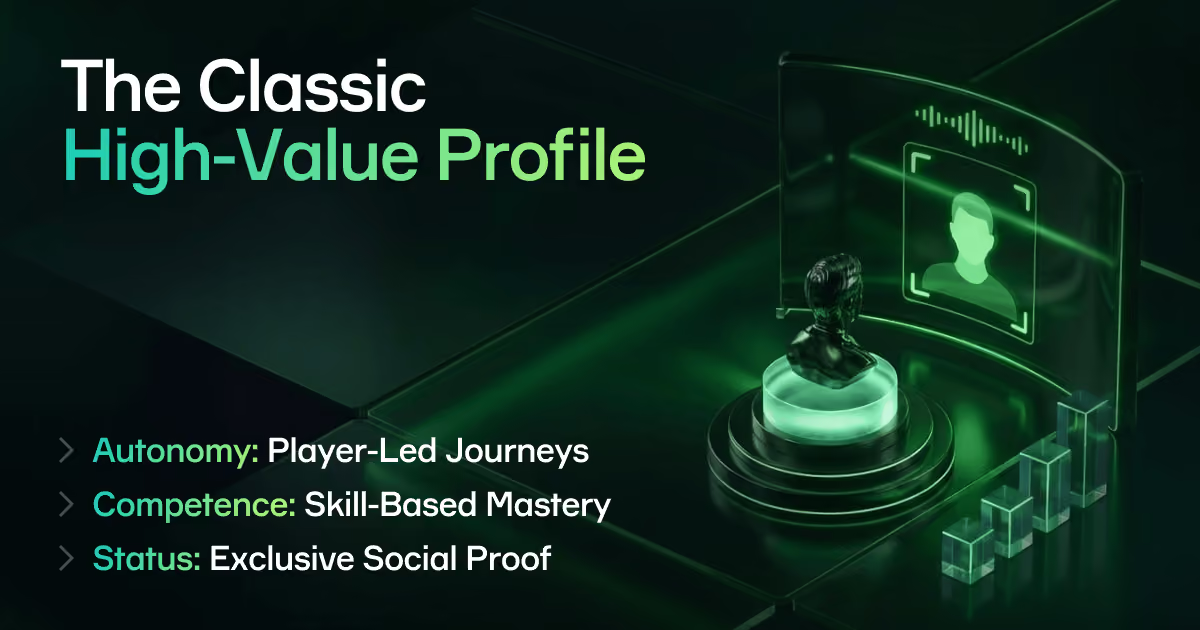
Three core motivators dominate high value gameplay.
Autonomy: High-value players want control over their journey. They dislike rigid VIP tiers that force predefined paths. Instead, they prefer flexible loyalty programmes that allow them to choose rewards, missions, and progression styles. Experience Points (XP), Daily Quests/Missions and customisable challenges give them that sense of ownership.
Competence: These players are motivated by skill and mastery of their favourite products. Achievement badges, advanced statistics, and progression systems based on skill rather than spend reinforce a feeling of growth. When iGaming gamification strategies emphasise learning curves and leveling mechanics, competence becomes a powerful retention driver.
Status
Above all, the experience must feel exclusive. High-value players expect a “private banking” version of iGaming, one that is discreet, premium and respectful. Real-time leaderboards, invite-only tournaments, and visible VIP tiers provide social proof without being intrusive.
When these motivators are aligned, VIP retention becomes less about incentives and more about identity.
Even the most sophisticated gamification systems fail if fundamental friction points remain unresolved. High-value players are acutely sensitive to inefficiencies and they vote with their wallets.
In highly competitive markets like Sweden or Romania, KYC (Know Your Customer) and anti-money laundering (AML) processes are unavoidable. However, poorly designed customer journeys create friction that drives VIP players toward unregulated alternatives. Excessive document requests, slow verification cycles and inconsistent communications erode efficiency and unregulated operators waste little time in catering to and welcoming these high spending players.
Smart operators are reframing RG and KYC as part of the premium experience, using automation, API integration and pre-verification to minimise friction while remaining compliant.
Nothing damages the user experience (UX) faster than unnecessary or irrelevant communications. A poker-only player receiving slot bonuses, or a sportsbook VIP getting push notifications at 3 am signals a lack of understanding.
Precision personalisation, with the power AI harnessed to ensure the messaging is as relevant as possible, is essential. Modern iGaming gamification strategies must operate in real time, adapting offers to player behaviour, time of day and preferred verticals. When done right, personalisation reduces churn rate and protects LTV.
For high-value players, withdrawal speed is a key feature that ensures they remain on an iGaming site. Long approval times undermine trust faster than technical issues. Fast payouts, supported by seamless API integration with payment providers, are no longer optional, they’re key components that drive loyalty and repeat custom. Operators that optimise their payment flows consistently outperform their competitors when it comes to customer retention metrics.
Motivational Engineering Gaming Application – or how to leverage the Meta-Game
The most effective iGaming gamification strategies replace static loyalty bars with immersive meta-games. Platforms like Soft2Bet’s Motivational Engineering Gaming Application (MEGA) demonstrate how layered progression systems built on experience points (XP), achievement badges, and real-time leaderboards create long-term engagement.
Daily quests, missions and seasonal competitions activate players without relying solely on monetary rewards. This approach transforms loyalty from a transaction into a journey.
Precision personalisation
Segmentation is no longer enough. High-value players expect individualised communications, messages and gaming offers. AI-driven systems can analyse betting patterns, preferred games, volatility tolerance, frequency of play and micro-moments to deliver hyper-relevant experiences.
Whether it’s tailored gamified sports betting challenges or exclusive casino missions, personalisation directly increases LTVs while lowering CPAs.
Tech excellence to drive customer retention
Zero-latency gameplay, mobile-first stability, and flawless UX are non-negotiable. High-value players wager at scale, often across live environments where delays are costly.
From providing random number generator (RNG) games that demonstrate integrity and fairness to optimising the UX on all devices, technical excellence underpins trust. Without it, even the best loyalty programmes will fail.
Beyond the wallet. How emotional rewards hit the spot
True loyalty isn’t built on cash or monetary rewards alone. Exclusive events, personalised VIP managers, early access to exclusive features and recognition of unique achievements create emotional investment.
High-value players respond strongly to rewards that acknowledge how they play, not just how much they spend. This is where iGaming gamification strategies intersect with psychology in meaningful ways.
The "human touch" is a key currency in today’s iGaming ecosystem and this is one of live casino’s strongest features when it comes to engaging with high-value players, who are the core constituency that makes up live casino customers. This is because VIP players seek more than just a spinning wheel, they demand recognition and tailored services, and live casino environments anchored by professional dealers have emerged as a highly powerful engine for engagement.
With VIPs expecting higher table limits and their own personal dealers, the quality and service levels offered by a platform’s bespoke experience is what will ensure those players return, or not, to specific iGaming brands. When a dealer greets a player by name or remembers their preferred betting patterns, barriers dissolve and genuine interactions can develop. This level of personalisation transforms transactions into real customer relationships.
By tailoring the gameplay to a player's favourite products, whether it’s a specific variation of blackjack or a high-stakes baccarat table, operators ensure that VIPs feel and are seen. When a player feels appreciated thanks to personalised benefits and familiar faces, their loyalty shifts towards the brand that provides them with those features. Moving beyond providing simple customer service, operators put their retention strategies into action every time VIPS are at the tables.
Connecting beyond the screen
Live dealers often act as the humanising bridge between high-value players, the technology and the ‘coldness’ of a computer screen. Their role goes beyond simply dealing cards or spinning wheels and, thanks to their training, can actually strengthen VIPs’ sense of comfort and satisfaction by enhancing these key functionalities:

Social connectivity: Future player retention systems will focus on community-based interactions. Private clubs, peer-to-peer challenges and social betting mechanics will continue to increase in importance and value. Real-time leaderboards and shared missions will turn solitary play into collective, and connected, experiences.
Regulatory-focused innovation: Responsible gambling will evolve into a premium feature. AI-driven monitoring will protect high-value players from burnout, preserving LTVs while satisfying regulators.While the front-end experience is defined by human warmth, the back-end is driven by rigorous, cutting-edge technology. For authentic interactions to flourish, the environment must be safe and totally secure. This is where high quality AI that is tailored to individual players can become the silent partner to the live dealer and act as a guide to VIP sessions. This shift can play a defining role in iGaming engagement trends in 2026.
Responsible gambling and fraud prevention: AI technologies monitor players in real-time, identifying patterns that might indicate problem gambling or fraudulent activity. By analysing thousands of data points such as sudden shifts in betting velocity or unusual login locations, AI technologies allow operators to intervene before a situation escalates or before players get into difficult situations.
In addition, behind the high-definition streams and shiny graphics, AI-driven security protocols protect the integrity of the game. This dual-layered approach ensures that the dealer can focus entirely on the player’s entertainment, while an invisible shield of technology handles the complexities of risk management and compliance.
The era of bonus dependency is over. High-value players demand intelligence, relevance, and respect, and only the operators that are willing to innovate will survive. The success of the modern VIP experience lies in the balance between the authentic and the algorithmic.
The dealer provides the emotional resonance and human contact, providing the "VIP feeling" that keeps players returning, while AI provides the safety net that allows the platform to operate with integrity and optimised tools. In a world of infinite digital options, the brands that win are those that use technology to empower human connections and harness them to benefit all parties.
Rewards earned in one brand will carry value across entire ecosystems. Unified VIP tiers, transferable experience points (XP) and shared loyalty currencies are redefining loyalty programmes.
The iGaming companies that make gamification strategies central components of their customer retention strategies and implement systems that iterate constantly and connect dealers, VIPs, AI and security technologies with the single goal of providing a complete end-to-end experience will win. In a world of endless choice, success belongs to operators who are ready to think creatively and truly understand their players.
For VIP-focused operators, customer retention has gone beyond just being a tactic to keep hold of high spending players. It’s a holistic programme that acts as a foundation on which they can build their businesses sustainably and safely.
iGaming gamification strategies increase Player Lifetime Value (LTV) by driving sustained engagement through personalized progression, Experience Points (XP), achievement badges, and real-time leaderboards. These mechanics reduce churn rate by creating emotional investment, making players more likely to return consistently and remain loyal beyond short-term incentives.
Why are bonuses no longer effective for VIP players?
Bonuses are less effective for VIP players because they offer limited differentiation and fail to address deeper motivations like autonomy, status, and recognition. High-value players prefer personalized journeys, exclusive access, and skill-based progression over generic financial incentives, making gamified loyalty systems more effective for Casino player retention.
What role does Responsible Gambling play in VIP retention?
Responsible Gambling supports VIP retention by preventing player burnout and protecting long-term engagement. AI-driven monitoring tools can detect fatigue or risky behavior early and adjust gameplay intensity accordingly. When integrated seamlessly, Responsible Gambling builds trust and extends Player Lifetime Value (LTV) without disrupting the user experience.
What defines iGaming engagement trends 2026?
iGaming engagement trends 2026 are defined by social connectivity, AI-powered personalization, interoperability across platforms, and premium Responsible Gambling features. High-value players will favor ecosystems offering community-driven play, transferable loyalty rewards, and real-time personalization that adapts to micro-moments rather than static player segments.

For over two decades the global iGaming industry has grown thanks to bonuses and marketing promotions. Deposit matches, free spins, cashback offers and reload promotions have formed the backbone of customer acquisition and retention. But in today’s hyper-competitive marketplace, this model is rapidly losing its power - especially when it comes to attracting and retaining high-value players.
Operators that work predominantly with high value players, more commonly known as VIPs, occupy a specific role within the iGaming ecosystem, and, while they are often seen as being at the top of the iGaming tree, their corporate focus requires specific skills and an approach that will optimise their activities at the same time as it reduces their risk exposure. Indeed, when a VIP wins big, operators must ensure they have the funds to cover liabilities and maintain operations for all their other customers.
This is because they serve a top percentile of players that generates the vast majority of their revenues (sometimes 90% or more), influence liquidity and define long-term profitability. These players drive player lifetime values (LTV) far beyond the average revenue per user (ARPU) but also expose the limits of traditional marketing. For those VIPs, another 100% match bonus is not an incentive, it’s just noise amid an already very noisy environment.
This shift has fundamentally changed how casino player retention must be approached. High-ARPU players are no longer motivated by generic offers. Of course, they seek and expect the best customer service possible, but just as important to them are recognition, autonomy, innovation, superior technology and quality content that will keep them engaged. They want experiences that feel bespoke, responsive and intelligent. In short, they expect iGaming platforms to evolve.
This is where iGaming gamification strategies step into the spotlight. Not as surface-level mechanics, but as deeply integrated systems built on real-time data and emotional intelligence. Operators that still compete on bonus size alone are fighting a losing battle, one that inflates costs per acquisition (CPA) as it simultaneously accelerates churn rate.
Competing on quality is now the only sustainable path. High-value loyalty can no longer just be purchased, instead it is engineered, designed and integrated into the most modern and performing iGaming platforms. This article explores how advanced iGaming gamification strategies are redefining retention systems for casino players, reshaping their loyalty programmes and setting the foundation for the next era of iGaming engagement trends.
Understanding high-value players requires moving beyond simple demographics and into behaviour. These players are not defined solely by how much they wager, but by how and why they engage.
High-value players typically exhibit longer sessions across multiple days.
They respond less to static promotions and more to systems that reward consistency, timing and confirm their know-how. The engagement of VIPs is driven by micro-moments: when relevance, context and intent align to hit the spot for players who are expert in the way they play, and appreciate being valued as such by customer service teams.
To truly understand these high-value segments, operators must look beyond the raw numbers and analyse the drivers behind these behaviours. For these VIPs, the "thrill of the chase" is often eclipsed by the desire for a seamless, premium user interface that respects and values their time.
They view their gameplay not merely as a pastime, but as an interactive experience where technology has to perform seamlessly, where low-latency live streams, instant withdrawal processes and a high quality UX are key reasons to return and act as primary retention factors.
Furthermore, the focus on their mastery of a product, whether that is blackjack or roulette, can be harnessed by developing progression-based systems that foster engagement and interaction. This involves moving away from the pure luck-based elements of gameplay towards environments where a player’s mentality and style of play are recognised through bespoke milestones that cater to their specific tastes.
For example, these features can manifest as:
Dynamic difficulty adjustment
Systems that tailor the challenge or the feedback loop to match the player's sophisticated risk profile. Dynamic difficulty adjustment is a core pillar of modern iGaming gamification strategies, replacing rigid progression systems with adaptive, player-centric mechanics. Rather than applying identical challenges to all users, these systems continuously interpret behavioural signals such as bet size volatility, risk appetite, session cadence, and response to outcomes—to dynamically shape the experience.
Contextual feedback
Real-time acknowledgments of ‘near-misses’ or strategic wins that reinforce the player’s sense of skill and agency. Contextual feedback elevates moment-to-moment gameplay into a resonant experience.
Predictive personalisation
Using machine learning and AI to anticipate when a player might be reaching a point of fatigue, offering a timely shift in content rather than an intrusive bonus. Predictive personalisation marks the evolution from reactive engagement to anticipatory experience design.

Three core motivators dominate high value gameplay.
Autonomy: High-value players want control over their journey. They dislike rigid VIP tiers that force predefined paths. Instead, they prefer flexible loyalty programmes that allow them to choose rewards, missions, and progression styles. Experience Points (XP), Daily Quests/Missions and customisable challenges give them that sense of ownership.
Competence: These players are motivated by skill and mastery of their favourite products. Achievement badges, advanced statistics, and progression systems based on skill rather than spend reinforce a feeling of growth. When iGaming gamification strategies emphasise learning curves and leveling mechanics, competence becomes a powerful retention driver.
Status
Above all, the experience must feel exclusive. High-value players expect a “private banking” version of iGaming, one that is discreet, premium and respectful. Real-time leaderboards, invite-only tournaments, and visible VIP tiers provide social proof without being intrusive.
When these motivators are aligned, VIP retention becomes less about incentives and more about identity.
Even the most sophisticated gamification systems fail if fundamental friction points remain unresolved. High-value players are acutely sensitive to inefficiencies and they vote with their wallets.
In highly competitive markets like Sweden or Romania, KYC (Know Your Customer) and anti-money laundering (AML) processes are unavoidable. However, poorly designed customer journeys create friction that drives VIP players toward unregulated alternatives. Excessive document requests, slow verification cycles and inconsistent communications erode efficiency and unregulated operators waste little time in catering to and welcoming these high spending players.
Smart operators are reframing RG and KYC as part of the premium experience, using automation, API integration and pre-verification to minimise friction while remaining compliant.
Nothing damages the user experience (UX) faster than unnecessary or irrelevant communications. A poker-only player receiving slot bonuses, or a sportsbook VIP getting push notifications at 3 am signals a lack of understanding.
Precision personalisation, with the power AI harnessed to ensure the messaging is as relevant as possible, is essential. Modern iGaming gamification strategies must operate in real time, adapting offers to player behaviour, time of day and preferred verticals. When done right, personalisation reduces churn rate and protects LTV.
For high-value players, withdrawal speed is a key feature that ensures they remain on an iGaming site. Long approval times undermine trust faster than technical issues. Fast payouts, supported by seamless API integration with payment providers, are no longer optional, they’re key components that drive loyalty and repeat custom. Operators that optimise their payment flows consistently outperform their competitors when it comes to customer retention metrics.
Motivational Engineering Gaming Application – or how to leverage the Meta-Game
The most effective iGaming gamification strategies replace static loyalty bars with immersive meta-games. Platforms like Soft2Bet’s Motivational Engineering Gaming Application (MEGA) demonstrate how layered progression systems built on experience points (XP), achievement badges, and real-time leaderboards create long-term engagement.
Daily quests, missions and seasonal competitions activate players without relying solely on monetary rewards. This approach transforms loyalty from a transaction into a journey.
Precision personalisation
Segmentation is no longer enough. High-value players expect individualised communications, messages and gaming offers. AI-driven systems can analyse betting patterns, preferred games, volatility tolerance, frequency of play and micro-moments to deliver hyper-relevant experiences.
Whether it’s tailored gamified sports betting challenges or exclusive casino missions, personalisation directly increases LTVs while lowering CPAs.
Tech excellence to drive customer retention
Zero-latency gameplay, mobile-first stability, and flawless UX are non-negotiable. High-value players wager at scale, often across live environments where delays are costly.
From providing random number generator (RNG) games that demonstrate integrity and fairness to optimising the UX on all devices, technical excellence underpins trust. Without it, even the best loyalty programmes will fail.
Beyond the wallet. How emotional rewards hit the spot
True loyalty isn’t built on cash or monetary rewards alone. Exclusive events, personalised VIP managers, early access to exclusive features and recognition of unique achievements create emotional investment.
High-value players respond strongly to rewards that acknowledge how they play, not just how much they spend. This is where iGaming gamification strategies intersect with psychology in meaningful ways.
The "human touch" is a key currency in today’s iGaming ecosystem and this is one of live casino’s strongest features when it comes to engaging with high-value players, who are the core constituency that makes up live casino customers. This is because VIP players seek more than just a spinning wheel, they demand recognition and tailored services, and live casino environments anchored by professional dealers have emerged as a highly powerful engine for engagement.
With VIPs expecting higher table limits and their own personal dealers, the quality and service levels offered by a platform’s bespoke experience is what will ensure those players return, or not, to specific iGaming brands. When a dealer greets a player by name or remembers their preferred betting patterns, barriers dissolve and genuine interactions can develop. This level of personalisation transforms transactions into real customer relationships.
By tailoring the gameplay to a player's favourite products, whether it’s a specific variation of blackjack or a high-stakes baccarat table, operators ensure that VIPs feel and are seen. When a player feels appreciated thanks to personalised benefits and familiar faces, their loyalty shifts towards the brand that provides them with those features. Moving beyond providing simple customer service, operators put their retention strategies into action every time VIPS are at the tables.
Connecting beyond the screen
Live dealers often act as the humanising bridge between high-value players, the technology and the ‘coldness’ of a computer screen. Their role goes beyond simply dealing cards or spinning wheels and, thanks to their training, can actually strengthen VIPs’ sense of comfort and satisfaction by enhancing these key functionalities:

Social connectivity: Future player retention systems will focus on community-based interactions. Private clubs, peer-to-peer challenges and social betting mechanics will continue to increase in importance and value. Real-time leaderboards and shared missions will turn solitary play into collective, and connected, experiences.
Regulatory-focused innovation: Responsible gambling will evolve into a premium feature. AI-driven monitoring will protect high-value players from burnout, preserving LTVs while satisfying regulators.While the front-end experience is defined by human warmth, the back-end is driven by rigorous, cutting-edge technology. For authentic interactions to flourish, the environment must be safe and totally secure. This is where high quality AI that is tailored to individual players can become the silent partner to the live dealer and act as a guide to VIP sessions. This shift can play a defining role in iGaming engagement trends in 2026.
Responsible gambling and fraud prevention: AI technologies monitor players in real-time, identifying patterns that might indicate problem gambling or fraudulent activity. By analysing thousands of data points such as sudden shifts in betting velocity or unusual login locations, AI technologies allow operators to intervene before a situation escalates or before players get into difficult situations.
In addition, behind the high-definition streams and shiny graphics, AI-driven security protocols protect the integrity of the game. This dual-layered approach ensures that the dealer can focus entirely on the player’s entertainment, while an invisible shield of technology handles the complexities of risk management and compliance.
The era of bonus dependency is over. High-value players demand intelligence, relevance, and respect, and only the operators that are willing to innovate will survive. The success of the modern VIP experience lies in the balance between the authentic and the algorithmic.
The dealer provides the emotional resonance and human contact, providing the "VIP feeling" that keeps players returning, while AI provides the safety net that allows the platform to operate with integrity and optimised tools. In a world of infinite digital options, the brands that win are those that use technology to empower human connections and harness them to benefit all parties.
Rewards earned in one brand will carry value across entire ecosystems. Unified VIP tiers, transferable experience points (XP) and shared loyalty currencies are redefining loyalty programmes.
The iGaming companies that make gamification strategies central components of their customer retention strategies and implement systems that iterate constantly and connect dealers, VIPs, AI and security technologies with the single goal of providing a complete end-to-end experience will win. In a world of endless choice, success belongs to operators who are ready to think creatively and truly understand their players.
For VIP-focused operators, customer retention has gone beyond just being a tactic to keep hold of high spending players. It’s a holistic programme that acts as a foundation on which they can build their businesses sustainably and safely.
iGaming gamification strategies increase Player Lifetime Value (LTV) by driving sustained engagement through personalized progression, Experience Points (XP), achievement badges, and real-time leaderboards. These mechanics reduce churn rate by creating emotional investment, making players more likely to return consistently and remain loyal beyond short-term incentives.
Why are bonuses no longer effective for VIP players?
Bonuses are less effective for VIP players because they offer limited differentiation and fail to address deeper motivations like autonomy, status, and recognition. High-value players prefer personalized journeys, exclusive access, and skill-based progression over generic financial incentives, making gamified loyalty systems more effective for Casino player retention.
What role does Responsible Gambling play in VIP retention?
Responsible Gambling supports VIP retention by preventing player burnout and protecting long-term engagement. AI-driven monitoring tools can detect fatigue or risky behavior early and adjust gameplay intensity accordingly. When integrated seamlessly, Responsible Gambling builds trust and extends Player Lifetime Value (LTV) without disrupting the user experience.
What defines iGaming engagement trends 2026?
iGaming engagement trends 2026 are defined by social connectivity, AI-powered personalization, interoperability across platforms, and premium Responsible Gambling features. High-value players will favor ecosystems offering community-driven play, transferable loyalty rewards, and real-time personalization that adapts to micro-moments rather than static player segments.