
%202.avif)
In the past, keeping a player was easy: operators would offer a deposit bonus or push a new promotion, players would bank them and keep playing on their sites until they ran out and the operator would try to find other ways to retain the players. In today’s iGaming industry, that is no longer enough. Players are overwhelmed with offers, and they quickly move between sites that offer them financial incentives. To keep high-value players for the long term, you need to build a different kind of relationship. In today's iGaming landscape, retention has become the most valuable currency: it’s no longer about just recruiting new players, but about how effectively you can make them stay.
The operators winning that battle understand something their competitors don't: players stay where they feel an emotional connection, not where they get the best deal. Emotional connections in iGaming are not a soft concept, they have hard commercial consequences. A player who feels genuinely recognised by a platform behaves completely differently from one who is simply chasing a bonus. They play more consistently, complain less, spend more during peak moments, and are far less likely to be poached by a competitor waving a larger welcome offer. Emotional loyalty is, by definition, resistant to transactional competition. What creates that connection? It begins with the feeling of being known. When a platform remembers a player's preferences, acknowledges their milestones, and communicates with them as an individual rather than a database entry, it signals something powerful: you matter here.
That signal, repeated consistently over time, matters. It builds trust and, in an industry where players are constantly being courted elsewhere, is extraordinarily difficult to replicate and nearly impossible to buy.
Gamification deepens this further. When a player is mid-way through a challenge, chasing a leaderboard position, or is two achievements away from unlocking a reward tier, they have a reason to return that has nothing to do with money. They are invested and the platform has become part of their routine; not because of what it pays out, but because of how it makes them feel while they're there. That sense of progress, status, and belonging is what helps retain players and turn them into loyal fans.
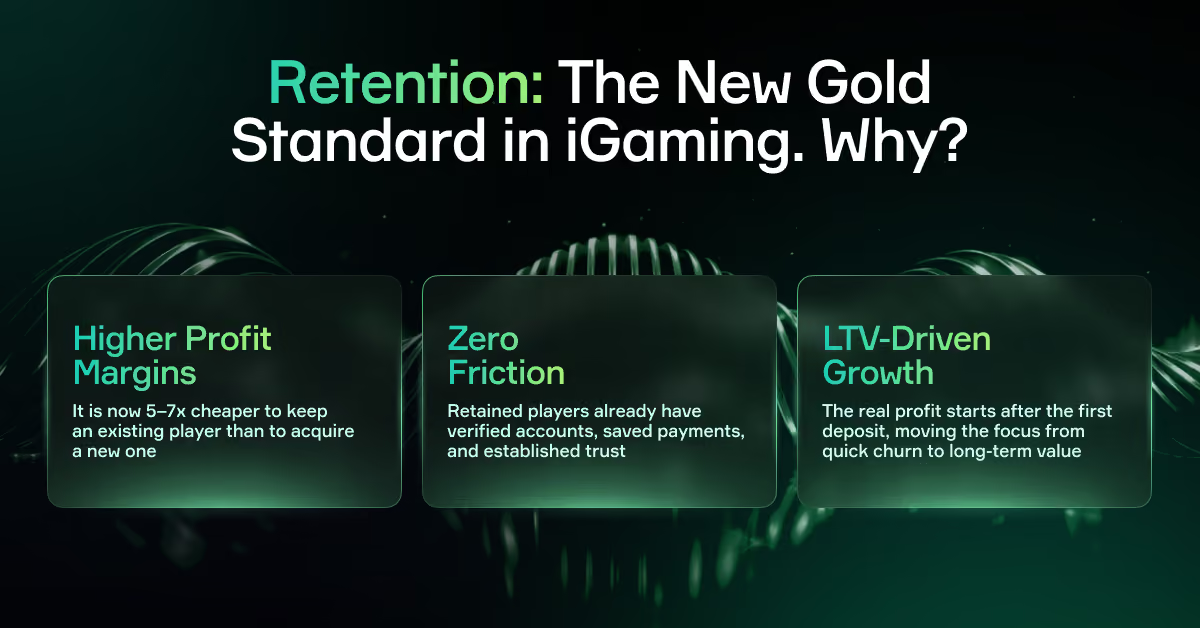
The economics of player acquisition in iGaming have changed dramatically. A decade ago, a well-placed affiliate deal and a competitive welcome bonus was enough to fill a lobby with new depositors at a manageable cost. That era is over. Today, competition for new player attention is fierce, regulations in key markets can be very demanding advertising, and the sheer volume of platforms fighting for the same pool of players has driven acquisition costs to levels that make many new player relationships unprofitable in the short term.
Acquiring a new depositing player usually costs several hundred euros depending on the market and channel, but when you factor in welcome bonuses, wagering subsidies, and the reality that a significant percentage of new players churn within the first 30 days, the true cost of acquisition becomes even harder to justify.
Conversely, retaining an existing player requires none of that infrastructure. The player already knows your platform, has passed KYC, has a deposit method saved, and has a game history. The groundwork of trust has already been laid. Keeping that player engaged costs a fraction of what it took to acquire them - industry analysis consistently places the ratio at 5-7x cheaper, and the commercial return is far more predictable. Smart operators are internalising this shift: acquisition is no longer the engine of growth and has become the starting point, with the real value created after the first deposit.
Retention improvements compound and turbocharge profitability. A player who stays on your platform for six months instead of two doesn't just generate three times the revenue. The behaviour deepens over time as they explore the game library, participate in tournaments and loyalty programmes, increase their session length, and become less sensitive to competitor offers. The relationship itself appreciates in value the longer it is maintained.
The compounding effect also works across the brand portfolio. A 5% improvement in retention doesn't just protect 5% of an operator’s revenue, it can prevent losing the players who are often closest to churning: mid-level regulars with significant remaining lifetime values. Retaining them has a disproportionate impact on total revenue because these mid-level spenders are still active, are in big numbers when compared to the number of VIPs, who by definition will represent a maximum 20% of the customer base, and can still generate significant amounts of revenue.
A platform that retains poorly is wasting money unnecessarily. A platform that retains well, even with modest acquisition numbers, builds a stable, growing revenue base that becomes increasingly profitable as the lifetime value of each retained player accumulates. The ROI of staying isn't theoretical. It is the most reliable path to sustainable margin in a market where acquisition economics are working against you.
There is a high level of commodification in today’s online gambling sector and when the product itself is interchangeable, the brand and the service provided is what differentiates one operator from another. And that in turn will determine how many players it attracts - and how many it keeps, which is why it is in many ways a more honest measure of a brand's strength than any brand awareness level and mainstream marketing campaign operators carry out.
Rates of customer retention are a direct readout of how much players value the experience your platform provides beyond the games themselves. They can be correlated to whether players enjoy the UX, communications, rewards, customer support, and overall identity of an iGaming brand. All those features add up in their decision to keep playing with a specific website and also signals that a platform has created something special: a reason to stay that isn't on offer elsewhere and isn’t based on a purely monetary value.
A low retention rate, regardless of how strong the acquisition numbers are, should be seen as an obvious warning signal. It means the platform is relying entirely on financial incentives to drive traffic and the experience itself is generating no loyalty. In a market where game content is commoditised and bonus offers are matched within hours, that is an unsustainable position. Retention is not just a metric. It is the verdict players deliver on your brand every time they choose to come back.
Transactional loyalty is the most common form of player retention in iGaming, and the most fragile. It describes a relationship built entirely on financial incentives, where a player stays not because they value the experience, but because the financial offer is attractive to them.
Signs to look out for:
In every meaningful respect, it is rarer and harder to build, but so much more valuable when it is achieved. An emotionally loyal player stays because they genuinely want to be there and is not swayed by the financial inducements that competitors use to poach transactional players.
Signs to look out for:
High-value players have a fundamentally different relationship with gambling than the average depositor. The standard they apply is the same: they expect the experience to be worth what they paid for it when it comes to quality of service and how it made them feel. A reload bonus pitched at a high-value player as a financial incentive misses the point, it brings everything back to a monetary value when the conversation should be about entertainment.
What separates memorable platforms from forgettable ones is the quality of the experiences they create. Numbers on a screen fade. Experiences don't. A player who received a 50% reload bonus three months ago has almost certainly forgotten it. But a player who was recommended a live dealer game they'd never tried, discovered they loved it, and received a personalised invitation to an exclusive tournament built around that game; that player will remember that experience.
Memory is the currency of genuine loyalty, generated not by what a platform pays out but by how well it demonstrates that it understands who a player is. When personalisation moves from a feature into a philosophy, when data is used to curate an experience rather than trigger automated emails, it generates moments of pleasant surprise that accumulate into a lasting narrative about the relationship.
Ultimately, people remember how they were treated, not how many free spins they received last Tuesday. A high-value player handled with genuine attentiveness, whose preferences were remembered and whose achievements were acknowledged personally will carry that feeling into every subsequent interaction. It becomes an emotional baseline of the relationship. If that feeling is delivered consistently, other competitors simply can’t match it.
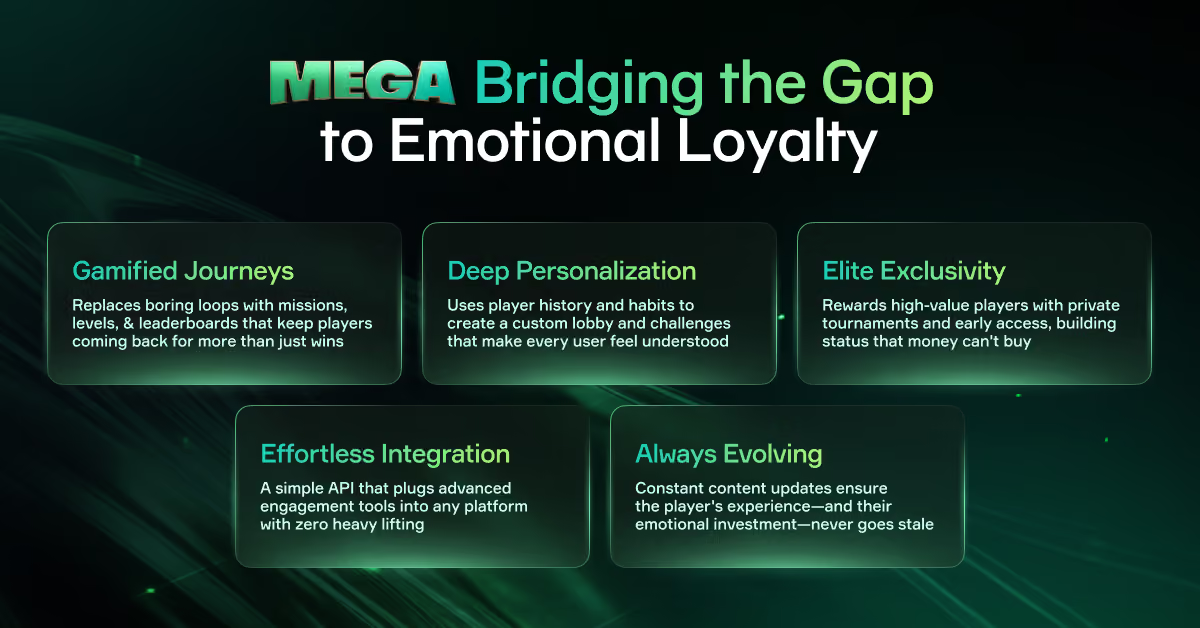
Moving a player from a transactional mindset to an emotional one requires the right tools: Soft2Bet has built its MEGA platform around precisely this challenge.
Motivational Engineering Gaming Application, or MEGA, is Soft2Bet's gamification engine. It increases player engagement and lifetime value through bets in class personalisation. Its gamification features have been perfected to tailor the experience to customers’ preferences, offering gaming options that are unique and productive for all our MEGA partners.
Who is MEGA for?
Can MEGA also work with providers?
How easy is it to integrate?
What problems does MEGA solve?
How do operators benefit from MEGA?
MEGA features
MEGA transforms the standard casino experience into a structured journey; with levels to progress through, achievements to unlock, missions that refresh and evolve, leaderboards that create genuine competitive tension.
Constant evolution
What makes MEGA distinctive is its commitment to the player's natural journey and growth. The platform is not static; it evolves continuously, introducing new content and challenge structures that keep the enjoyable experience alive. A gamification system that hasn't been updated in six months sends a clear message about how much an operator values the ongoing player experience.
Commercial returns and exclusivity
The commercial impact is measurable, because contextually relevant content drives higher engagement rates. Across every touchpoint, personalisation makes the platform feel built for this specific person, that feeling of individual relevance is one of the most powerful differentiators available.
Soft2Bet's platform makes this deliverable at scale, but without feeling manufactured or labour. By identifying and catering to players who qualify for elevated treatment based on genuine user metrics and creating experiences that are personal, players appreciate the sense of exclusivity and being selected for these invitations. It anchors them emotionally and they stay because they appreciate a customer status that they value.
Incentives are a good way to start a relationship, but they cannot sustain a business. A welcome bonus opens a door but, as the old saying goes, it does not build a home. The operators pulling ahead in this market are the ones who have recognised that the race to offer the most money generates the least loyalty and have chosen to compete on a different dimension entirely.
The most profitable players in any operator's portfolio are not there because of what they were given on day one. They are there because the experience has earned their trust and eventually their genuine affection for the platform. That outcome is not accidental, and it is not cheap to build, but it is far less expensive than perpetually replacing churned players with new acquisitions at rising CPA costs.
To retain the players who matter most, operators must invest where it is hardest to copy: in product quality, in personalised experience, in gamification that creates real emotional investment, and in the consistent delivery of a platform that feels worth staying on.
Technology like Soft2Bet's MEGA exists precisely to make that investment practical and scalable. The question is no longer whether emotional engagement works. The question is whether your platform is built to deliver it.
Why is retention now considered more valuable than acquisition?
Acquiring new players has become increasingly expensive due to high competition and regulatory costs. In contrast, retaining existing players is five to seven times cheaper and generates more predictable, compounding profits over time.
What distinguishes emotional loyalty from transactional loyalty?
Transactional loyalty is fragile and based strictly on financial incentives like bonuses. Emotional loyalty is built through personalized experiences and recognition, making players resistant to competitors' offers.
How does gamification contribute to player lifetime value?
Gamification encourages players to return for non-monetary reasons, such as achieving milestones or climbing leaderboards. This creates a sense of progress and belonging that integrates the platform into the player’s daily routine.
What is the primary function of Soft2Bet’s MEGA engine?
MEGA is a gamification tool designed to drive engagement through narrative-driven progression and deep personalization. It helps operators transition players from a transactional mindset to an emotional connection with the brand.
.svg)
.svg)



.png)


.png)