



Retention was once an afterthought in iGaming, used primarily to optimise post-acquisition behaviour.
That equation no longer holds. As customer acquisition costs rise, attention fragments across platforms, and celebrity partnerships evolve beyond traditional endorsement models, the industry’s competitive battleground has shifted inside the product itself: not how many players arrive, but how many continue playing, returning, and engaging over time.
Paid acquisition channels have become more expensive with less predictable returns. Growth can still be bought through acquisition, bonus driven onboarding and traffic arbitrage, but these strategies generate volume without guaranteeing durable engagement or long-term player value. Therefore retention is a core design necessity.
This shift reframes the entire logic of online betting platforms. The challenge is continuity and building systems that sustain interaction beyond the first session, the first bet, or even the first win.
As rising acquisition costs continue to squeeze margins across iGaming, Soft2Bet has taken a structural alternative path by turning retention into a competitive advantage rather than a secondary optimisation layer.
Soft2Bet’s collaboration with Diego Simeone, extended through its Betinia and CampoBet brands, signals a shift from traditional celebrity endorsement toward next-generation embedded engagement design where celebrity influence is built into the experience itself.
Whilst traditional marketing operates in bursts with campaigns designed to generate spikes in attention, Soft2Bet’s emerging model is continuous. Engagement is sustained internally through a structured system. Soft2Bet has positioned its partnership with Diego Simeone as a strategic extension of its long-term engagement philosophy, aligning his leadership identity and disciplined approach with a product ecosystem designed to strengthen player retention and lifetime value.
Soft2Bet operates in a highly competitive sportsbook and online gaming environment where growth strategies are evolving in response to changing market dynamics. For years, operators relied on acquisition-focused models, media buying and bonus-led onboarding strategies to scale user growth.
Rising acquisition costs, tighter advertising regulation, and platform saturation have significantly reduced the scalability of user acquisition. Operators are therefore shifting focus toward lifetime value optimisation as a structural requirement for profitability rather than a performance metric.
This changes how platforms are evaluated. Growth is no longer defined by the volume of users entering the system, but by the duration and depth of their engagement once inside it. Soft2Bet’s model reflects this transition by prioritising gamification as core infrastructure with engagement sustained inside the product rather than through external campaigns.
Soft2Bet’s MEGA framework addresses key industry challenges by improving monetisation metrics, including rising ARPU, strengthening LTV, and reducing churn through higher player engagement and retention efficiency.
Operators leveraging MEGA consistently see improved revenue quality by shifting from short-term activity spikes to sustained user value and lifecycle engagement.
The effectiveness of the Diego Simeone and Soft2Bet collaboration is not defined by celebrity recognition alone, but by structural alignment between sport, persona, and system logic. Soft2Bet appointment Simeone as an official ambassador in a partnership designed to combine football culture and personalised player experiences. As part of the collaboration, Soft2Bet introduced a proprietary in-platform football manager experience built around progression and rewards, as well as long-term engagement.
Football is uniquely suited to retention-driven systems because above all it is built on passion, identity, and collective experience. It remains one of the few global entertainment ecosystems capable of uniting people across generations, cultures and communities. Unlike linear entertainment formats, football is constant and fragmented into recurring micro-events such as matches, predicts and transfers as well as creating an environment of anticipation and participation.
This model is increasingly visible beyond iGaming, where celebrity integration has, over decades, shaped some of the world’s most iconic consumer ecosystems. In sportswear, premium brands evolved beyond conventional sponsorship, using athletes to build enduring cultural relevance and continuous fan engagement.
Football fandom is also identity-driven. Users align themselves with teams and players creating long-term emotional attachment loops that extend beyond individual events. This makes football one of the few entertainment verticals where behavioural persistence is already culturally embedded.
Within this context, Diego Simeone functions as more than a recognisable figure. His managerial identity is built around discipline, control, and system orientation, which aligns closely with structured engagement design.
Simeone’s football philosophy prioritises controlled tempo over volatility, built on a passion and commitment that has defined his career both as a player and a manager. This logic closely mirrors modern gamified engagement design, where missions, progression systems, and reward pacing are structured to sustain participation over time rather than generate short-lived spikes in activity.
The partnership therefore operates on two levels. On the surface, it provides cultural relevance. At a structural level, it reinforces product logic where discipline and progression are central to sustained engagement.
The partnership with Diego Simeone also marked the launch of MEGA 11, a football-themed evolution of Soft2Bet’s gamification framework designed to translate fan engagement into long-term player interaction. Built around progression systems, competitive mechanics, and recurring participation loops, MEGA 11 connects football culture directly with retention-driven product design.
The MEGA framework has demonstrated strong performance uplift across operator environments where it has been deployed as a fully integrated engagement system. Results vary depending on market conditions and product configuration.
Across selected operator environments and controlled deployments where MEGA is embedded into the core product experience, the following outcomes have been observed:
Up to +65% increase in Net Gaming Revenue (NGR) reported in selected operator environments following MEGA integration, reflecting improved monetisation efficiency driven by deeper engagement and sustained user activity over time.
Up to +45% increase in Average Revenue Per User (ARPU) observed in controlled deployments where MEGA is fully integrated into the player journey, indicating stronger per-user value generation through structured engagement systems.
Up to +30% increase in deposit frequency recorded in fully integrated environments, where mission-based progression and continuous engagement loops drive repeat user activity.
Up to +50% growth in total deposits reported in selected operator environments, reflecting a combination of increased engagement frequency and extended lifecycle participation.
Up to 4x increase in screen time and platform engagement observed in controlled MEGA deployments, where users interact continuously within the ecosystem rather than through isolated transactional betting sessions.
These outcomes are driven by the combined effect of MEGA’s gamification architecture, progression-based engagement design, and embedded behavioural systems, which collectively shift user activity from short-term interaction patterns to sustained lifecycle engagement.
Performance impact is most pronounced in environments where MEGA is fully integrated across the product ecosystem, rather than applied as a standalone feature layer.
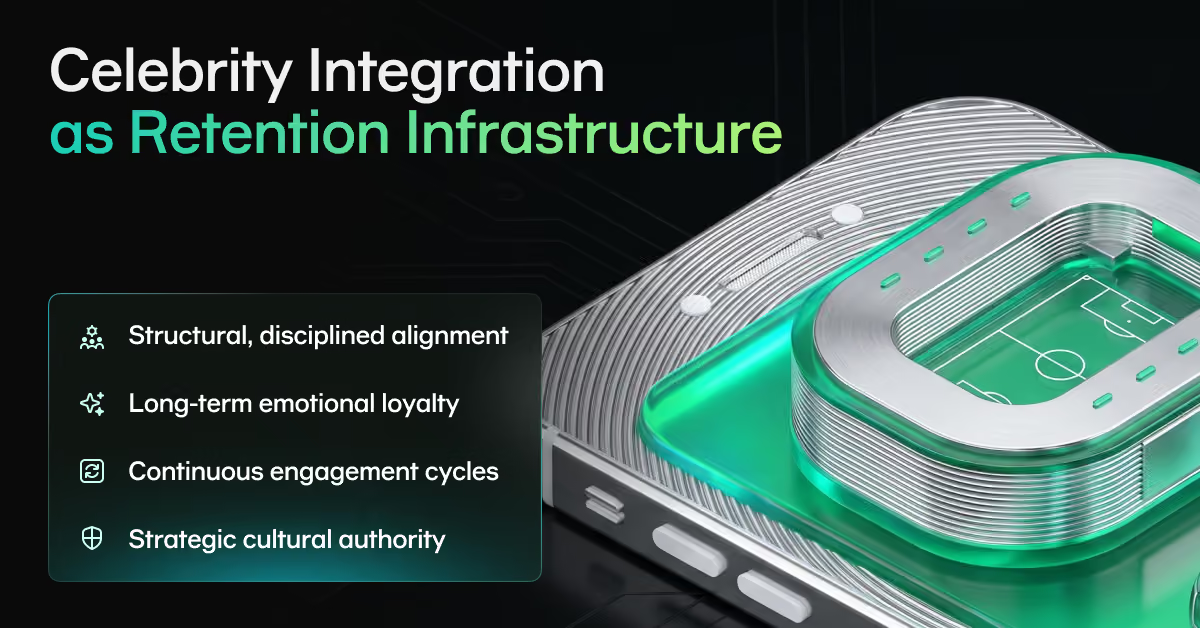
The rise of the superfan economy provides the behavioural foundation for this shift. In innovative digital environments, celebrities and influencers no longer operate as random attention drivers. They function as continuous engagement nodes embedded within platform ecosystems.
Value creation has moved from reach to user loyalty.
Algorithms have accelerated this shift, creating a media environment structured around continuous interaction loops. Soft2Bet’s collaboration with Diego Simeone sits directly within this framework, positioning him not as promotion, but as continuity infrastructure.
For Soft2Bet, working with Simeone, the real value is not visibility but alignment. Synergy between personality and product determines whether a partnership feels decorative or structural and whether it simply borrows attention, or actively shapes how users behave within a system.
As a player, the Argentine midfielder was known for intensity and tactical discipline, winning league titles in Spain and Italy while representing Argentina at three FIFA World Cups. His transition into management amplified those traits.
Since taking charge of Atlético Madrid in 2011, Simeone has transformed the club into one of Europe’s most consistent competitive forces. Under his leadership, Atlético broke the dominance of Real Madrid and Barcelona to win multiple La Liga titles and reached two UEFA Champions League finals. More importantly, he built a football identity that prioritised structure and endurance over financial power.
Soft2Bet’s rationale for the partnership sits precisely in that continuity mindset. Simeone is not a conventional ambassador for reach, but a figure whose professional identity embodies the disciplined, long-term logic on which retention-driven product design is built.
This long-cycle philosophy is precisely what makes Soft2Bet’s collaboration with Simeone strategically relevant to retention-led gaming systems.
MEGA 11 through the Diego Simeone partnership reflect a shift in how engagement is designed across modern betting platforms. Gamification is often misunderstood as a layer of engagement mechanics placed on top of core betting activity. In practice gamification is effective when it converts unpredictable user behaviour into repeatable loops.
At the centre of this system is a mechanism where rewards are not fixed or predictable but distributed in a way that sustains anticipation. Unlike static incentives such as one-off variable systems create expectation cycles where users return not because they know what they will receive, but because they are engaged.
This reinforces a feedback loop where anticipation and engagement become a form of reward.In sportsbook environments, the unpredictability of sport strengthens these dynamics, supporting more sustained engagement over time.
A second driver is progression bias. Users are more likely to continue engagement when they perceive measurable advancement. Tier systems, missions, and unlockable rewards convert abstract activity into visible progression. Even marginal gains, such as approaching the next tier, act as reinforcement signals that extend participation.
Gamified systems also leverage loss aversion. Disengagement carries perceived cost in the form of lost progress and momentum. Finally, social visibility loops embedded in leaderboards introduce comparative pressure. Users are not only engaging with a system but with other participants, turning individual behaviour into competitive performance.
Together, these mechanisms form architecture that structures repetition and progression the foundations of retention-led product design.

The Diego Simeone partnership with Soft2Bet is delivered through the MEGA 11 gamification architecture within the Betinia sportsbook environment, translating football culture into a structured engagement system.
MEGA 11 is designed around a football-manager-inspired progression model built in direct reference to Simeone’s identity on the touchline, his intensity, emotional control, and distinctive sideline gestures that have become symbolic of his coaching style. Soft2Bet has also incorporated visual cues inspired by these signature expressions into the experience, reinforcing emotional connection and recognisable behavioural patterns within the product environment.
User activity begins as conventional betting behaviour but simultaneously feeds into a secondary progression system. Betting frequency, selection patterns, and participation in featured events are translated into mission-based objectives.
These missions function as structured behavioural tasks, ranging from simple activity milestones to competitive challenges and leaderboard events. Completion unlocks rewards, progression points, and access to higher engagement tiers.
Progression is continuously reinforced through tier systems, visual tracking, and dynamic leaderboards. This ensures engagement extends beyond live sporting events into continuous system participation. Rather than starting and stopping with individual matches, users operate inside an ongoing environment where progression is continuous.
Traditional sportsbook UX is transactional. Users interact through discrete actions such as placing bets and receiving outcomes.
The first evolution introduced loyalty systems, rewarding activity without shaping.
A second evolution introduced light gamification layered onto existing systems, improving engagement but remaining peripheral.
Soft2Bet’s model shifts to system-native gamification, where engagement mechanics are embedded directly into the product. The MEGA 11 framework does not reward behaviour externally but it structures it internally. Celebrity integration reinforces this shift. Diego Simeone functions not as a marketing but as behavioural alignment within the system.
In Soft2Bet’s model, gamification operates as infrastructure.
The broader implication of the Simeone collaboration is not the use of celebrity in gaming, but the redefinition of what celebrity does inside digital ecosystems.
Influence is no longer external to the product. It is embedded within it.
As gamification becomes more sophisticated and systems more central to retention, celebrity integration evolves from marketing strategy to infrastructure design.
Visibility is no longer the objective. Continuity is.
The role of celebrity has been fundamentally redefined. It is no longer external to the system but part of the system.
As highlighted in research studies on customer lifetime value and lifecycle marketing, modern growth strategies are increasingly shaped by retention, repeat engagement, and long-term customer value rather than short-term acquisition or campaign-driven reach . In this environment, the distinction between marketing, product design, and infrastructure continues to blur. What was once measured in impressions is now measured in sustained engagement, recurrence, and lifetime value.
What remains constant is the objective: not just to attract users, but to keep them engaged and interested and to make their experience more immersive.
Has iGaming reached the limits of growth through acquisition?
Yes. Paid acquisition has become progressively less reliable as a growth engine: media inflation has pushed up customer acquisition costs, while new and fragmented markets across platforms have reduced the effectiveness of traditional performance marketing.
In practice, operators can still buy traffic, but they cannot assume that traffic will convert into long-term value. The first deposit has become relatively easy to secure; what is far harder is sustaining engagement beyond it in a way that produces predictable lifetime value.
This is why retention is no longer a secondary optimisation layer applied after acquisition. It has become the primary determinant of profitability. The question for operators is no longer how efficiently they can acquire users, but how effectively they can design systems that make users return, re-engage, and extend their lifecycle within the product.
What role does celebrity integration actually play in retention, beyond branding?
When it is treated as a surface-level endorsement, celebrity integration adds little beyond short-term visibility spikes. Its real value emerges only when it is structurally embedded into the product experience itself. In that configuration, it stops functioning as marketing and starts operating as behavioural architecture.
In the case of Soft2Bet, celebrity integration is not positioned as an external campaign layer but as a mechanism that reinforces engagement loops inside the product. The objective is not to attract attention at the top of the funnel, but to influence how users behave once they are already inside the ecosystem, how often they return, how long they stay, and how consistently they progress through the platform.
Why is a football icon like Diego Simeone relevant to Soft2Bet’s gamified product design?
Because the alignment is less about fame and more about behavioural logic. Simeone’s managerial identity is defined by structure, discipline, and controlled intensity, qualities that are not incidental in football but central to sustained performance over time.
These same principles map neatly onto retention-driven system design. Gamified ecosystems rely on rhythm rather than randomness: progression systems, pacing mechanisms, and repeat engagement loops that reward consistency over volatility. Simeone, as both a player and manager, represents a model of controlled repetition under pressure, which mirrors how modern engagement systems are engineered to maintain user participation across extended cycles.
How is Soft2Bet using gamification differently from traditional sportsbook models?
Traditional sportsbook UX has historically been transactional: users enter, place bets, and exit. Even when loyalty mechanics or bonuses are introduced, they typically sit alongside the core product rather than within it.
Soft2Bet’s approach is structurally different. Gamification is embedded into the product architecture itself, meaning engagement mechanics are not layered on top but designed into the user journey from the outset. This shifts the role of gamification from an incentive layer to a behavioural system.
As a result, user interaction is no longer driven solely by external triggers such as odds or promotions, but by internal progression logic, missions, tiers, and continuous feedback loops that shape behaviour over time rather than reacting to it intermittently.
What does success look like when a celebrity becomes part of product architecture?
Success is not measured in visibility metrics such as reach, awareness, or campaign recall. Those indicators are relevant in traditional marketing frameworks but become secondary when celebrity is integrated into system design.
In a model like Soft2Bet’s, the real measure of success is continuity: whether the presence of the celebrity fades into the background of the experience while still influencing behaviour. In other words, the celebrity stops being perceived as an external figure and becomes part of the operating environment of the product.
If that integration is effective, it should not feel like a campaign at all. It becomes invisible infrastructure, quietly shaping engagement, reinforcing progression, and extending the user lifecycle without drawing attention to itself.
.svg)
.svg)



.png)




.avif)