

SIGMA | ROME
Play with us. Win with us.
NOVEMBER 4-6
Stand 6035
ITALY
ROME

Discover the thrill of MEGA Clawee and experience the fun first-handed at our stand

Fill in the form
Thank you! Your submission has been received!
We'll get back to you soon!
Oops! Something went wrong while submitting the form.
Back to all news

Payment-Method Risk Profiling and Market-Specific Controls: How Soft2Bet Prevents Payment System Abuse and Improves Withdrawal Monitoring

March 24, 2026
5 Minutes reading
Payment-Method Risk Profiling and Market-Specific Controls: How Soft2Bet Prevents Payment System Abuse and Improves Withdrawal Monitoring
No items found.

Payments have become one of the biggest operational pressure points in European iGaming. In 2026, operators need a cashier that can support growth, maintain trust, meet local rules, and prevent payment system abuse before it disrupts the player journey.

A payment stack may look strong on paper, yet still fail if it cannot identify risk early and respond in a way that aligns with the regulatory environment in which it operates. The pressure is no longer limited to a single fraud type. Bonus abuse can sit alongside synthetic identities, deepfake fraud, botnet activity, and coordinated account rings designed to push suspicious activity through the weakest point in the flow.

Seen more broadly, operators cannot afford to treat bonus abuse, account manipulation, payment system abuse, and fraud prevention as separate workstreams. The cost of doing so is too high. Soft2Bet addresses this challenge by building AI-driven monitoring and risk controls into the player journey, from registration to withdrawal.

The 2026 overview

As operators move through 2026, the consequences of weak payment control are becoming harder to ignore. A cashier that accepts deposits quickly but lacks strong KYC procedures, risk profiling, payment security, and transaction monitoring will come under pressure when fraud levels rise or a regulator asks for evidence. In that environment, payments need to run through a control model that identifies risk early while keeping legitimate player activity moving without unnecessary delay.

Fraud methods are also moving faster than many payment systems are built to handle. The European Payments Council has pointed to growing pressure around payment instruments and instant payments, while identity-fraud reporting shows deepfake fraud and synthetic identities becoming more convincing and easier to scale.

This trend makes AI-driven monitoring, fraud prevention, and suspicious activity detection a daily operational need rather than a periodic review. In this environment, operators need controls that can be refreshed as new abuse patterns emerge, so the payment system can respond before they reach scale.

Proactive payment-method risk profiling

The strongest defence starts before the first deposit is authorised. Soft2Bet uses risk profiling at the point where the player, device, payment method, and jurisdiction first come together. KYC procedures, behavioural biometrics, real-time risk scoring, geolocation compliance, and transaction monitoring all help determine whether the player should move through a light-touch path, face stepped-up checks, or be blocked altogether. At that point, payment security becomes a commercial issue as well as a protective one, because a sound first decision makes every later stage easier to manage.

That early read matters because different payment methods carry different levels of exposure. A verified bank transfer from a familiar device does not carry the same risk as a first-time e-wallet deposit from a new device with a location mismatch and abrupt changes in play.

Soft2Bet uses risk profiling and AI-driven monitoring to place preventative gates at that point. KYC procedures become more precise when triggered by evidence rather than queue pressure, and fraud prevention becomes more effective when it filters suspicious activity before it escalates into payment system or bonus abuse.

The same principle applies after onboarding, once the account starts to generate real behavioural signals. Risk is not fixed at registration, so Soft2Bet links CDD and EDD procedures, real-time risk scoring, and transaction monitoring to ongoing account behaviour. As payment gateway risk rises, the system can respond accordingly, whether by requesting additional evidence or, where necessary, moving the case to review.

If a player’s profile remains consistent, payment security can stay proportionate. It is also at this stage that source-of-wealth verification may need to enter the flow, especially when transaction patterns or account behaviour no longer match the earlier profile.

Combating payment system abuse

Payment system abuse is usually gradual rather than sudden. More often, it appears as a pattern of smaller warning signs, including shared devices, repeated method changes, weak engagement paired with fast deposits, or withdrawal behaviour that is out of keeping with the player’s previous activity.

Soft2Bet solution offers the ability to use behavioural biometrics, cross-platform intelligence, and transaction signals to connect those earlier warning signs before they develop into broader abuse patterns. That is how bonus abuse stops being dismissed as promo leakage and starts to be treated as part of payment system abuse and fraud prevention.

Fraud teams are now dealing with automated attacks as well as organised abuse, which makes payment defences harder to manage in real time. They have to contend with adversarial machine learning, synthetic identities, deepfake fraud, and botnet activity designed to probe payment systems and expose weak or poorly sequenced controls.

Soft2Bet addresses that pressure with AI-driven monitoring and retrainable controls that can adapt as those tactics change. Payment system abuse becomes far harder to contain once it reaches scale, so the real advantage lies in identifying the pattern while it still looks minor. At that stage, risk profiling and fraud prevention need to work together, rather than waiting for one step to trigger the next.
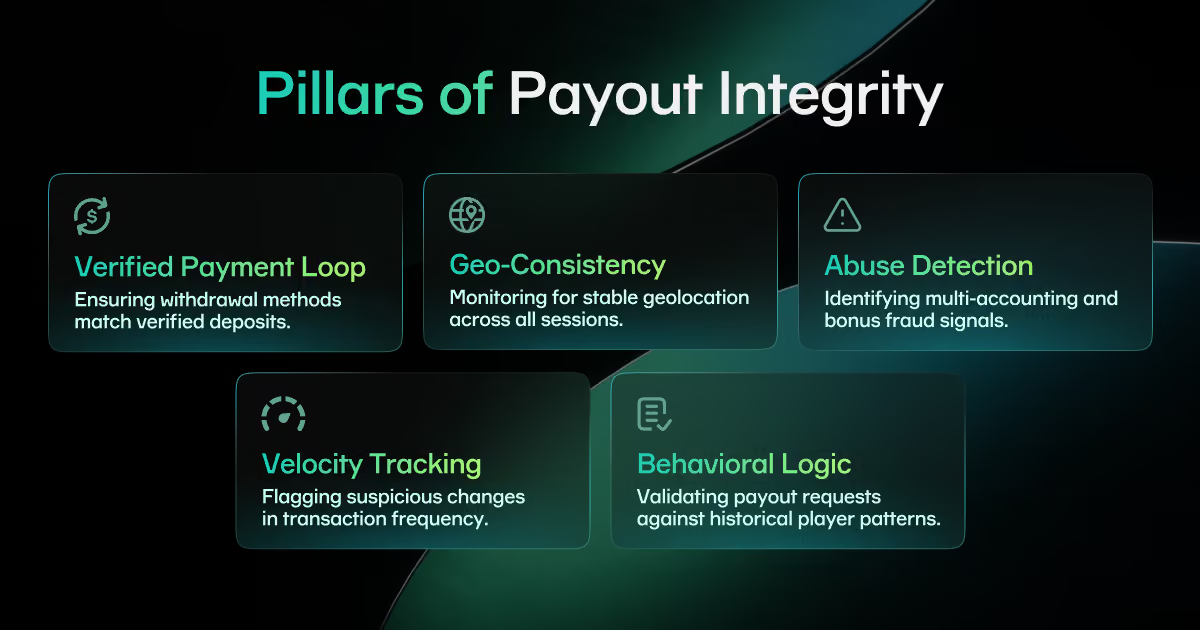
Advanced withdrawal monitoring and payout integrity

While players are generally tolerant of a failed deposit attempt, a negative withdrawal experience can quickly erode their trust. Soft2Bet, therefore, treats withdrawal monitoring as the stage at which payment integrity becomes visible to the player. The aim is to move legitimate funds quickly, prevent withdrawals from being released, verify the legitimacy of the request, and keep every approved withdrawal easy to defend.

Strong withdrawal monitoring depends on a full view of the account, including:

- Has the player used the same verified method for both deposit and withdrawal?

- Is geolocation compliance consistent across the account?

- Does the account show suspicious activity, multi-account signals, bonus abuse, or changes in velocity that increase risk?

- Do the withdrawal amount, timing, and destination still make sense in light of the player’s previous behaviour?

With transaction monitoring, real-time risk scoring, and risk profiling running in the background, Soft2Bet can answer those questions as they arise. This sharpens the withdrawal process, protects payout integrity, and keeps fraud prevention focused on the cases that actually need escalation.

Method-level control matters here too, because cards, e-wallets, bank transfers, and open banking routes do not carry the same exposure or fail in the same way. Soft2Bet applies payment orchestration so withdrawals can move through the most appropriate provider and approval logic. Low-risk cases can move to an approved withdrawal more quickly, while withdrawal monitoring remains tight when source-of-wealth verification, identity verification, anti-money laundering (AML), or destination review is required.

Human review still has an important place, despite the growth of automated controls. High-value or unusual withdrawals may still need manual review even when earlier checks were clean, because risk can rise late in the journey. Soft2Bet uses managed anti-fraud services to help operators maintain accurate, audit-ready withdrawal monitoring and improve the approved withdrawal rate for low-risk players. When those judgement calls are backed by evidence and reviewed properly, payout integrity is easier to protect.

Implementing market-specific controls

Market-specific controls are where payment design proves whether it can work across key markets without losing discipline. A shared control core is useful, but local payment methods, identity rules, reporting duties, and player-protection requirements still have to be respected. Soft2Bet builds around that principle, which is why market-specific controls sit alongside payments and compliance rather than being treated as an afterthought.

Sweden

In Sweden, the rules are direct and tightly structured. Operators cannot allow gambling to begin until they have established the player’s identity and confirmed that the player is not self-excluded. Players must set a maximum deposit limit, and the law contains a credit ban on gambling stakes. The Swedish Gambling Authority also notes that the sector carries a high risk of money laundering and recommends e-identification, including BankID, for online identification.

For Soft2Bet, this means that market-specific controls, KYC and AML procedures, risk profiling, payment security, and withdrawal monitoring must operate as a single Swedish control chain rather than as separate checks. A clean approved withdrawal is easier to achieve when the initial identity and funding decisions are sound.

Denmark

The Danish framework uses a different mix, but reaches a similar standard. Operators must be able to communicate with ROFUS (the Register of Self-Excluded Players), check the register when a new player account is created, and check it again at login. The Danish Gambling Authority’s 2025 guidance also requires an eID or strong customer authentication for deposits, withdrawals, and changes to payment instruments.

Player information must be kept up to date, and if gambling patterns change significantly, the operator must update its knowledge. Denmark also makes clear that temporary gambling accounts cannot be used for withdrawals until identity has been verified. For Soft2Bet, that means market-specific controls, KYC checks, payment security, and withdrawal monitoring need to remain integrated throughout the account lifecycle.

Romania

The Romanian regulatory model places greater emphasis on traceability. Under the official law, the central ICT (Information and Communication Technology) system must automatically record every transaction in real time to a backup server made available to the ONJN (Oficiul Național pentru Jocuri de Noroc, the Romanian National Gambling Office) and submit periodic summary reports. That leaves operators with less room for fragmented data, weak reconciliation, or unclear decision trails.

Soft2Bet addresses this with market-specific controls that keep transaction monitoring, payment security, withdrawal monitoring, and payout integrity visible at both system and account level. It is a practical response to a market where local reporting and audit readiness matter every day, with controls built to support ongoing regulatory scrutiny.

Ontario

Ontario places emphasis on a different mix of payment and player controls. AGCO standards require operators to detect and continuously monitor player location and block unverified attempts to play. The same standards place strict limits on public advertising of gambling inducements, bonuses, and credits, while also requiring mechanisms to monitor player risk profiles and behaviours.

Within that framework, market-specific controls in Ontario need to link geolocation compliance, KYC procedures, bonus abuse control, and withdrawal monitoring before money moves. Soft2Bet uses that local logic to keep the player journey clear while ensuring local payment rules and player-protection requirements are built in from the start.
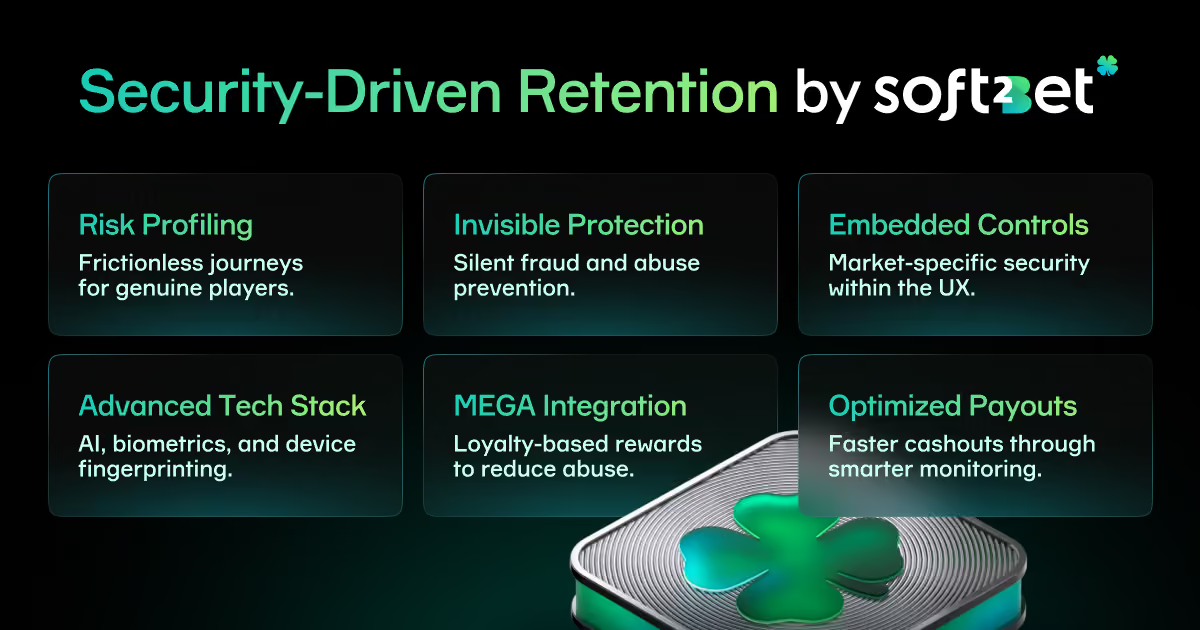
Security-driven retention by Soft2Bet

Security only feels heavy when it is poorly placed and interrupts the player's journey. Soft2Bet uses risk profiling to place checks where the evidence justifies them and to keep genuine players clear of unnecessary delays. That matters because payment security influences retention more than many operators expect.

A localised cashier, clear status messaging, familiar methods, and reliable withdrawals all support customer trust, but those benefits only hold if bonus abuse and payment system abuse are dealt with quietly in the background. That is why Soft2Bet brings market-specific controls into product design and customer experience, so they operate as part of the same system.

MEGA (Motivational Engineering Gaming Application) supports the commercial side of that work. Soft2Bet’s own recent material presents MEGA as a retention engine built around progress and long-term value, rather than short-term extraction. That also supports security, because rewards tied to clearer engagement patterns give operators less reason to overexpose the cashier to blunt incentive mechanics that invite bonus abuse.

Through the platform’s use of managed anti-fraud services, payment orchestration, device fingerprinting, behavioural biometrics, AI-driven monitoring, and transaction monitoring, Soft2Bet helps operators maintain strong fraud prevention while moving towards a better approved withdrawal experience for legitimate players.

Future-proofing your payment strategy

Payment systems that can adjust their logic quickly will be better placed to handle the next phase of compliance change and fraud risk. Payment orchestration plays a key role here because the way transactions are routed and managed directly affects payment acceptance rates, operating costs, transaction speed, and risk exposure.

The same is true of AI-driven monitoring and adversarial machine learning. Attackers are learning to probe payment systems from onboarding through to withdrawal faster and more cheaply, so fraud prevention has to adapt at the same pace.

The wider European payments picture supports the same conclusion, as regulatory change continues to reshape how operators need to manage payment oversight. The European Commission’s PSD3 (Third Payment Services Directive) and PSR (Payment Services Regulation) proposals remain part of an active legislative process. A February 2026 state-of-play note from the Council of the European Union shows that a provisional agreement was reached in late 2025, while final implementation remains pending.

Operators, therefore, need to prepare for tighter payment governance without assuming every final rule is already in force. In practical terms, that means keeping risk profiling, KYC procedures, suspicious activity handling, and market-specific controls ready for change. Soft2Bet’s approach fits that need, combining payment security and regulatory compliance within a flexible architecture that can adjust as new rules emerge.

Sustained payment control has clear commercial effects across the platform. Lower levels of payment system abuse reduce marketing waste, while tighter controls on bonus abuse allow promotional budgets to perform as intended. Accurate withdrawal monitoring also helps genuine withdrawals move to an approved withdrawal with less friction, while trusted payment security supports payout integrity and encourages players to stay.

In that context, Soft2Bet brings payments, risk management, and localisation together in a single operating structure that strengthens fraud prevention while keeping control standards aligned across markets.

FAQ

What is payment-method risk profiling?

Payment-method risk profiling is the process of assessing the player, payment method, device, and jurisdiction together before funds move. Operators use KYC procedures, real-time risk scoring, transaction monitoring, and payment security checks to determine whether an account should proceed along a light-touch path, undergo stepped-up checks, or be blocked. This allows operators to apply friction where the risk is real, rather than where the queue happens to be longest.

How do operators stop bonus abuse before it turns into payment system abuse?

Operators need to identify abusive behaviour early, before bonus abuse spreads across multiple accounts or payment methods. Bonus abuse often turns into payment system abuse when the same account or account cluster begins method hopping, shows suspicious activity around withdrawals, or recycles identities and devices. AI-driven monitoring, together with managed anti-fraud services, helps teams connect those signals earlier, making containment faster and less costly.

Why is withdrawal monitoring so important to the approved withdrawal rate?

Withdrawal monitoring plays a direct role in whether a withdrawal feels safe and fair. When it is tied to a player’s verified account history and risk signals, more low-risk withdrawals can be approved for withdrawal quickly, while higher-risk cases still receive proper review. That balance protects payout integrity without making the cashier feel slow.

Why do market-specific controls matter so much?

Each market puts pressure on a different part of the payment and compliance flow. Market-specific controls keep payments, risk monitoring, identity checks, and local regulatory requirements aligned, so operators can meet those demands without disrupting the player journey.

How do managed services for anti-fraud help with suspicious activity?

Managed services for anti-fraud help operators separate routine edge cases from genuine suspicious activity. They support more consistent review and provide clearer evidence, so teams can make better decisions around withdrawals and account risk. This strengthens fraud prevention and helps stop abusive patterns before funds are released.

How should operators prepare for adversarial machine learning?

Preparation starts with the assumption that adversarial machine learning will continue to test onboarding, payment checks, and withdrawals. Static rule sets cannot keep pace in that environment, because attackers are constantly adapting their methods. Effective defence depends on monitoring systems that can detect coordinated abuse as it emerges, particularly where deepfake fraud or synthetic identities are involved.

Share to:
Payment-Method Risk Profiling and Market-Specific Controls: How Soft2Bet Prevents Payment System Abuse and Improves Withdrawal Monitoring

Payments have become one of the biggest operational pressure points in European iGaming. In 2026, operators need a cashier that can support growth, maintain trust, meet local rules, and prevent payment system abuse before it disrupts the player journey.

A payment stack may look strong on paper, yet still fail if it cannot identify risk early and respond in a way that aligns with the regulatory environment in which it operates. The pressure is no longer limited to a single fraud type. Bonus abuse can sit alongside synthetic identities, deepfake fraud, botnet activity, and coordinated account rings designed to push suspicious activity through the weakest point in the flow.

Seen more broadly, operators cannot afford to treat bonus abuse, account manipulation, payment system abuse, and fraud prevention as separate workstreams. The cost of doing so is too high. Soft2Bet addresses this challenge by building AI-driven monitoring and risk controls into the player journey, from registration to withdrawal.

The 2026 overview

As operators move through 2026, the consequences of weak payment control are becoming harder to ignore. A cashier that accepts deposits quickly but lacks strong KYC procedures, risk profiling, payment security, and transaction monitoring will come under pressure when fraud levels rise or a regulator asks for evidence. In that environment, payments need to run through a control model that identifies risk early while keeping legitimate player activity moving without unnecessary delay.

Fraud methods are also moving faster than many payment systems are built to handle. The European Payments Council has pointed to growing pressure around payment instruments and instant payments, while identity-fraud reporting shows deepfake fraud and synthetic identities becoming more convincing and easier to scale.

This trend makes AI-driven monitoring, fraud prevention, and suspicious activity detection a daily operational need rather than a periodic review. In this environment, operators need controls that can be refreshed as new abuse patterns emerge, so the payment system can respond before they reach scale.

Proactive payment-method risk profiling

The strongest defence starts before the first deposit is authorised. Soft2Bet uses risk profiling at the point where the player, device, payment method, and jurisdiction first come together. KYC procedures, behavioural biometrics, real-time risk scoring, geolocation compliance, and transaction monitoring all help determine whether the player should move through a light-touch path, face stepped-up checks, or be blocked altogether. At that point, payment security becomes a commercial issue as well as a protective one, because a sound first decision makes every later stage easier to manage.

That early read matters because different payment methods carry different levels of exposure. A verified bank transfer from a familiar device does not carry the same risk as a first-time e-wallet deposit from a new device with a location mismatch and abrupt changes in play.

Soft2Bet uses risk profiling and AI-driven monitoring to place preventative gates at that point. KYC procedures become more precise when triggered by evidence rather than queue pressure, and fraud prevention becomes more effective when it filters suspicious activity before it escalates into payment system or bonus abuse.

The same principle applies after onboarding, once the account starts to generate real behavioural signals. Risk is not fixed at registration, so Soft2Bet links CDD and EDD procedures, real-time risk scoring, and transaction monitoring to ongoing account behaviour. As payment gateway risk rises, the system can respond accordingly, whether by requesting additional evidence or, where necessary, moving the case to review.

If a player’s profile remains consistent, payment security can stay proportionate. It is also at this stage that source-of-wealth verification may need to enter the flow, especially when transaction patterns or account behaviour no longer match the earlier profile.

Combating payment system abuse

Payment system abuse is usually gradual rather than sudden. More often, it appears as a pattern of smaller warning signs, including shared devices, repeated method changes, weak engagement paired with fast deposits, or withdrawal behaviour that is out of keeping with the player’s previous activity.

Soft2Bet solution offers the ability to use behavioural biometrics, cross-platform intelligence, and transaction signals to connect those earlier warning signs before they develop into broader abuse patterns. That is how bonus abuse stops being dismissed as promo leakage and starts to be treated as part of payment system abuse and fraud prevention.

Fraud teams are now dealing with automated attacks as well as organised abuse, which makes payment defences harder to manage in real time. They have to contend with adversarial machine learning, synthetic identities, deepfake fraud, and botnet activity designed to probe payment systems and expose weak or poorly sequenced controls.

Soft2Bet addresses that pressure with AI-driven monitoring and retrainable controls that can adapt as those tactics change. Payment system abuse becomes far harder to contain once it reaches scale, so the real advantage lies in identifying the pattern while it still looks minor. At that stage, risk profiling and fraud prevention need to work together, rather than waiting for one step to trigger the next.

Advanced withdrawal monitoring and payout integrity

While players are generally tolerant of a failed deposit attempt, a negative withdrawal experience can quickly erode their trust. Soft2Bet, therefore, treats withdrawal monitoring as the stage at which payment integrity becomes visible to the player. The aim is to move legitimate funds quickly, prevent withdrawals from being released, verify the legitimacy of the request, and keep every approved withdrawal easy to defend.

Strong withdrawal monitoring depends on a full view of the account, including:

- Has the player used the same verified method for both deposit and withdrawal?

- Is geolocation compliance consistent across the account?

- Does the account show suspicious activity, multi-account signals, bonus abuse, or changes in velocity that increase risk?

- Do the withdrawal amount, timing, and destination still make sense in light of the player’s previous behaviour?

With transaction monitoring, real-time risk scoring, and risk profiling running in the background, Soft2Bet can answer those questions as they arise. This sharpens the withdrawal process, protects payout integrity, and keeps fraud prevention focused on the cases that actually need escalation.

Method-level control matters here too, because cards, e-wallets, bank transfers, and open banking routes do not carry the same exposure or fail in the same way. Soft2Bet applies payment orchestration so withdrawals can move through the most appropriate provider and approval logic. Low-risk cases can move to an approved withdrawal more quickly, while withdrawal monitoring remains tight when source-of-wealth verification, identity verification, anti-money laundering (AML), or destination review is required.

Human review still has an important place, despite the growth of automated controls. High-value or unusual withdrawals may still need manual review even when earlier checks were clean, because risk can rise late in the journey. Soft2Bet uses managed anti-fraud services to help operators maintain accurate, audit-ready withdrawal monitoring and improve the approved withdrawal rate for low-risk players. When those judgement calls are backed by evidence and reviewed properly, payout integrity is easier to protect.

Implementing market-specific controls

Market-specific controls are where payment design proves whether it can work across key markets without losing discipline. A shared control core is useful, but local payment methods, identity rules, reporting duties, and player-protection requirements still have to be respected. Soft2Bet builds around that principle, which is why market-specific controls sit alongside payments and compliance rather than being treated as an afterthought.

Sweden

In Sweden, the rules are direct and tightly structured. Operators cannot allow gambling to begin until they have established the player’s identity and confirmed that the player is not self-excluded. Players must set a maximum deposit limit, and the law contains a credit ban on gambling stakes. The Swedish Gambling Authority also notes that the sector carries a high risk of money laundering and recommends e-identification, including BankID, for online identification.

For Soft2Bet, this means that market-specific controls, KYC and AML procedures, risk profiling, payment security, and withdrawal monitoring must operate as a single Swedish control chain rather than as separate checks. A clean approved withdrawal is easier to achieve when the initial identity and funding decisions are sound.

Denmark

The Danish framework uses a different mix, but reaches a similar standard. Operators must be able to communicate with ROFUS (the Register of Self-Excluded Players), check the register when a new player account is created, and check it again at login. The Danish Gambling Authority’s 2025 guidance also requires an eID or strong customer authentication for deposits, withdrawals, and changes to payment instruments.

Player information must be kept up to date, and if gambling patterns change significantly, the operator must update its knowledge. Denmark also makes clear that temporary gambling accounts cannot be used for withdrawals until identity has been verified. For Soft2Bet, that means market-specific controls, KYC checks, payment security, and withdrawal monitoring need to remain integrated throughout the account lifecycle.

Romania

The Romanian regulatory model places greater emphasis on traceability. Under the official law, the central ICT (Information and Communication Technology) system must automatically record every transaction in real time to a backup server made available to the ONJN (Oficiul Național pentru Jocuri de Noroc, the Romanian National Gambling Office) and submit periodic summary reports. That leaves operators with less room for fragmented data, weak reconciliation, or unclear decision trails.

Soft2Bet addresses this with market-specific controls that keep transaction monitoring, payment security, withdrawal monitoring, and payout integrity visible at both system and account level. It is a practical response to a market where local reporting and audit readiness matter every day, with controls built to support ongoing regulatory scrutiny.

Ontario

Ontario places emphasis on a different mix of payment and player controls. AGCO standards require operators to detect and continuously monitor player location and block unverified attempts to play. The same standards place strict limits on public advertising of gambling inducements, bonuses, and credits, while also requiring mechanisms to monitor player risk profiles and behaviours.

Within that framework, market-specific controls in Ontario need to link geolocation compliance, KYC procedures, bonus abuse control, and withdrawal monitoring before money moves. Soft2Bet uses that local logic to keep the player journey clear while ensuring local payment rules and player-protection requirements are built in from the start.

Security-driven retention by Soft2Bet

Security only feels heavy when it is poorly placed and interrupts the player's journey. Soft2Bet uses risk profiling to place checks where the evidence justifies them and to keep genuine players clear of unnecessary delays. That matters because payment security influences retention more than many operators expect.

A localised cashier, clear status messaging, familiar methods, and reliable withdrawals all support customer trust, but those benefits only hold if bonus abuse and payment system abuse are dealt with quietly in the background. That is why Soft2Bet brings market-specific controls into product design and customer experience, so they operate as part of the same system.

MEGA (Motivational Engineering Gaming Application) supports the commercial side of that work. Soft2Bet’s own recent material presents MEGA as a retention engine built around progress and long-term value, rather than short-term extraction. That also supports security, because rewards tied to clearer engagement patterns give operators less reason to overexpose the cashier to blunt incentive mechanics that invite bonus abuse.

Through the platform’s use of managed anti-fraud services, payment orchestration, device fingerprinting, behavioural biometrics, AI-driven monitoring, and transaction monitoring, Soft2Bet helps operators maintain strong fraud prevention while moving towards a better approved withdrawal experience for legitimate players.

Future-proofing your payment strategy

Payment systems that can adjust their logic quickly will be better placed to handle the next phase of compliance change and fraud risk. Payment orchestration plays a key role here because the way transactions are routed and managed directly affects payment acceptance rates, operating costs, transaction speed, and risk exposure.

The same is true of AI-driven monitoring and adversarial machine learning. Attackers are learning to probe payment systems from onboarding through to withdrawal faster and more cheaply, so fraud prevention has to adapt at the same pace.

The wider European payments picture supports the same conclusion, as regulatory change continues to reshape how operators need to manage payment oversight. The European Commission’s PSD3 (Third Payment Services Directive) and PSR (Payment Services Regulation) proposals remain part of an active legislative process. A February 2026 state-of-play note from the Council of the European Union shows that a provisional agreement was reached in late 2025, while final implementation remains pending.

Operators, therefore, need to prepare for tighter payment governance without assuming every final rule is already in force. In practical terms, that means keeping risk profiling, KYC procedures, suspicious activity handling, and market-specific controls ready for change. Soft2Bet’s approach fits that need, combining payment security and regulatory compliance within a flexible architecture that can adjust as new rules emerge.

Sustained payment control has clear commercial effects across the platform. Lower levels of payment system abuse reduce marketing waste, while tighter controls on bonus abuse allow promotional budgets to perform as intended. Accurate withdrawal monitoring also helps genuine withdrawals move to an approved withdrawal with less friction, while trusted payment security supports payout integrity and encourages players to stay.

In that context, Soft2Bet brings payments, risk management, and localisation together in a single operating structure that strengthens fraud prevention while keeping control standards aligned across markets.

FAQ

What is payment-method risk profiling?

Payment-method risk profiling is the process of assessing the player, payment method, device, and jurisdiction together before funds move. Operators use KYC procedures, real-time risk scoring, transaction monitoring, and payment security checks to determine whether an account should proceed along a light-touch path, undergo stepped-up checks, or be blocked. This allows operators to apply friction where the risk is real, rather than where the queue happens to be longest.

How do operators stop bonus abuse before it turns into payment system abuse?

Operators need to identify abusive behaviour early, before bonus abuse spreads across multiple accounts or payment methods. Bonus abuse often turns into payment system abuse when the same account or account cluster begins method hopping, shows suspicious activity around withdrawals, or recycles identities and devices. AI-driven monitoring, together with managed anti-fraud services, helps teams connect those signals earlier, making containment faster and less costly.

Why is withdrawal monitoring so important to the approved withdrawal rate?

Withdrawal monitoring plays a direct role in whether a withdrawal feels safe and fair. When it is tied to a player’s verified account history and risk signals, more low-risk withdrawals can be approved for withdrawal quickly, while higher-risk cases still receive proper review. That balance protects payout integrity without making the cashier feel slow.

Why do market-specific controls matter so much?

Each market puts pressure on a different part of the payment and compliance flow. Market-specific controls keep payments, risk monitoring, identity checks, and local regulatory requirements aligned, so operators can meet those demands without disrupting the player journey.

How do managed services for anti-fraud help with suspicious activity?

Managed services for anti-fraud help operators separate routine edge cases from genuine suspicious activity. They support more consistent review and provide clearer evidence, so teams can make better decisions around withdrawals and account risk. This strengthens fraud prevention and helps stop abusive patterns before funds are released.

How should operators prepare for adversarial machine learning?

Preparation starts with the assumption that adversarial machine learning will continue to test onboarding, payment checks, and withdrawals. Static rule sets cannot keep pace in that environment, because attackers are constantly adapting their methods. Effective defence depends on monitoring systems that can detect coordinated abuse as it emerges, particularly where deepfake fraud or synthetic identities are involved.

Share to: