

SIGMA | ROME
Play with us. Win with us.
NOVEMBER 4-6
Stand 6035
ITALY
ROME

Discover the thrill of MEGA Clawee and experience the fun first-handed at our stand

Fill in the form
Thank you! Your submission has been received!
We'll get back to you soon!
Oops! Something went wrong while submitting the form.
Back to all news

Audit-Ready AML Case Management Software for iGaming and How Soft2Bet Supports AML Measures for Each Player

February 17, 2026
5 Minutes reading
Audit-Ready AML Case Management Software for iGaming and How Soft2Bet Supports AML Measures for Each Player
No items found.

Not long ago, AML in iGaming was often handled through manual reviews at key moments and reporting that sat slightly apart from day-to-day operations. Such an approach worked when volume was lower and fewer requirements for supporting evidence existed.

Today, regulatory requirements have shifted, as operators face closer scrutiny and tighter accountability standards, particularly when decisions are reviewed post factum.

In response, audit-ready investigation and case-management platforms have moved from the margins into daily operations. These systems are designed to capture activity as it happens and preserve it in a format that can withstand later review.

This shift has changed how compliance functions operate across brands and licences, placing practical case handling and reliable record keeping at the centre of routine workflows. The following content shows how an audit-ready compliance operating model is applied in practice through structured case handling and integrated monitoring.

Regulatory context and industry challenge

As regulatory demands now focus on both timing and accountability, AML scrutiny in iGaming has deepened and become more stringent. Regulators and auditors expect early detection of suspicious activity, along with clear proof that decisions were reasonable when made. AML compliance solutions must meet both requirements, especially when technical audits request historical cases on short notice.

Increasing AML scrutiny in competitive iGaming markets

Online gambling involves high transaction volumes, remote onboarding, fast payments, and ongoing account activity. That mix can attract bad actors who aim to place funds and move value through accounts in ways that can look legitimate on the surface. Based on that exposure, operators are expected to spot patterns that emerge over time.

This is also why transaction monitoring system design matters so much. If monitoring focuses mainly on high-value, obvious events, suspicious activity can slip through as smaller, repeated behaviours. That creates compliance exposure and player protection risk simultaneously.

Full traceability and auditability requirements

Traceability is now essential, as a technical audit will often test whether an operator can explain the full decision-making chain for selected accounts. That chain covers the initial trigger, the investigation itself, the evidence reviewed, the reasoning applied, and any escalation.

In practice, this means the company that complies with the local Criminal Code must be able to provide an end-to-end, time-stamped, and attributable audit trail. Regulator access requests must also be responded to promptly and in a format that withstands review.

Common operator challenges under regulatory expectations

Most operators face similar pressure points, even when the policy is well-defined. Monitoring and investigations often span multiple tools, while documentation quality can vary across analysts. As a result, evidence becomes scattered across systems and harder to reconstruct when scrutiny increases.

The pattern is predictable, with suspicious activity handling slowing down as SAR (Suspicious Activity Reporting) and STR (Suspicious Transactions Report) become more difficult to track. A technical audit can then trigger remediation work that a better case structure would have prevented.

The problem with fragmented AML investigations

Fragmentation worsens outcomes: when key facts are scattered across separate systems, investigations take longer, findings are less consistent, and the burden of proof increases.

Disconnected AML, KYC, and transaction systems

In many technology stacks, KYC sits in one tool, transaction monitoring in another, customer support notes in another, and payment data is split again. That setup creates inconsistent player profiling because analysts do not always see the same inputs simultaneously.

This separation weakens AML measures for each player because suspicious activity is often pattern-based. If the case view cannot connect deposits, withdrawals, behavioural signals, and prior decisions, teams either miss risk or overcorrect, harming the player journey.

Manual investigations and inconsistent workflows

Manual case handling places undue weight on personal reporting habits across the team. One analyst documents due diligence well and captures evidence into a shared location. Another keeps evidence outside the case and writes only a short narrative. During a technical audit, that difference becomes visible.

Consistency matters because compliance analysts investigate under time pressure. Without structure, risk scoring becomes subjective, and the audit trail shows gaps in reasoning. A case management AML compliance workflow needs to guide each step so outcomes remain defensible across teams and shifts.

Limited visibility into historical decisions

A technical audit rarely focuses only on recent activity. Reviews often focus on cases from months ago, especially those where suspicious activity was escalated, closed, or monitored over time.

If those decisions were not captured in a single evidence repository with a clear audit trail, teams spend extra time rebuilding the story. That increases cost and delays regulator access responses, creating remediation work that distracts from active monitoring.

Financial crime investigation platform and solution overview

A modern financial crime investigation platform integrates AML case management software, transaction monitoring systems, SAR/STR tools, and evidence handling into a single operating layer. The system converts signals into structured cases and routes work through defined steps, preserving evidence from the first alert to the final decision.

For operators, the shift is practical because real-time alerts open a case with the relevant player profile attached, allowing risk scoring to guide priority and escalation as information is captured in a single repository throughout the investigation. SAR/STR decisions are made from the same case file, using the same timeline and supporting materials.

This operating structure supports AML measures for each player by keeping the process visible and consistent. The same structure also supports player protection and responsible gambling teams by consolidating related risk signals and actions in one place.
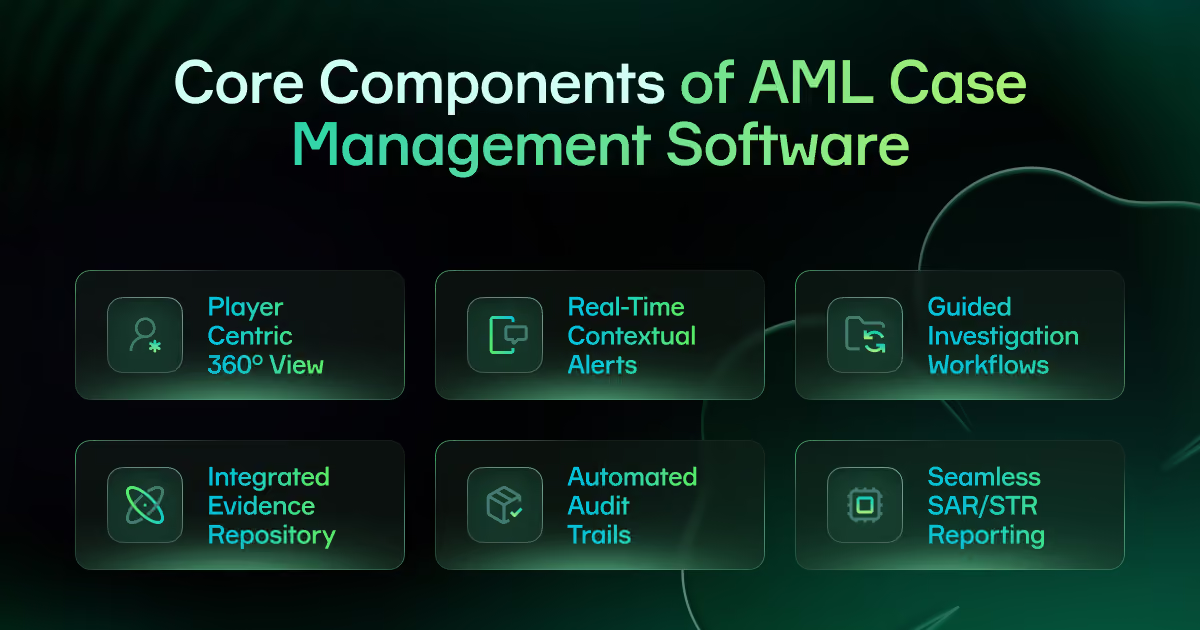
Core components of AML case management software

AML case management software works best when it aligns with how investigations are conducted. The platform needs to support how compliance analysts investigate suspicious activity while making audit readiness a natural outcome of daily work.

Player-centric case management, player profiling, and player risk assessment

A player-centric model starts with a single case file as the source of truth. Like in Criminal Code, the evidence has to be collected before any decisions. That single record brings together identity status, verification milestones, deposits, withdrawals, payment instruments, gameplay-linked risk signals, linked identifiers, past cases, and remediation outcomes, giving investigators a consolidated view from the outset.

This case file serves as the basis for player profiling by maintaining behavioural and transactional information in a single, continuous record. As behaviour changes and new information is added, the profile develops over time. Player risk assessment works effectively within this structure because updates are triggered by new signals instead of fixed review cycles.

As investigations progress, due diligence is handled within the same case file. Additional checks, outcomes, and supporting material are recorded when activity triggers review, including Source of Funds (SoF) or Source of Wealth (SoW) evidence where relevant. This preserves the audit trail and reduces the burden of proof later.

A unified case view also helps maintain consistent AML measures across brands and supports coordination when compliance and player protection concerns overlap.

Transaction monitoring system and real-time alerts

A transaction monitoring system needs to detect patterns that are easy to miss when teams focus only on single high-value events. In iGaming, suspicious activity can manifest as repeated small behaviours, rapid fund movements, unusual withdrawal timing, or a mismatch between the player profile and the transaction pattern.

Real-time alerts should open a case with the relevant context already attached. That context includes the transaction chain, the risk assessment history, and relevant player profiling notes, allowing monitoring signals to move directly into action while improving case management AML compliance.

Workflow optimisation follows from this structure. When alerts open clean cases, analysts spend less time gathering data and more time analysing it, with improvements becoming evident in both throughput and quality, especially during peak-volume periods.

Structured investigation workflow for compliance analysts

A strong workflow removes guesswork without doing away with judgment. The process guides investigations through the same sequence every time, improving quality and audit readiness.

A simple structure is often the most reliable in practice and under review. Triage the alert, confirm context in the player file, gather and store evidence, test the hypothesis against red flags, align this with the internal ‘criminal code’ of offences, document findings, then decide, escalate, or monitor. Each step logs decisions, ensuring the audit trail explains why they were made.

The same workflow also accommodates responsible gambling considerations. When protection concerns arise alongside suspicious activity, teams can record decisions in the same case file, simplifying later review.

Evidence repository, audit trail, and decision logging

Audit readiness depends on how consistently evidence is captured and stored. The evidence repository should hold documents, screenshots, transaction extracts, and investigator notes within the case file. Every item should be time-stamped, with each key action linked to the responsible analyst.

Decision logging requires clear records of what was decided and why. The audit trail should present a complete, unbroken timeline, covering internal checks, information requests, and escalation steps as they occur.

This is what turns a technical audit into a straightforward response. Instead of searching across systems, the team exports a single case record that shows the full story with supporting evidence.

SAR/STR tools and reporting workflow

Effective SAR/STR handling works best when it operates inside case handling, since the investigation record already contains the chronology, evidence, and rationale. That allows SAR/STR filing to become a controlled step in the workflow, rather than a task dependent on memory or manual copy-and-paste.

A clean approach also records decisions not to file, with clear reasoning. That matters because regulators may ask why suspicious activity did not lead to a report, and the burden of proof still applies. When SAR/STR tools are integrated, reporting becomes easier to track and simpler to review during a technical audit.

Audit readiness by design

Reliance on individual habits or personal organisation leaves gaps that only surface under scrutiny, which is why audit readiness needs to be embedded directly into the platform's operations. Built-in structure maintains evidence capture and accountability regardless of who handles a case.

A well-designed system supports AML measures for each player through time-stamped accountability, consistent evidence capture, and exports suited for regulator access. The same design allows internal audit teams to test the programme using live case data without disrupting routine operations.

Time-stamped accountability and regulator access

A technical audit often tests speed as much as quality, requiring operators to provide case records promptly with a clear timeline, clear ownership, and linked evidence.

Time-stamped actions and investigator attribution carry real weight because they show clear control and allow regulator access requests to be handled without rewriting case history.

Record keeping, retention, and technical audit exports

Effective record management depends on being able to retrieve complete case information in a clear, structured format when required. Retention discipline plays a critical role where regulatory expectations differ across jurisdictions, reinforcing consistent compliance and risk control.

Since investigations already sit within a single, case-led record, an audit-ready platform should support exports that present the full history in a format designed for regulatory review. These exports combine the player profile, audit trail, key decisions, and reporting actions, with remediation tracking maintained alongside the original findings.

Internal audit readiness and forensic audit posture

Ongoing internal reviews often test whether monitoring rules perform as intended and whether investigations are handled consistently under scrutiny. That review is easier when case records are structured, time-stamped, and clearly attributable.

The same foundation supports deeper forensic review when cases demand closer examination. Complex cases can be reconstructed directly from the audit trail, with decisions and remediation steps traceable through the recorded evidence.
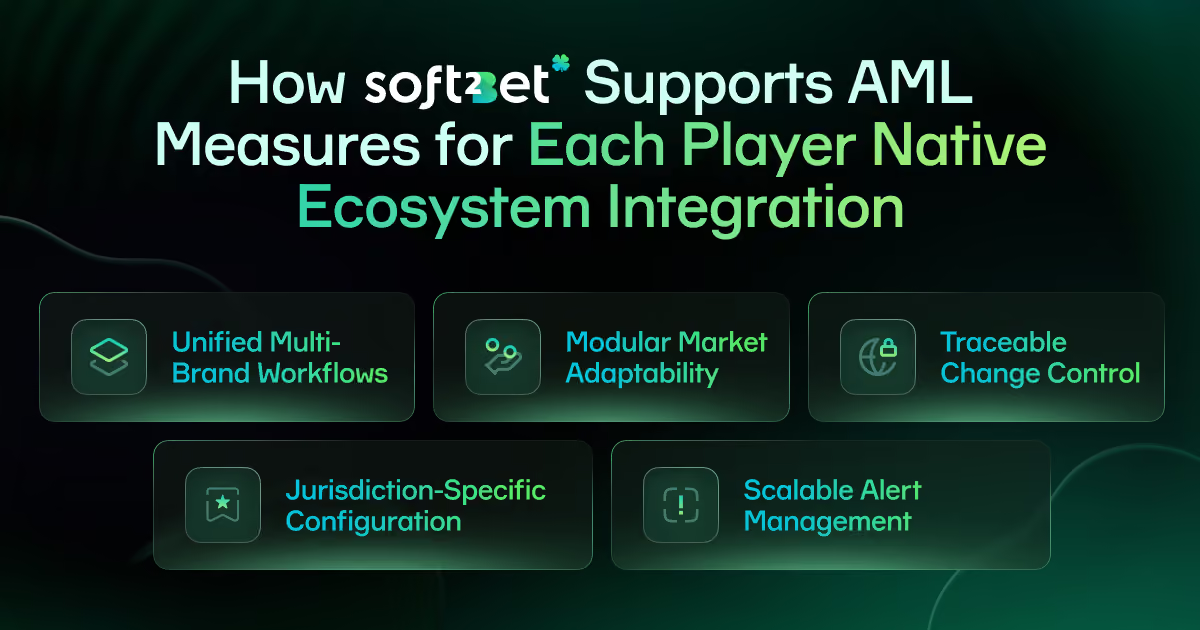
Soft2Bet integration and value for AML compliance solutions

As AML operations become more embedded into everyday workflows, integration plays a decisive role in how smoothly controls function in practice. Compliance tools tend to feel heavy when added to an existing stack rather than built into it.

Soft2Bet supports integrated case handling through a modular platform approach. The modular design allows operators to align controls with local expectations while keeping the operating process stable across brands. This consistency proves its value when the same teams manage multiple licences and need reliable handling of suspicious activity across different environments.

Native integration with the Soft2Bet ecosystem

Within the Soft2Bet ecosystem, case handling draws directly from live operational data across the player lifecycle, reducing manual effort and keeping player profiling and player risk assessment consistent.

Through this native integration, Soft2Bet also provides a shared view that supports coordination between responsible gambling and player protection teams, allowing actions to be recorded under a single audit trail without fragmenting oversight.

Unified workflows across brands and licences

Multi-brand operations struggle when each brand develops its own habits, making consistency harder to maintain across teams. A unified workflow closes that gap by ensuring the same suspicious activity pattern leads to the same review steps, evidence capture, and decision logging across brands.

Soft2Bet delivers this consistency through configurable controls that reflect local rules while keeping the core workflow stable. That stability becomes a practical advantage during a technical audit, where reviewers can see a uniform approach applied across the portfolio.

Scalability and market adaptability

Scaling compliance goes beyond headcount growth and requires maintaining consistent investigations as volume increases, while ensuring controls remain aligned as rules change across markets.

A single case-management platform supports this aim by allowing operators to maintain a single way of working while configuring market-specific requirements within the same system. The same design preserves AML measures for each player even as volumes grow.

Multi-market and multi-licence support

As operations expand across markets, differences in thresholds and documentation expectations can lead to inconsistencies when teams move between brands without a shared way of working.

A configurable platform maintains a stable operating process while allowing licence-specific adjustments where applicable. That consistency improves audit readiness, as the workflow remains familiar even as regulatory rules vary across jurisdictions.

Jurisdiction-specific configuration and change control

The configuration needs to cover risk-scoring weightings, real-time alert triggers, due diligence evidence standards, local criminal code, SoF or SoW thresholds, and how reporting obligations apply across different regimes. Change control plays a central role here, as regulators will examine when rules were updated and whether those changes were tested before implementation.

A strong system keeps a traceable record of configuration changes by linking them to the audit trail, allowing operators to show when controls changed and the rationale for those changes. That visibility becomes valuable during a technical audit and supports remediation work when gaps are identified.

Scaling alert volume without losing quality

As activity increases, alert volume grows as well, placing greater pressure on review capacity. If the platform creates too many low-value cases, teams drown. If thresholds are too high, genuine risk can pass through unnoticed.

Scalable AML case management relies on clear priorities and orderly queues, with evidence consistently captured even under pressure. Quality also improves as rules are refined over time, drawing on lessons from past investigations and internal audit reviews.

Key takeaways for iGaming operators

AML measures for each player become easier to run and defend when investigations are structured around a single case and supported by clear evidence.

  1. AML case management software is most effective when it is player-centric, since profiling, due diligence, and investigation history sit in one record

  2. A transaction monitoring system should turn real-time alerts into actionable cases by opening them with the relevant context already in place

  3. Structured workflows improve quality by ensuring compliance analysts investigate in a consistent sequence and record decisions with clear reasoning

  4. An evidence repository and a complete audit trail reduce the burden of proof during a technical audit and make regulator access responses faster, similar to how prosecutors treat criminal code in real life

  5. SAR/STR tools work best when reporting sits inside the case file, so narratives, evidence, and timelines stay aligned

  6. Soft2Bet supports AML compliance solutions that can be configured per licence while keeping the operating model consistent across brands and markets

FAQ

What is AML case management software in iGaming?

AML case management software turns monitoring signals into structured investigations within a single case record. The system supports AML measures for each player by bringing together profiling, risk evaluation, evidence capture, documented decisions, and a complete audit trail, allowing teams to respond to a technical audit by exporting the full case without reconstructing events.

What makes a financial crime investigation platform different from basic monitoring?

Basic monitoring flags activity, while a financial crime investigation platform manages the full path from alert to decision in accordance with the local criminal code. The platform connects real-time alerts with case handling, investigation context, evidence capture, criminal code, and SAR/STR filing within a single workflow, allowing compliance analysts to investigate suspicious activity in a consistent way and respond to regulator access requests with complete records.

What should AML compliance solutions include for iGaming operators?

Strong compliance solutions typically include case management software, transaction monitoring systems, real-time alerts, player risk assessment, player profiling, risk scoring, an evidence repository, decision logging, a complete audit trail, SAR/STR tools with integrated reporting workflows, retention controls, regulator access exports, and remediation tracking.

How do SAR/STR tools improve reporting quality?

These tools keep reports tied directly to the underlying case, using the same timeline and supporting evidence created during the investigation. That link improves accuracy and consistency, while making decisions easier to justify during a technical audit, including cases where no report was filed.

What makes a transaction monitoring system effective in online gambling?

A transaction monitoring system is effective when it detects behavioural patterns and routes them quickly into AML case management. Real-time alerts should open cases with enough context for compliance analysts to investigate clearly and record decisions in the audit trail.

What should anti-money laundering software capture for a technical audit?

Anti-money laundering software should capture the full audit trail from alert to decision, including timestamps, investigator attribution, evidence uploads, due diligence records, SoF or SoW documentation, risk scoring changes, remediation actions, and SAR/STR submission outcomes. Having this record available reduces the burden of proof when a technical audit requests historical cases.

How should player risk assessment work across the player lifecycle?

Player risk assessment should update as behaviour changes. The assessment should combine onboarding due diligence, player profiling, transaction-monitoring signals, real-time alerts, risk scoring, investigation outcomes, remediation actions, and SAR/STR decisions, where relevant. When this local ‘criminal code’ record is case-led and time-stamped, AML measures for each player become consistent, with protection and responsible gambling actions documented in the same disciplined way.

Share to:
Audit-Ready AML Case Management Software for iGaming and How Soft2Bet Supports AML Measures for Each Player

Not long ago, AML in iGaming was often handled through manual reviews at key moments and reporting that sat slightly apart from day-to-day operations. Such an approach worked when volume was lower and fewer requirements for supporting evidence existed.

Today, regulatory requirements have shifted, as operators face closer scrutiny and tighter accountability standards, particularly when decisions are reviewed post factum.

In response, audit-ready investigation and case-management platforms have moved from the margins into daily operations. These systems are designed to capture activity as it happens and preserve it in a format that can withstand later review.

This shift has changed how compliance functions operate across brands and licences, placing practical case handling and reliable record keeping at the centre of routine workflows. The following content shows how an audit-ready compliance operating model is applied in practice through structured case handling and integrated monitoring.

Regulatory context and industry challenge

As regulatory demands now focus on both timing and accountability, AML scrutiny in iGaming has deepened and become more stringent. Regulators and auditors expect early detection of suspicious activity, along with clear proof that decisions were reasonable when made. AML compliance solutions must meet both requirements, especially when technical audits request historical cases on short notice.

Increasing AML scrutiny in competitive iGaming markets

Online gambling involves high transaction volumes, remote onboarding, fast payments, and ongoing account activity. That mix can attract bad actors who aim to place funds and move value through accounts in ways that can look legitimate on the surface. Based on that exposure, operators are expected to spot patterns that emerge over time.

This is also why transaction monitoring system design matters so much. If monitoring focuses mainly on high-value, obvious events, suspicious activity can slip through as smaller, repeated behaviours. That creates compliance exposure and player protection risk simultaneously.

Full traceability and auditability requirements

Traceability is now essential, as a technical audit will often test whether an operator can explain the full decision-making chain for selected accounts. That chain covers the initial trigger, the investigation itself, the evidence reviewed, the reasoning applied, and any escalation.

In practice, this means the company that complies with the local Criminal Code must be able to provide an end-to-end, time-stamped, and attributable audit trail. Regulator access requests must also be responded to promptly and in a format that withstands review.

Common operator challenges under regulatory expectations

Most operators face similar pressure points, even when the policy is well-defined. Monitoring and investigations often span multiple tools, while documentation quality can vary across analysts. As a result, evidence becomes scattered across systems and harder to reconstruct when scrutiny increases.

The pattern is predictable, with suspicious activity handling slowing down as SAR (Suspicious Activity Reporting) and STR (Suspicious Transactions Report) become more difficult to track. A technical audit can then trigger remediation work that a better case structure would have prevented.

The problem with fragmented AML investigations

Fragmentation worsens outcomes: when key facts are scattered across separate systems, investigations take longer, findings are less consistent, and the burden of proof increases.

Disconnected AML, KYC, and transaction systems

In many technology stacks, KYC sits in one tool, transaction monitoring in another, customer support notes in another, and payment data is split again. That setup creates inconsistent player profiling because analysts do not always see the same inputs simultaneously.

This separation weakens AML measures for each player because suspicious activity is often pattern-based. If the case view cannot connect deposits, withdrawals, behavioural signals, and prior decisions, teams either miss risk or overcorrect, harming the player journey.

Manual investigations and inconsistent workflows

Manual case handling places undue weight on personal reporting habits across the team. One analyst documents due diligence well and captures evidence into a shared location. Another keeps evidence outside the case and writes only a short narrative. During a technical audit, that difference becomes visible.

Consistency matters because compliance analysts investigate under time pressure. Without structure, risk scoring becomes subjective, and the audit trail shows gaps in reasoning. A case management AML compliance workflow needs to guide each step so outcomes remain defensible across teams and shifts.

Limited visibility into historical decisions

A technical audit rarely focuses only on recent activity. Reviews often focus on cases from months ago, especially those where suspicious activity was escalated, closed, or monitored over time.

If those decisions were not captured in a single evidence repository with a clear audit trail, teams spend extra time rebuilding the story. That increases cost and delays regulator access responses, creating remediation work that distracts from active monitoring.

Financial crime investigation platform and solution overview

A modern financial crime investigation platform integrates AML case management software, transaction monitoring systems, SAR/STR tools, and evidence handling into a single operating layer. The system converts signals into structured cases and routes work through defined steps, preserving evidence from the first alert to the final decision.

For operators, the shift is practical because real-time alerts open a case with the relevant player profile attached, allowing risk scoring to guide priority and escalation as information is captured in a single repository throughout the investigation. SAR/STR decisions are made from the same case file, using the same timeline and supporting materials.

This operating structure supports AML measures for each player by keeping the process visible and consistent. The same structure also supports player protection and responsible gambling teams by consolidating related risk signals and actions in one place.

Core components of AML case management software

AML case management software works best when it aligns with how investigations are conducted. The platform needs to support how compliance analysts investigate suspicious activity while making audit readiness a natural outcome of daily work.

Player-centric case management, player profiling, and player risk assessment

A player-centric model starts with a single case file as the source of truth. Like in Criminal Code, the evidence has to be collected before any decisions. That single record brings together identity status, verification milestones, deposits, withdrawals, payment instruments, gameplay-linked risk signals, linked identifiers, past cases, and remediation outcomes, giving investigators a consolidated view from the outset.

This case file serves as the basis for player profiling by maintaining behavioural and transactional information in a single, continuous record. As behaviour changes and new information is added, the profile develops over time. Player risk assessment works effectively within this structure because updates are triggered by new signals instead of fixed review cycles.

As investigations progress, due diligence is handled within the same case file. Additional checks, outcomes, and supporting material are recorded when activity triggers review, including Source of Funds (SoF) or Source of Wealth (SoW) evidence where relevant. This preserves the audit trail and reduces the burden of proof later.

A unified case view also helps maintain consistent AML measures across brands and supports coordination when compliance and player protection concerns overlap.

Transaction monitoring system and real-time alerts

A transaction monitoring system needs to detect patterns that are easy to miss when teams focus only on single high-value events. In iGaming, suspicious activity can manifest as repeated small behaviours, rapid fund movements, unusual withdrawal timing, or a mismatch between the player profile and the transaction pattern.

Real-time alerts should open a case with the relevant context already attached. That context includes the transaction chain, the risk assessment history, and relevant player profiling notes, allowing monitoring signals to move directly into action while improving case management AML compliance.

Workflow optimisation follows from this structure. When alerts open clean cases, analysts spend less time gathering data and more time analysing it, with improvements becoming evident in both throughput and quality, especially during peak-volume periods.

Structured investigation workflow for compliance analysts

A strong workflow removes guesswork without doing away with judgment. The process guides investigations through the same sequence every time, improving quality and audit readiness.

A simple structure is often the most reliable in practice and under review. Triage the alert, confirm context in the player file, gather and store evidence, test the hypothesis against red flags, align this with the internal ‘criminal code’ of offences, document findings, then decide, escalate, or monitor. Each step logs decisions, ensuring the audit trail explains why they were made.

The same workflow also accommodates responsible gambling considerations. When protection concerns arise alongside suspicious activity, teams can record decisions in the same case file, simplifying later review.

Evidence repository, audit trail, and decision logging

Audit readiness depends on how consistently evidence is captured and stored. The evidence repository should hold documents, screenshots, transaction extracts, and investigator notes within the case file. Every item should be time-stamped, with each key action linked to the responsible analyst.

Decision logging requires clear records of what was decided and why. The audit trail should present a complete, unbroken timeline, covering internal checks, information requests, and escalation steps as they occur.

This is what turns a technical audit into a straightforward response. Instead of searching across systems, the team exports a single case record that shows the full story with supporting evidence.

SAR/STR tools and reporting workflow

Effective SAR/STR handling works best when it operates inside case handling, since the investigation record already contains the chronology, evidence, and rationale. That allows SAR/STR filing to become a controlled step in the workflow, rather than a task dependent on memory or manual copy-and-paste.

A clean approach also records decisions not to file, with clear reasoning. That matters because regulators may ask why suspicious activity did not lead to a report, and the burden of proof still applies. When SAR/STR tools are integrated, reporting becomes easier to track and simpler to review during a technical audit.

Audit readiness by design

Reliance on individual habits or personal organisation leaves gaps that only surface under scrutiny, which is why audit readiness needs to be embedded directly into the platform's operations. Built-in structure maintains evidence capture and accountability regardless of who handles a case.

A well-designed system supports AML measures for each player through time-stamped accountability, consistent evidence capture, and exports suited for regulator access. The same design allows internal audit teams to test the programme using live case data without disrupting routine operations.

Time-stamped accountability and regulator access

A technical audit often tests speed as much as quality, requiring operators to provide case records promptly with a clear timeline, clear ownership, and linked evidence.

Time-stamped actions and investigator attribution carry real weight because they show clear control and allow regulator access requests to be handled without rewriting case history.

Record keeping, retention, and technical audit exports

Effective record management depends on being able to retrieve complete case information in a clear, structured format when required. Retention discipline plays a critical role where regulatory expectations differ across jurisdictions, reinforcing consistent compliance and risk control.

Since investigations already sit within a single, case-led record, an audit-ready platform should support exports that present the full history in a format designed for regulatory review. These exports combine the player profile, audit trail, key decisions, and reporting actions, with remediation tracking maintained alongside the original findings.

Internal audit readiness and forensic audit posture

Ongoing internal reviews often test whether monitoring rules perform as intended and whether investigations are handled consistently under scrutiny. That review is easier when case records are structured, time-stamped, and clearly attributable.

The same foundation supports deeper forensic review when cases demand closer examination. Complex cases can be reconstructed directly from the audit trail, with decisions and remediation steps traceable through the recorded evidence.

Soft2Bet integration and value for AML compliance solutions

As AML operations become more embedded into everyday workflows, integration plays a decisive role in how smoothly controls function in practice. Compliance tools tend to feel heavy when added to an existing stack rather than built into it.

Soft2Bet supports integrated case handling through a modular platform approach. The modular design allows operators to align controls with local expectations while keeping the operating process stable across brands. This consistency proves its value when the same teams manage multiple licences and need reliable handling of suspicious activity across different environments.

Native integration with the Soft2Bet ecosystem

Within the Soft2Bet ecosystem, case handling draws directly from live operational data across the player lifecycle, reducing manual effort and keeping player profiling and player risk assessment consistent.

Through this native integration, Soft2Bet also provides a shared view that supports coordination between responsible gambling and player protection teams, allowing actions to be recorded under a single audit trail without fragmenting oversight.

Unified workflows across brands and licences

Multi-brand operations struggle when each brand develops its own habits, making consistency harder to maintain across teams. A unified workflow closes that gap by ensuring the same suspicious activity pattern leads to the same review steps, evidence capture, and decision logging across brands.

Soft2Bet delivers this consistency through configurable controls that reflect local rules while keeping the core workflow stable. That stability becomes a practical advantage during a technical audit, where reviewers can see a uniform approach applied across the portfolio.

Scalability and market adaptability

Scaling compliance goes beyond headcount growth and requires maintaining consistent investigations as volume increases, while ensuring controls remain aligned as rules change across markets.

A single case-management platform supports this aim by allowing operators to maintain a single way of working while configuring market-specific requirements within the same system. The same design preserves AML measures for each player even as volumes grow.

Multi-market and multi-licence support

As operations expand across markets, differences in thresholds and documentation expectations can lead to inconsistencies when teams move between brands without a shared way of working.

A configurable platform maintains a stable operating process while allowing licence-specific adjustments where applicable. That consistency improves audit readiness, as the workflow remains familiar even as regulatory rules vary across jurisdictions.

Jurisdiction-specific configuration and change control

The configuration needs to cover risk-scoring weightings, real-time alert triggers, due diligence evidence standards, local criminal code, SoF or SoW thresholds, and how reporting obligations apply across different regimes. Change control plays a central role here, as regulators will examine when rules were updated and whether those changes were tested before implementation.

A strong system keeps a traceable record of configuration changes by linking them to the audit trail, allowing operators to show when controls changed and the rationale for those changes. That visibility becomes valuable during a technical audit and supports remediation work when gaps are identified.

Scaling alert volume without losing quality

As activity increases, alert volume grows as well, placing greater pressure on review capacity. If the platform creates too many low-value cases, teams drown. If thresholds are too high, genuine risk can pass through unnoticed.

Scalable AML case management relies on clear priorities and orderly queues, with evidence consistently captured even under pressure. Quality also improves as rules are refined over time, drawing on lessons from past investigations and internal audit reviews.

Key takeaways for iGaming operators

AML measures for each player become easier to run and defend when investigations are structured around a single case and supported by clear evidence.

  1. AML case management software is most effective when it is player-centric, since profiling, due diligence, and investigation history sit in one record

  2. A transaction monitoring system should turn real-time alerts into actionable cases by opening them with the relevant context already in place

  3. Structured workflows improve quality by ensuring compliance analysts investigate in a consistent sequence and record decisions with clear reasoning

  4. An evidence repository and a complete audit trail reduce the burden of proof during a technical audit and make regulator access responses faster, similar to how prosecutors treat criminal code in real life

  5. SAR/STR tools work best when reporting sits inside the case file, so narratives, evidence, and timelines stay aligned

  6. Soft2Bet supports AML compliance solutions that can be configured per licence while keeping the operating model consistent across brands and markets

FAQ

What is AML case management software in iGaming?

AML case management software turns monitoring signals into structured investigations within a single case record. The system supports AML measures for each player by bringing together profiling, risk evaluation, evidence capture, documented decisions, and a complete audit trail, allowing teams to respond to a technical audit by exporting the full case without reconstructing events.

What makes a financial crime investigation platform different from basic monitoring?

Basic monitoring flags activity, while a financial crime investigation platform manages the full path from alert to decision in accordance with the local criminal code. The platform connects real-time alerts with case handling, investigation context, evidence capture, criminal code, and SAR/STR filing within a single workflow, allowing compliance analysts to investigate suspicious activity in a consistent way and respond to regulator access requests with complete records.

What should AML compliance solutions include for iGaming operators?

Strong compliance solutions typically include case management software, transaction monitoring systems, real-time alerts, player risk assessment, player profiling, risk scoring, an evidence repository, decision logging, a complete audit trail, SAR/STR tools with integrated reporting workflows, retention controls, regulator access exports, and remediation tracking.

How do SAR/STR tools improve reporting quality?

These tools keep reports tied directly to the underlying case, using the same timeline and supporting evidence created during the investigation. That link improves accuracy and consistency, while making decisions easier to justify during a technical audit, including cases where no report was filed.

What makes a transaction monitoring system effective in online gambling?

A transaction monitoring system is effective when it detects behavioural patterns and routes them quickly into AML case management. Real-time alerts should open cases with enough context for compliance analysts to investigate clearly and record decisions in the audit trail.

What should anti-money laundering software capture for a technical audit?

Anti-money laundering software should capture the full audit trail from alert to decision, including timestamps, investigator attribution, evidence uploads, due diligence records, SoF or SoW documentation, risk scoring changes, remediation actions, and SAR/STR submission outcomes. Having this record available reduces the burden of proof when a technical audit requests historical cases.

How should player risk assessment work across the player lifecycle?

Player risk assessment should update as behaviour changes. The assessment should combine onboarding due diligence, player profiling, transaction-monitoring signals, real-time alerts, risk scoring, investigation outcomes, remediation actions, and SAR/STR decisions, where relevant. When this local ‘criminal code’ record is case-led and time-stamped, AML measures for each player become consistent, with protection and responsible gambling actions documented in the same disciplined way.

Share to: