


%202.avif)
Market entries are often full of risks and challenges and can also be costly for new operators, as business and regulatory costs clash with the urgent need to generate revenues. While those point to some unchanging business fundamentals, iGaming success has evolved considerably and in 2026 it is no longer about the size of the marketing budget, but rather the flexibility, scale and compliance of the underlying tech stack.
Without question, launching an iGaming brand is less of a gold rush and more of a calculated risk than it might have been 10 or 15 years ago. Priorities have also changed - the industry’s most widespread and trusted mode of operation was to aggressively target user acquisition, but a modern strategy for entry into an iGaming market now hinges as much on how an operator deals with the fine print of local regulations as it does coming up with clever marketing slogans and acquisition campaigns.
The "move fast and break things" approach long favoured by startups has largely been replaced by technical and implementation expertise, with regulatory standards often dictating the pace of growth before a single bet is even placed.
In Europe, the appeal of strong economies remains, yet entering new markets presents an evolving set of challenges. This is reflected in the high standards required for bonus structures, player protection and advertising. While Europe’s online gaming and betting market reached an impressive €47.9bn in 2024, launching into new territories requires a strategic approach to balance growth with long-term stability.
As mentioned, new entrants can face a brutal reality between balancing out high costs and the need to generate revenues and many fail or face considerable struggles during their first years of operation. The cause is rarely a lack of player interest; instead, it is a combination of high costs, aggressive marketing spend and failing to account for immediate regulatory and compliance requirements. In many markets, operators spend millions on brand awareness only to find their funnels choked by rigid know your customer (KYC) requirements, affordability checks or deposit limits.
Why are early years so risky for operators in new markets? Reasons are numerous, but many operators fail to reach their revenue targets because they don’t account for regulatory and compliance issues that can result in hefty fines. In 2019, within just five months of receiving their licenses in Sweden, three major operators were hit with combined fines of SEK 19 million (approximately $2 million) for violating strict bonus regulations. The regulator (Spelinspektionen) penalized the firms for offering unauthorized incentives, demonstrating that even industry giants can falter when adapting to the rigorous compliance standards of a newly regulated territory.
The reason so many operators get caught out, including many of the biggest names in the industry, is because their tech stacks are not built for the strict online gambling regulations that are now being applied to European companies.
By the time a brand adjusts its platform to meet these local nuances, its marketing budget has been incinerated on a high-churn user base that cannot be properly onboarded or retained. The result is a "marketing burn" that outpaces the lifetime value (LTV) of players. Some companies address the issue by taking shortcuts to their responsible gambling ‘duty of care’ obligations and, while these can help maintain certain levels of player spend, they also eventually lead to regulatory investigations and financial penalties that can be significant.
Indeed, in 2026 success is defined as much by the companies that view compliance as a way optimise their operations and provide players with high quality engagement and user experiences - as it is for those wanting to gain a competitive edge through clever marketing campaigns or slogans that generate media and consumer attention. However, the shift from clunky builds towards modern and modular platforms that allow operators to plug into specific markets or regions with strong localisation tools is now baked in.
For new brands, the choice often comes down to two paths:
The era of winning through the sheer size of a marketing budget is over. In 2026, operators that rely on a flexible, compliance-ready tech stack and can leverage a robust B2B iGaming platform will navigate the fragmented regulatory map of Europe with agility, ensuring that their first year of operations is spent building a loyal player base rather than fighting regulatory emergencies.
.avif)
The "180-Day Launch Cycle"
Most operators fail to reach profitability within their first three years and, while this is often related to general business cycles - in other words the time it takes a new company to be profitable and generate returns and dividends for shareholders, new operators can also enter what’s knows as a "marketing vacuum."
This can be illustrated by the ‘Bonus paradox’. In jurisdictions like Ontario, Canada, operators are legally barred from advertising bonuses or inducements publicly; they can only do that once players have signed up and opened accounts and are already ‘in the system’. Meanwhile in Sweden, the "one-bonus rule" means operators can only send one bonus offer to players, which means that if, for whatever reason, the customer onboarding journey is not perfect or the player churns, an iGaming brand cannot use promotions or bonuses to win them back.
Compounding this is the pressure that comes from taxes and operators wanting to generate margins. With taxes on gross gaming revenues (GGR) of 22% in Sweden and 28% in Denmark, there is little room for operational inefficiencies or wasting onboarding opportunities. It means ‘trial and error’ strategies are out of the question as they cause expenses to increase. If an iGaming platform is not optimised to handle these issues quickly and automatically, operators’ marketing spend effectively subsidizes the state rather than your growth.
Furthermore, localisation friction can create significant technical issues. Integrating local ID systems like Finland’s TUPAS or Sweden’s BankID is no longer optional and is the baseline for consumer trust. Failing to meet specific responsible gambling telemetric requirements, such as real-time loss tracking and mandatory breaks, can lead to fines or license suspensions before an iGaming brand has even had a chance to establish itself.
As the iGaming industry moves further into 2026, the European map is being redrawn by two of its most anticipated regulatory shifts. For operators seeking a resilient iGaming market entry strategy, Finland and Ireland represent the next frontier. However, these are not "plug-and-play" territories; success in these jurisdictions requires a tech-first approach centered on a flexible B2B iGaming platform.
Finland: Moving towards a post-monopoly market
Finland is currently executing one of the most significant pivots in Nordic gaming history. After decades under the Veikkaus monopoly, the Finnish Parliament has approved a transition to a multi-license model. As of early 2026, the window for B2C license applications is officially open, with the market expected to fully go live in mid-2027.The Finnish model is characterised by its "moderate" approach to marketing.
Key features include:
For brands entering Finland, a turnkey solution must be more than a skin; it needs a pre-integrated "compliance engine" that can handle Finland’s specific telemetry and reporting requirements without manual intervention.
Ireland: The holy GRAI
Similar to the reforms in Finland, Ireland has replaced its fragmented 20th-century laws with the Gambling Regulation Act.The newly established Gambling Regulatory Authority of Ireland (GRAI) is now the sole supervisor of the market, bringing a level of structure previously unseen in the Republic.
Operating in Ireland in 2026 demands a lean, high-performance tech stack that is able to deal with to several "high-friction" requirements:
The role of the B2B iGaming platform
In both markets, the margin for error is razor-thin. Taxes on GGR taxes (proposed at 22% in Finland) and strict compliance audits mean that being in ‘technical debt’ can be costly, or even terminal for companies that do not have a tight control on costs, tech and resources. Operators are increasingly moving toward specialised casino compliance software that automates the monitoring of player behaviour and financial triggers.
The most successful brands in 2026 will be those that treat their B2B iGaming platform as a strategic partner rather than just a software vendor. Whether it is managing the ‘bonus paradox’ in Finland or the advertising watershed in Ireland, the winners will be the ones whose technology is built to adapt, harness and strive within these new regulations.
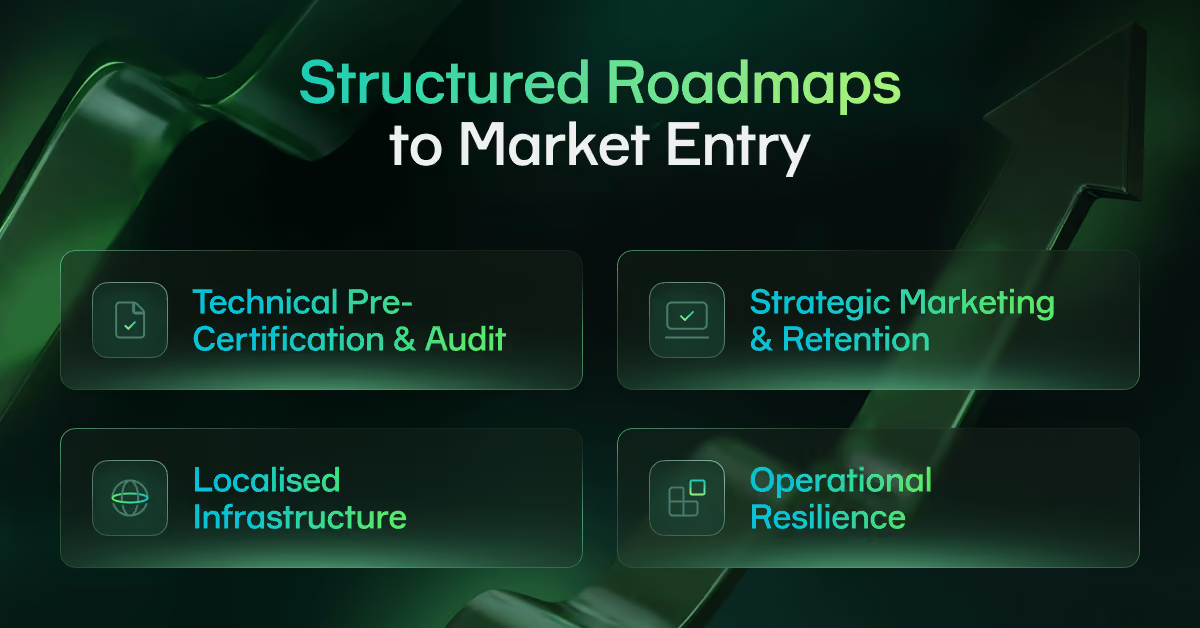
iGaming companies can no longer afford to ‘launch and learn’ in 2026. With regulators in markets like Finland and Ireland now demanding real-time compliance data, the margin for operational error has vanished. To survive the critical first 180 or even 365 days, operators must replace guesswork with a high-precision, pre-certified roadmap.
1. Technical pre-certification & audit
Before a single player registers, a comprehensive ‘Regulatory gap analysis’ is mandatory. Such work can be time-consuming and in some cases assess many hypothetical scenarios, but it can also act as a highly valuable legal and technical stress test that can flag up problems early. Operators must ensure the pre-certification of their technical stack covers local technical standards over issues like random number generators (RNG) or specific "Sports betting protocols" (such as the approved list of events that can be offered or how bets are recorded) that dictate how wagers are logged.
For brands to be successful in these high volume, high velocity environments, specialised casino compliance software that provides continuous compliance audits are now a must-have for operators that work under near-constant regulatory scrutiny. As European laws shift, for instance covering topics such as slot spin speeds and financial risk assessments, these AI-driven platforms update their core systems automatically. This prevents the compliance or technical debt that often forces smaller brands to go offline for weeks to recode their systems.
2. Localised infrastructure
Winning a new market requires a technical infrastructure that feels domestic. This begins with local ID and payment integrations. In Finland, integrating with national digital IDs (like TUPAS) and mobile-first payment gateways like Zimpler is the only way to achieve friction-free onboarding.
Localisation also extends to content curation. In the Finnish market, a platform must prioritise offering sports like ice hockey and other winter sports such as ski jumping over generic global markets to resonate with local bettors. Crucially, this must be underpinned by a proactive compliance automation layer that enables operators’ RG teams to predict and address harm rather than having to report it. Flagging problematic play patterns through behavioural analytics before they trigger a regulatory inquiry or heavy fines is an obvious choice to make for iGaming companies in 2026.
3. Strategic marketing and retention
Traditional or edgy advertising can create a media buzz, but also faces increased scrutiny, criticism and potential sanctions in 2026 as iGaming market entry strategies have shifted toward early, ‘warm-up’ branding campaigns that allow operators to build trust levels through sponsorships, influencer-led and localised content months before the site goes live.
Once operational, the focus can turn toward a gamified loyalty architecture. Since jurisdictions like Sweden and Finland restrict traditional bonuses (the "one-bonus rule"), operators must reward players through non-monetary value. Using XP levels, badges and progress bars allows a brand to foster deep engagement and long-term loyalty without violating strict "no-public-inducement" regulations. This turns the platform into a social experience rather than just a gaming shop.
4. Operational resilience
The final pillar of success is a comprehensive crisis management strategy. From self-exclusion register glitches to tax hikes , an operator that is not prepared for such eventualities can face significant or even terminal challenges.
Partnering with a provider that offers a robust B2B iGaming platform or turnkey solution provides an essential safety net. These partners offer built-in disaster recovery and regulatory shielding, ensuring that if a local server fails or a legal requirement is updated, the business remains operational. In a year defined by high taxes and strict oversight, this technical flexibility is the ultimate competitive advantage.
Conclusion
Marketing remains a key component of operational success, but in 2026 it is no longer enough on its own and operators that prioritise a compliance-ready tech stack that is also flexible and can deliver scale. By leveraging a robust B2B iGaming platform, gaming brands can navigate the fragmented regulatory map of Europe with agility, ensuring that their first, crucial years of operating are spent building a loyal player base that will generate sustainable revenues while Soft2Bet manages the demanding regulatory requirements that make the European iGaming landscape.
The variety of individual markets’ regulatory environments means that in 2026 operators’ technical infrastructures must be flexible and able to pivot to new technical settings without a total system overhaul is the ultimate differentiator. This is where Soft2Bet’s Motivational Engineering Gaming Application (MEGA) solution provides a decisive competitive edge.
The cornerstone of Soft2Bet’s strategy and MEGA’s strength is its modular architecture. Unlike legacy systems that require months of hard-coding for every new jurisdiction, the MEGA platform is built on a centralised, plug-and-play backend. This allows operators to "toggle" jurisdiction-specific compliance layers instantly.
For example, an operator launching in Ireland can automatically enforce the 5:30am-9:00pm advertising watershed and integrate the National Self-Exclusion Register with a single API update. By isolating the core gaming logic from the regulatory frontend, Soft2Bet allows brands to localise their iGaming market entry strategy in weeks rather than months, quarters or semesters, drastically reducing the "time-to-market" friction that can cause so many problems for startups and new entrants.
Gamification as a compliance advantage
One of the most innovative features of the MEGA engine is how it navigates the ‘Bonus paradox’ found in markets like Sweden or Ontario (Canada). To address this, Soft2Bet leverages its Gamified Loyalty Architecture through its In-game Shop and City Builder mechanics.
Soft2Bet’s Automated Defensive Stack (ADS)
Speed plays a key role in enhancing player safety and iGaming compliance. In 2026 and Soft2Bet’s B2B iGaming platform includes an Automated Defensive Stack that is powered by AI-driven casino compliance software and optimises player onboarding thanks to:
By automating these "defensive" tasks, Soft2Bet’s proactive tech stack ensures that a brand doesn't just enter a market like Ireland or Finland - it enables it to focus on the essentials: building customer loyalty through quality content and fostering sustainable, long term growth.
Q: How can operators legally offer incentives in markets with strict bonus limits?
A: In markets like Sweden or Ontario (Canada), where traditional "deposit-match" bonuses are either restricted to a one-time use or barred from public advertising, operators are pivoting toward non-monetary value exchange. Using Soft2Bet’s MEGA engine, brands can implement a "Mission-to-Shop" cycle. Instead of a prohibited bonus, players earn virtual currency by completing in-game achievements (e.g., "win 5 rounds on a local slot"). This currency is then spent in a localized In-game Shop for skins, avatars, or loyalty points. This allows the operator to maintain high engagement and provide rewards that are compliant with "one-bonus" or "no-public-inducement" rules.
Q: What are the biggest risks when entering the European iGaming markets?
A: The three primary risks in 2026 are compliance challenges, margins being squeezed, and technical debt, when operators’ tech platforms have not been updated and are lagging behind regulatory evolutions.
Q: How does a modular platform like MEGA reduce Time-to-Market?
A: Soft2Bet’s modular platform operates on a "Plug-and-Play" basis rather than a "Full-Build" basis. Instead of building a unique platform for newly-regulated markets, Soft2Bet operators use a single, centralised backend. They can then toggle specific jurisdictional layers such as local payment gateways (e.g., BankID), localised sports and specific tax-reporting modules without touching the core code. This reduces the time-to-market from 12–18 months down to just a few weeks, allowing operators to launch and gain from their first-mover advantage.
Q: What rules will make market entry easier and reduce the risks?
A number regulatory frameworks are specifically designed to reduce operational risk and speed up the onboarding process in 2026:
Q: Which European jurisdictions are considered high-priority target markets for 2026?
Based on regulatory readiness and market volume, two jurisdictions have emerged as being of particular interest:
.svg)
.svg)



.png)


.png)
.png)
.png)