



Retention through cosmopoiesis and world-building gamification
The economics of online gaming are entering a period of diminishing returns. Customer acquisition costs continue to rise across markets, welcome bonuses have become increasingly commoditised, and customer relationship management (CRM) programmes are locked in an escalating cycle of promotional incentives. Operators are spending more simply to maintain the status quo. The result is a widening disconnect between Gross Gaming Revenue (GGR) growth and long-term profitability: wagering volumes may be increased, but the cost of generating that activity often rises faster.
In online gaming operations, Gross Gaming Revenue (GGR) is driven primarily by wagering volume and underlying game hold, meaning the difference between what players stake and what they win before operational costs are applied. As a result, most operators do not optimise for GGR in isolation; but they optimise for a combination of acquisition volume, conversion efficiency, and post-deposit behaviour.
The commercial reality is that higher engagement does not automatically translate into profit unless the cost of that engagement is tightly controlled at the NGR level. Most operator strategies have therefore focused on optimising individual stages of the player lifecycle: marketing teams acquire traffic, CRM teams reactivate dormant players, and product teams encourage repeat deposits through bonuses, loyalty schemes and promotional mechanics.
Traditional points, badges and leaderboards are starting to lose structural impact in mature iGaming markets. Players already understand the mechanics. Bonuses feel interchangeable, and engagement tends to spike briefly before flattening out. What is emerging instead is a shift away from reward systems towards persistent digital environments that players inhabit over time.
The shift is not unique to gambling. Across the wider digital economy, competitive advantage has increasingly migrated from transactional products towards persistent ecosystems. Whether in online games, subscription platforms or creator communities, users are less likely to abandon environments in which they have accumulated identity, progress and ownership. Rather than repeatedly acquiring attention, the most successful digital businesses now compound engagement over time. The question is no longer whether this logic applies to iGaming, but how quickly operators adapt it. Soft2Bet operates within this broader transition, offering one of the more developed implementations of persistent, system-driven engagement in the sector.
This is the logic of cosmopoiesis, the structured creation of digital “worlds” in which engagement is not triggered by rewards alone but produced through the persistence of the system itself. Originally used to describe the construction of coherent and self-sustaining “worlds” in other contextual domains, cosmopoiesis is here applied as an analytical lens to gamification systems in online gaming environments.
Soft2Bet’s MEGA (Motivational Engineering Gaming Application) ecosystem can be viewed through this framework, where gamification is no longer an overlay on gameplay but an environment that continuously constructs itself around the user.
Taken together, MEGA 11 and MEGA Islands represent two expressions of cosmopoiesis within the same ecosystem. MEGA 11 constructs competitive identity through structured progression, MEGA Islands constructs continuity through accumulation and ownership, and the predictive engine ensures both remain dynamically responsive. The result is a shift from isolated engagement mechanics toward persistent world systems, where retention is not driven by rewards but by the ongoing existence of a world the player has already helped build.
However, the marginal effect of progression systems is likely to diminish over time as users internalise the structure of advancement. Once progression becomes predictable, it risks shifting from behavioural motivation to behavioural routine, at which point retention stabilises rather than compounds. In this sense, world-building does not eliminate churn; it reshapes its timing curve.
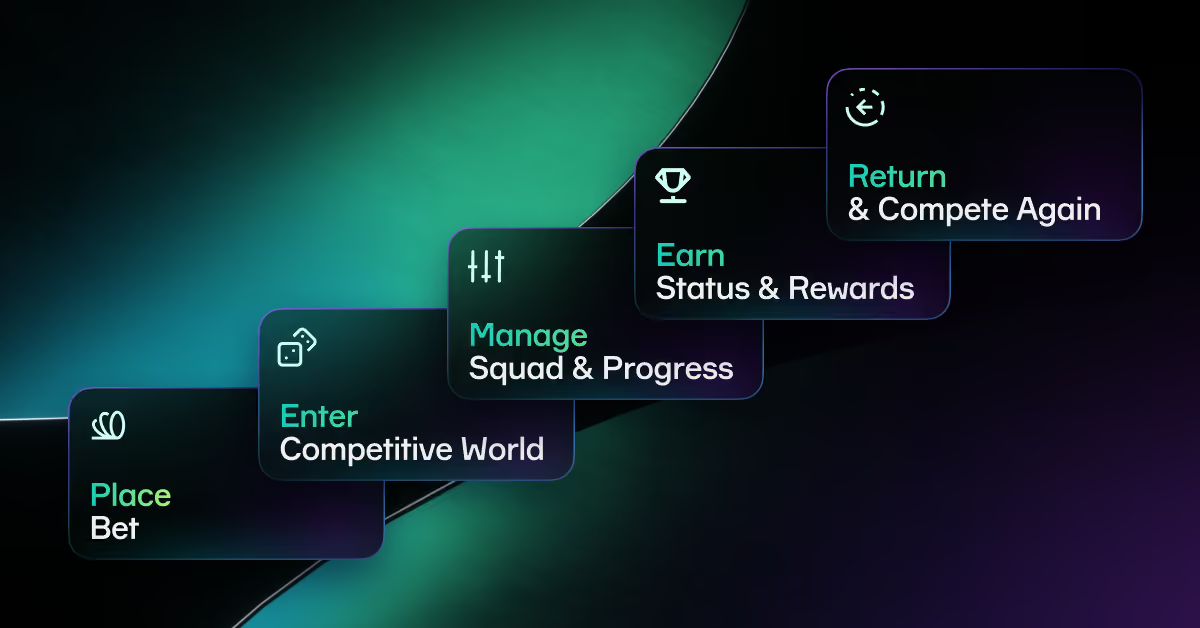
MEGA 11 illustrates cosmopoiesis through competitive world-building anchored in football behaviour. A user might place a weekend accumulator as usual, but instead of exiting the experience once the bet is placed, they remain inside a parallel competitive structure. Over the week, that same user returns to adjust a fantasy-style squad, accumulate progression points linked to betting activity, and advance through tiered status levels that reflect ongoing participation. Players accumulate status over time through repeated participation within a structured competitive hierarchy.
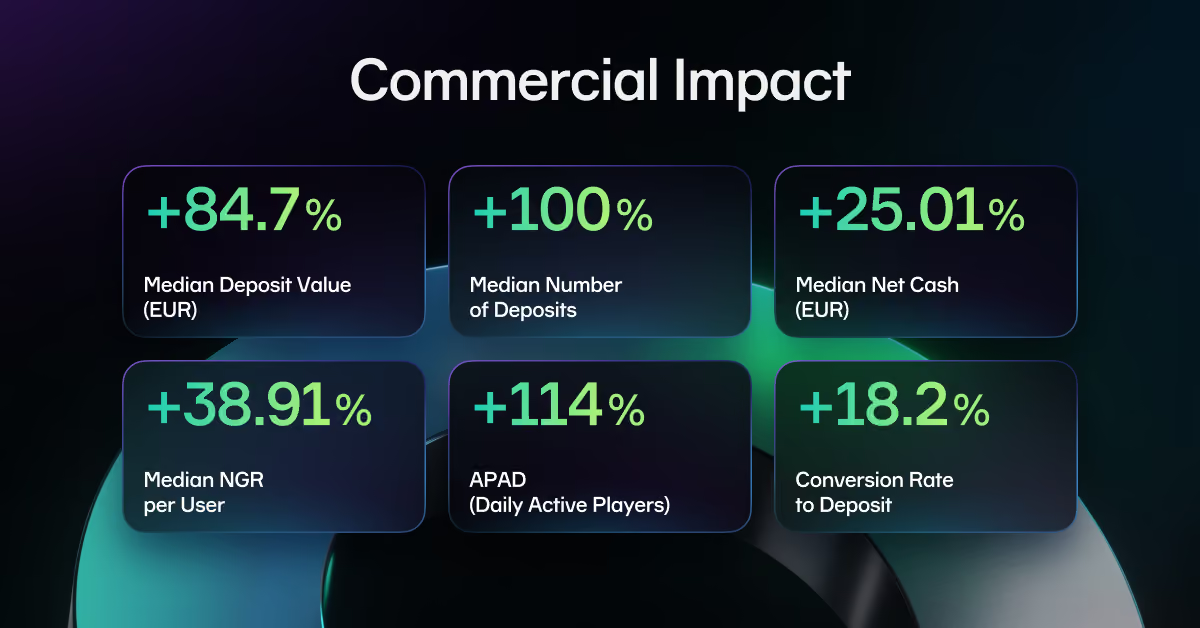
The behavioural shift is reflected in commercial performance. By extending engagement beyond individual betting sessions, MEGA 11 encourages users to return more frequently, deepen their participation and generate greater lifetime value. Rather than producing a short-lived promotional uplift, the system transforms engagement into an ongoing progression loop that supports both retention and revenue growth. Following deployment, median deposits in euro terms increased by 84.7 %, while the number of deposits doubled. Net Cash rose by 25.01 % and median Net Gaming Revenue per user increased by 38.91 %. Daily active players grew by 114 %, while conversion from registration to first deposit improved by 18.2 %. Taken together, these indicators suggest that persistent progression encourages not only more frequent play but also greater commercial commitment from existing users.
However, the marginal impact of progression systems is unlikely to remain linear over time. Early engagement gains are driven by novelty and structural clarity, but as users internalise the logic of progression, the system risks shifting from motivational to habitual. At that point, behavioural uplift stabilises rather than compounds, and retention improvements become increasingly dependent on incremental design adjustments rather than structural effects. In this sense, world-building does not eliminate churn; it redistributes it across a longer temporal curve.
Source: Soft2Bet. This data demonstrates that commercial logic is straightforward: when players return to protect or improve their position within an evolving competitive environment. Every additional session creates further opportunities to deposit, wager and re-engage.
If engagement increasingly originates inside product architecture rather than marketing campaigns, operators may need to rethink how capital is allocated. Investment shifts away from promotional budgets towards product engineering, behavioural analytics and progression design. The competitive battleground moves from who can spend more acquiring players to who can retain them more efficiently through product itself.
MEGA Islands expresses the same logic through creative world-building. Where MEGA 11 builds competitive identity through status and progression, MEGA Islands cultivates a sense of digital ownership, encouraging players to return not to defend their rank, but to expand, personalise and preserve a virtual world they increasingly perceive as their own.
A casual casino player enters short, habitual sessions, yet each interaction contributes to the construction of a personal environment. At product level, progression is embedded into gameplay loops. At data level, interactions are stored as persistent progression state. Economically, this reduces churn sensitivity by increasing switching costs and extending lifetime value. A spin or game session generates resources that are reinvested into a growing island rather than immediately consumed. Buildings are constructed, upgraded, and preserved between sessions, meaning the player returns not to a world shaped by their prior behaviour.
The more significant effect is perceived loss aversion. Players are not only leaving a system; they are abandoning a partially completed identity narrative. This introduces an emotional friction layer that traditional CRM systems cannot replicate because it is not incentive-based, but history-based.
The effect is economic rather than aesthetic: it increases switching costs and improves lifetime value by reducing churn sensitivity. In cosmopoietic terms, user actions are accumulated into persistent system state rather than discrete rewards. It accumulates user behaviour into an evolving environment that retains memory of prior activity.
Maintaining these persistent worlds requires continual adaptation. The MEGA system is coordinated through a predictive layer that functions as the operating engine of this world-building logic. The predictive engine continuously reshapes the world itself, altering pacing, challenge and reward structures so that each player experiences an environment calibrated to sustain long-term engagement.
Lower-engagement users may be guided through simplified pathways that reduce friction, while higher-value players encounter deeper and more demanding progression loops designed to sustain ongoing participation. In operational terms, prediction governs how content, difficulty, and progression are sequenced across user groups, effectively determining the structure of the player experience over time rather than simply responding to behaviour.
Economically, prediction reallocates promotional expenditure away from broad segmentation and towards behavioural precision. Rather than offering identical incentives across cohorts, the platform adjusts progression intensity according to predicted churn risk and expected lifetime value. In effect, the predictive engine functions as a capital-allocation mechanism, determining where engagement investment produces the highest future return.
Churn remains the industry's hidden tax. Monthly attrition rates of around 10–15% force operators into an expensive cycle of replacing players almost as quickly as they acquire them.
Traditional models attempt to reverse churn once it has begun. World-building systems are designed to prevent it in the first place by giving players an ongoing sense of progress, identity and continuity that extends beyond any single betting session. The economics are unforgiving: acquiring a new player can cost several times more than retaining an existing one, yet early-stage friction, from bonus complexity to weak onboarding loops, ensures that retention is structurally under-optimised across much of the sector.
Even marginal improvements in retention have outsized effects on profitability, with industry estimates suggesting that a 5% increase in retention can lift profits by 25% to 95%. In that context, churn is not a marketing inefficiency; it is the primary constraint on scalable GGR.
This is where the logic of cosmopoiesis becomes relevant. In a traditional model, churn is treated as a commercial leak to be patched through CRM, bonuses, or reactivation campaigns. In a world-building framework such as MEGA, it becomes a design variable embedded into the product itself. Retention is no longer an outcome of marketing intensity but a function of iGaming platform architecture.
If the system continues to evolve, competitively in MEGA 11, or cumulatively in MEGA Islands, then disengagement is no longer a neutral exit, but a loss of position within an ongoing world. Instead, disengagement becomes a loss of accumulated position within a persistent system where value builds through continued presence. The shift is subtle but important: from managing churn as a marketing metric to designing it out through system architecture.
The playbook and CRM system have traditionally operated as two separate layers of the same monetisation stack: one embedded in the product through mechanics such as points, bonuses, and progression loops, and the other sitting externally as a behavioural control system that tries to stabilise engagement after the fact. In practice, gamification is designed to stimulate short-term interaction, while CRM is designed to correct for decay through segmentation, messaging, and reactivation.
CRM does not disappear in this model, but its marginal cost of retention rises relative to product-native progression systems. As engagement is increasingly generated within the product architecture itself, externally induced reactivation requires progressively higher incentive spend to achieve the same behavioural response, creating a widening efficiency gap between product-led and marketing-led retention.
This creates a structural imbalance where engagement is repeatedly “restarted” rather than continuously sustained. Even when both systems are sophisticated, they still rely on periodic incentives to prevent churn rather than designing engagement persistence into the core environment. Within a cosmopoietic framework like MEGA, this separation begins to dissolve: gamification becomes the operating system of the product world itself, while CRM shifts from being a recovery tool to a reinforcement layer that supports an already self-sustaining behavioural system.
The same behavioural logic is visible in MEGA Shoot, albeit in compressed form. Rather than relying on standalone promotional engagement, the feature embeds progression into short-cycle competitive play. Early deployment recorded a 13.5% uplift in retention, with 71.2% of players returning after a first match. Although operating on a shorter time horizon, it reinforces the same principle: retention improves when interaction is experienced as continuous. Although operating on a much shorter time horizon than MEGA 11 or MEGA Islands, MEGA Shoot demonstrates the same principle: retention improves when players perceive an experience as ongoing rather than complete after a single interaction.
Affiliate and revenue-share models sit at the core of how iGaming growth is actually financed, but they are often misunderstood as pure acquisition mechanics. In reality, every affiliate payout is a downstream claim on Net Gaming Revenue (NGR), not Gross Gaming Revenue (GGR), meaning what matters is not how much players wager, but how much value survives the full deduction waterfall of bonuses, fees, taxes, and platform costs. This is why two operators with identical GGR can end up with very different affiliate economics. The difference is not volume, but margin integrity. Seen through this lens, affiliates are not just traffic suppliers; they are embedded participants in the revenue ecosystem, sharing in the economics of player lifetime value rather than one-off acquisition.
Modern gaming monetisation is fundamentally an exercise in converting engagement into revenue over time, rather than through a single transaction. Across industry models, value is generated through a mix of in-app purchases, subscriptions, advertising, and hybrid systems that collectively extend player lifetime value (LTV). The common logic is that only a small proportion of users directly spend, but revenue scales when engagement is sustained and monetised across multiple touchpoints, whether through microtransactions, recurring access, or time-based progression systems such as battle passes.
Crucially, the most effective models are not those that maximise short-term spend, but those that balance monetisation with retention, ensuring players remain active long enough for value to compound. In iGaming, GGR reflects the same dynamic seen in modern monetisation systems, which are increasingly structured around sustained engagement rather than individual transactions.
The structural limits of legacy gamification are now visible. Points, badges and leaderboards (PBL) systems were designed for an earlier phase of digital engagement, when novelty alone could sustain user activity. In mature iGaming markets, however, that model is increasingly constrained by rising player acquisition costs (PAC), accelerating churn and a growing fatigue with bonus-led retention mechanics. The result is diminishing marginal returns from reward-based engagement strategies.
What is emerging in its place can be described as the next phase in Gamification: a shift from externally applied incentives to internally generated engagement systems. Soft2Bet is increasingly designing environments in which engagement is produced through continuity, progression and accumulated user investment. Within the cosmopoiesis framework, retention is no longer an outcome of marketing intensity but a function of product architecture. Players remain engaged not because they are repeatedly prompted, but because they are continuously progressing within a system that reflects the world they have created.
Soft2Bet’s MEGA ecosystem provides a practical expression of this transition. Through MEGA 11, engagement is reframed as competitive progression, where betting activity feeds into structured identity and status-building. Through MEGA Islands, engagement extends into creative ownership, where user activity contributes to a persistent digital environment shaped over time. Underpinning both is a predictive layer that dynamically calibrates progression intensity, aligning experience design with behavioural signals and lifetime value potential.
The commercial implication is significant. By embedding engagement within the product, it reduces reliance on promotional spend, improves conversion efficiency, and extends player lifetime value. In doing so, it challenges the traditional separation between acquisition, CRM and product, replacing it with a unified system in which engagement, retention and monetisation are continuously co-generated.
In this model, gross gaming revenue (GGR) increasingly reflects the broader evolution of modern monetisation architectures: value is compounded through sustained participation. As gamification matures into system-level design, the competitive advantage in iGaming is shifting away from promotional mechanics and towards predictive environments capable of sustaining player engagement over time.
Evidence suggests a structural reallocation of value creation in iGaming. As acquisition costs rise and traditional gamification loses marginal effectiveness, retention becomes a product of system design rather than marketing intervention. Operators that successfully integrate predictive modelling, progression architecture and persistent user environments are effectively converting engagement from a managed input into an embedded output.
In Soft2Bet’s model, GGR reflects not activity stimulated externally, but value compounded internally through continuous participation.
What is driving the shift from transactional engagement to persistent digital environments?
The shift towards persistent digital environments is being driven by a broader transformation in how digital value is created. Increasingly, value is not derived from isolated transactions but from accumulated user presence within a system. In other words, platforms are becoming more effective at retaining attention over time than repeatedly purchasing it.
This trend is visible across digital industries, including gaming, streaming and social platforms, where user retention is closely tied to accumulated identity, progress and behavioural history. OECD analysis of digital platform economies has highlighted that modern platforms generate competitive advantage through embedded user data and switching costs, which make exit from the ecosystem increasingly unattractive over time.
In parallel, research from firms such as PwC shows that live-service and recurring engagement models are outperforming traditional transactional formats in gaming markets. These models prioritise continuity over episodic interaction, reinforcing the idea that users are less responsive to discrete rewards and more responsive to systems that evolve with them.
The result is a structural shift: platforms are no longer optimising for attention capture, but for attention retention through continuity of experience.
Why is CRM becoming less effective as a primary retention tool in iGaming?
CRM is becoming less effective as a primary retention mechanism because it operates as a corrective layer rather than a structural one. Most CRM systems are designed to react to disengagement through segmentation, bonuses and reactivation campaigns. This creates a cycle in which engagement is repeatedly restarted rather than continuously sustained.
From a behavioural perspective, this limits CRM’s ability to influence long-term retention. Once a player has disengaged, CRM interventions are often competing against the absence of ongoing intrinsic motivation within the product itself. As a result, CRM becomes dependent on increasing incentive intensity, which can raise cost without necessarily improving retention quality.
Regulatory frameworks have also begun to constrain the effectiveness of incentive-heavy reactivation strategies. The UK Gambling Commission and several European regulators have emphasised the importance of reducing over-reliance on inducements, particularly where they reinforce short-term behavioural loops.
More broadly, research in digital consumer behaviour, including work referenced by McKinsey, suggests that retention is increasingly determined by product architecture rather than post-hoc marketing interventions. In this context, CRM does not disappear, but its role shifts from primary retention driver to secondary reinforcement layer.
How does behavioural science explain world-building retention systems such as MEGA?
World-building systems such as MEGA can be understood through established principles in behavioural science that explain how humans respond to progress, ownership and uncertainty. One of the most important is the endowment effect, identified by Kahneman and Thaler, which shows that individuals assign higher value to things they have created or accumulated. Another is the goal-gradient effect, which demonstrates that motivation increases as individuals perceive themselves as closer to a meaningful objective.
These effects are reinforced by variable reward structures derived from operant conditioning theory, which show that unpredictable reinforcement schedules tend to produce more sustained engagement than fixed ones. This principle has been widely documented in behavioural psychology and is often applied in game design research published in journals such as Computers in Human Behavior.
In systems like MEGA, these mechanisms are not deployed as isolated features but integrated into a continuous environment. Progress is persistent, identity is accumulated, and rewards are embedded within a system that evolves over time. This creates what can be described as behavioural ownership, where engagement is driven not just by incentives but by the perceived value of what has already been built.
Is there evidence that retention has become more economically important than acquisition in digital markets?
There is strong evidence across multiple sectors that retention has become more economically important than acquisition. In digital subscription and platform economies, growth is increasingly driven by lifetime value rather than one-off conversion events. PwC’s Global Entertainment and Media Outlook highlights the structural shift towards recurring revenue models, particularly in digital content and gaming markets.
Academic and industry research also supports this shift. Bain & Company has found that even a modest 5% improvement in retention can increase profitability by between 25% and 95%, depending on the sector, due to the compounding effect of sustained engagement. Similarly, Harvard Business Review research has long established that acquiring a new customer can be significantly more expensive than retaining an existing one, often by a multiple of five to twenty-five times.
In gaming specifically, Newzoo reports that live-service models now dominate revenue generation in many markets, reflecting a shift away from acquisition-led spikes towards long-term engagement ecosystems. This is further reinforced by regulatory constraints in markets such as the UK and parts of Europe, where restrictions on bonuses and advertising reduce the effectiveness of pure acquisition strategies.
Taken together, these dynamics suggest that retention is no longer a secondary optimisation problem, but the central driver of profitability in mature digital markets.
What does the MEGA model illustrate about the future structure of digital monetisation?
The MEGA model illustrates a broader shift in digital monetisation from incentive-driven engagement to environment-driven engagement. Traditionally, digital revenue systems have relied on acquisition campaigns, promotional bonuses and CRM reactivation cycles to generate activity. These mechanisms treat engagement as something that must be repeatedly stimulated from the outside.
In contrast, systems such as MEGA indicate a move towards architectures where engagement is produced internally through persistent user progression, accumulated behavioural history and evolving digital environments. This aligns with wider platform economics theory, which suggests that digital ecosystems increasingly generate value through lock-in effects and cumulative user investment rather than discrete transactional events.
In this model, monetisation is no longer primarily dependent on triggering behaviour, but on maintaining the continuity of a system that users do not want to exit because of what they have already built within it. The result is a structural shift from campaign-based economics to ecosystem-based economics, where the product itself becomes the primary driver of retention and, ultimately, revenue generation.
Why are traditional iGaming loyalty systems losing effectiveness in mature markets?
Traditional loyalty systems in iGaming are losing effectiveness because they rely heavily on extrinsic rewards that degrade in value as users become familiar with them. Points, badges and leaderboard structures initially generate behavioural uplift, but over time they tend to flatten engagement rather than deepen it. This is consistent with behavioural research linked to Self-Determination Theory, widely cited in psychology literature by Deci and Ryan, which shows that extrinsic reward systems are most effective in early engagement phases but can weaken intrinsic motivation when they become predictable or repetitive.
Industry regulators have also increasingly acknowledged the limitations of bonus-led engagement. The UK Gambling Commission, for instance, has highlighted concerns around promotional dependency and the risk that inducements encourage short-cycle behaviour rather than sustainable engagement. At the same time, broader digital advertising markets have become more expensive, with platforms such as Google and Meta experiencing sustained auction inflation, which reduces the efficiency of acquisition-led growth strategies.
Taken together, these pressures mean loyalty systems are not necessarily failing in design terms, but in economic relevance. Their marginal impact declines in markets where users already understand the mechanics and where acquisition costs are structurally rising.
.svg)
.svg)





.jpg)
.png)
.png)