


.png)
Responsible gaming requires operators to monitor player behaviour, provide clear controls and respond when signs of risk appear. Self-exclusion remains an essential safeguard because it gives a player a direct way to stop gambling. It can come later in the process, after concerning changes in activity have already become visible.
The ability to intervene earlier gives operators more time to identify a concern and decide what support is appropriate. iGaming responsible gambling software can compare changes in a player's day-to-day account activity with their usual behaviour. When several signals appear together, the operator can review the account without waiting for the player to show signs of risk.
Soft2Bet connects that process across the systems operators use every day. A shared player record links the first sign of concern with account review, intervention and follow-up. With the relevant information in one place, teams can act sooner and make a proportionate decision without treating every unusual action as evidence of harm.
Under a reactive model, player protection usually begins only when there is an obvious reason to act. A player may request self-exclusion, set a limit after noticing a problem or contact customer support to ask for help. The operator may also step in only when account activity reaches a serious level of concern.
Instead of relying on the player to act, proactive player protection in iGaming uses activity and account information to identify changes that may need attention. This gives the operator more opportunities to review the account and offer support before the concern grows. Reactive controls remain essential when a player requests self-exclusion or stronger action is required.
No two player accounts should be assessed in exactly the same way. A long session, larger deposit or higher stake may be unusual for one person and normal for another. The same behaviour can carry a different level of concern depending on the player's usual habits, recent changes and wider account history, so one action alone rarely tells the full story.
A deposit that stands out sharply from one player's usual behaviour may be routine for someone else. The same applies to stakes, session length and frequency of play. Responsible gambling software works best when it compares recent activity with the player's own history and considers several signals together.
Reactive and proactive controls should form one protection process. Earlier monitoring gives the operator a chance to act sooner and reactive controls remain available when the player requests them or stronger action is required.
Self-exclusion gives a player a clear route to set appropriate limits for a set period or permanently, depending on the options available in the relevant market. It remains one of the most important player safety tools for iGaming operators and should be applied quickly and consistently when requested.
A player may only reach that decision after their spending, session length or betting frequency has changed significantly. Some people may not recognise those changes as signs of harm. Others may notice the problem and delay seeking help. Waiting for a self-exclusion request can leave a long gap between the first warning signs and the operator’s response.
Early intervention in responsible gaming gives operators a way to act during that gap. A player may receive a reminder about available controls, a prompt to review their activity, a suggestion to set a limit or an invitation to take a break. Stronger or repeated signals can lead to direct contact, closer review or account restrictions under the operator’s policy.
If a player chooses self-exclusion, or the operator applies another account restriction, that status should be reflected across the platform. Access, payments, promotional eligibility, customer support and reporting need to follow the same decision so the account is handled consistently.
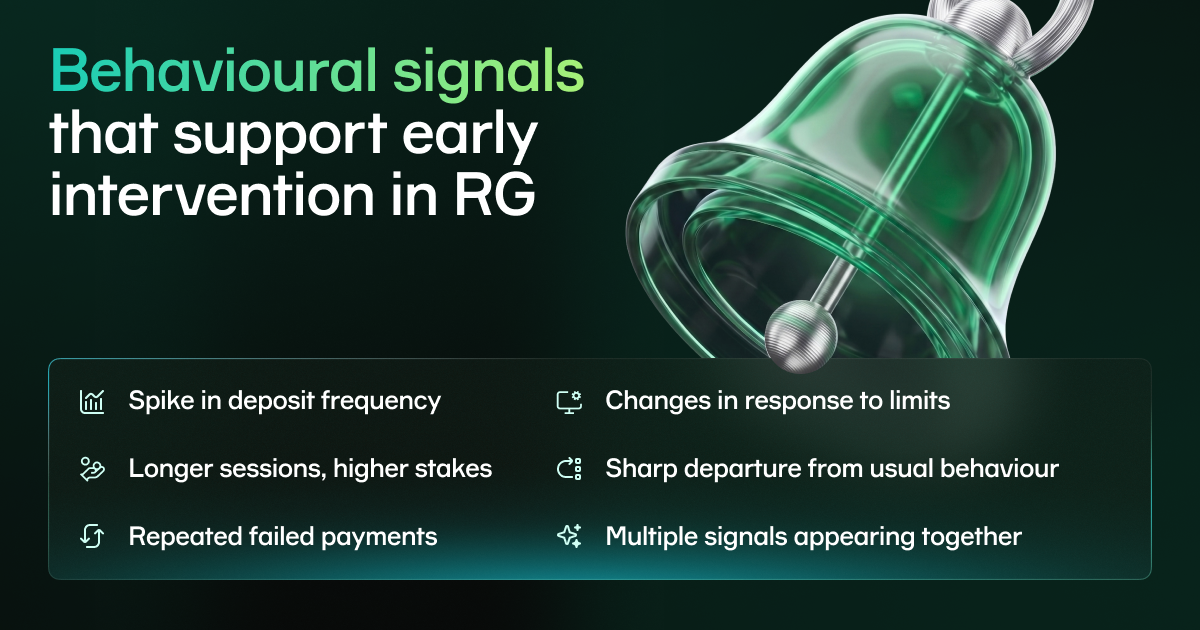
Changes in player activity can show that an account needs closer review. Signals may include deposit frequency, betting habits, session length, stake size, playing hours, payment patterns, changes to limits and responses to earlier contact. Several changes appearing together provide a stronger reason for review. One sharp departure from a player's usual behaviour may also warrant attention.
Operators need enough account history to judge whether recent activity is unusual for that player. Someone who normally deposits once a week but suddenly makes several deposits in a day may need closer review, especially when sessions get longer or stakes rise. Repeated payment attempts can add another signal. The team can then assess how far the account has moved from its usual pattern.
Real-time player monitoring in iGaming can reduce the delay between a notable change and an account review. Approved rules can flag an account when a pattern reaches a defined threshold. The alert should bring the relevant account information into view so the team can decide whether to keep monitoring or take action.
A change in deposit value becomes more meaningful when it is reviewed alongside the player's wider account activity. Changes in playing hours, repeated payment attempts, responses to earlier contact and use of limit tools may point to a wider pattern. Together, these signals help the operator judge whether the concern is isolated, developing or persistent.
Automated player risk detection in iGaming helps operators identify which accounts may need attention first. The software can flag a pattern, but trained staff still need to review the wider account history and decide whether intervening would be an appropriate action. Automation supports the decision; it does not diagnose the player.
Those signals must remain visible as the review continues. A change that appears minor at first can become more concerning if it repeats over several days or returns after earlier contact. Keeping the full history in one record helps the team recognise escalation, rather than treating each alert as a separate case.
Detection only has value when the operator has a clear process for what happens next. Once an account is flagged, the team should be able to review recent behaviour against the player's baseline, check earlier contact and controls, assess the strength of the signals and select an action that fits the level of concern.
The first response may be a reminder about available controls, an account message or direct access to limit-setting tools. If the pattern continues, the operator may suggest a temporary break, tighten account controls or arrange contact from the responsible gambling team. Serious or escalating concerns can require stronger restrictions. The player may choose self-exclusion, and the operator may close the account where its policy and the rules of the relevant market allow.
Operators need clear thresholds so teams know how each alert should be handled. A shared basis for assessment helps similar cases receive a similar level of attention without forcing every alert through the same response.
A player’s account history should guide the response. An isolated change may justify continued monitoring or a reminder. Repeated signals after earlier prompts can call for direct contact. Recording why that action was chosen gives the next reviewer a clear starting point.
A thorough account review helps operators avoid disrupting players and ensures any contact is based on what the account actually shows.
This reduces the chance of contacting someone whose activity changed for an ordinary reason. It also gives teams a consistent basis for deciding where each case sits and helps ensure a genuine concern is not left unaddressed.
Each stage needs a clear owner and a defined timeframe. Automated prompts can be issued under approved rules. Manual reviews need a named team to assess the evidence, choose the action and record the decision.
Giving players easy access to controls is another important part of early intervention. Depending on the market and operator policy, these may include deposit limits, loss limits, session limits, reality checks, time-outs and self-exclusion. Each gives the player a different way to manage their activity.
These tools need to be easy to find and understand. A limit hidden behind several menus is easy to miss. Placing it in an area the player already visits makes it easier to use. Reality checks and temporary breaks should state what they do and how long they apply. Clear wording helps the player make an informed choice.
The player's status should also be reflected across every relevant part of the product. Once self-exclusion is applied, access and promotional contact should be restricted in line with operator policy and market rules. A time-out or limit should take effect wherever the relevant activity occurs. A player under review may also need to be removed from standard campaign messaging until the account status changes.
Account controls, CRM eligibility, payments, customer-support notes and risk markers need to stay aligned. A decision made by the responsible gambling team should not be contradicted by a promotional message or by another part of the product. Connected records give the player consistent information and show operator teams what has already been applied.
Messages shown during an intervention need the same clarity. A prompt should explain why it has appeared, which options are available and what happens next. The message should support the action on the account instead of leaving the player unsure.
An intervention should be followed by continued account monitoring. Changes in spending, session activity, use of control tools and responses to contact show whether the first action was sufficient or whether the account needs another review.
The same player record should capture the signals identified, the action taken and what happened afterwards. This gives responsible gambling, customer support and CRM teams the same account history, supports consistent decisions and helps operators refine thresholds and intervention rules over time.
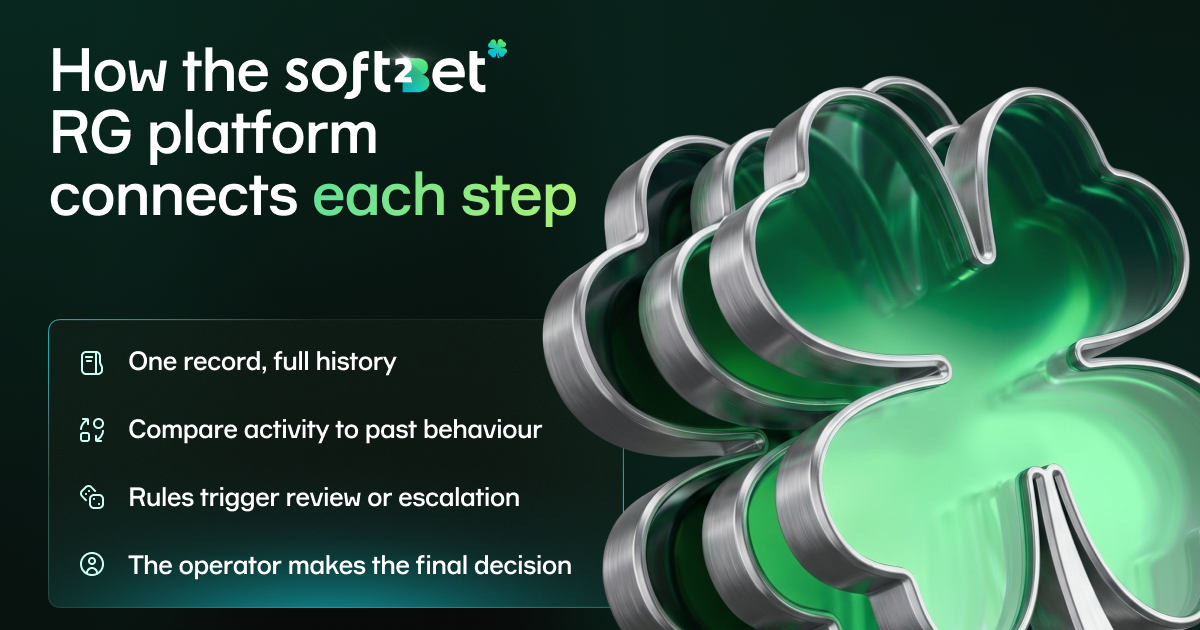
Detection, account review, intervention and follow-up are connected through one player record in Soft2Bet's platform. Partners can review account activity, payment information, risk controls, CRM rules, customer-support notes, marketing eligibility and reporting without pulling information from separate systems.
Consider a player whose deposits become more frequent as their sessions grow longer. The partner can compare that activity with the player's earlier behaviour, see whether limits have changed, check previous contact and review payment information in the same record. The strength, frequency and combination of those signals can guide the next step.
The partner’s rules can determine whether the account receives a lower-level prompt or moves to manual review. Stronger patterns can be escalated under the operator's policy. Each action is recorded in the same player record, allowing later activity and contact to be assessed against what has already happened.
iGaming responsible gambling software is at its most practical when the process continues after an alert. Alerts, controls and records need to stay connected so teams can see why an account was flagged, what action was taken and what happened afterwards. A large volume of warnings adds little value when those links are missing. Soft2Bet gives partners a clearer route from the first signal to a documented decision.
The platform supports this process without replacing the operator's responsibility. Licence obligations, internal policies, staffing, thresholds and sensitive account decisions remain with the partner. Soft2Bet provides the player safety tools, shared records and workflows needed to carry out those responsibilities consistently across the product.
Player protection can begin before a player decides that self-exclusion is needed. Operators can review meaningful changes and offer support sooner, strengthening the wider process without reducing the importance of a direct and enforceable way to stop gambling.
Reactive and proactive player protection belong in one connected model. Proactive monitoring creates earlier opportunities to act. Reactive controls provide stronger measures when the player asks for them or when the level of concern requires them. Self-exclusion remains central within that model.
For players, the result is earlier access to relevant controls and support. For operators, it creates a clearer route from detection to intervention, stronger records and clearer ownership across teams. Early intervention cannot prevent every harmful pattern, but it gives operators more opportunities to identify possible risk and respond.
Soft2Bet brings account data, payments, risk controls, CRM rules, support activity and reporting into one player record. Operators reviewing iGaming responsible gambling software should ask whether the system can identify meaningful changes, bring the right information together, support proportionate action and record the outcome. Meeting those requirements turns early intervention in responsible gaming into a daily operating process.
What is iGaming responsible gambling software?
iGaming responsible gambling software helps operators monitor changes in player activity, identify possible risk and apply suitable controls. Depending on the market and operator policy, it may support account prompts, limits, time-outs, manual reviews, reporting and self-exclusion.
What does proactive player protection in iGaming mean?
Proactive player protection in iGaming uses player and account data to identify changes that may require attention before the player asks for help. The operator reviews the wider pattern and chooses a response that fits the assessed level of concern.
Which behavioural signals can support early intervention in responsible gaming?
Operators may look at changes in deposit frequency, betting habits, session length, stake size, playing hours, payment activity, limit use and responses to earlier contact. These signals should be considered together and compared with the player's usual behaviour.
Is early intervention an alternative to self-exclusion in iGaming?
No. Early intervention creates more opportunities to review the account and offer support before a player requests self-exclusion. Self-exclusion remains an essential safeguard for players who choose it, and stronger restrictions may be needed in more serious cases.
How does the Soft2Bet responsible gambling platform support operators?
It connects account data, payments, risk controls, CRM rules, customer-support information, marketing eligibility and reporting through the same player record. Operators can use that view to assess behavioural changes, apply suitable controls and follow the outcome of an intervention.
.svg)
.svg)



.png)




.avif)