


.png)
Few people have as broad a view of the shifts that reshape global gambling as Rasmus Sojmark. As Founder and Chief Executive of SBC, he has a rare vantage point across the sector, with direct insight into its key stakeholders at a time when global gambling is going through an evolving set of pressures. Ahead of the SBC Summit this month, Sojmark speaks about the next 12 months in iGaming, from A1 and prediction markets to taxation, regulation and changing consumer behaviour. In this exclusive interview, he explains how the industry is increasingly shifting towards a deeper understanding of the player.
Rasmus Sojmark: The obvious one is AI. We were talking about it last year, of course, but there was still a lot of 'What is this actually going to mean?' Now people are using it every day for all aspects of their working and personal lives.
The other big shift is prediction markets, which are fascinating. A year ago I could probably have gone through an entire SBC event without having five serious conversations about them. Now I can have five before lunch as businesses work out their positioning and whether they are a threat or an opportunity.
That's exactly why we've launched the Global Prediction Markets Forum at SBC Summit this year, because a conversation moving that fast needed a dedicated space of its own rather than a single panel squeezed in among everything else.
And perhaps the less sexy answer is tax. Nobody is going to put taxation on a Super Stage and expect 5,000 people to start cheering, but some of the changes we're seeing are having a very real impact on investment decisions.
Rasmus Sojmark: I actually think the mood is very good. Not because everything is easy. It definitely isn't, but because the conversations feel more sophisticated.
Five years ago, I would meet an operator and within five minutes we'd be talking about which market they were entering next. Of course those conversations still happen, but now we're just as likely to be talking about retention, product, trust or how to build a sustainable business in a market that's becoming much more competitive.
Rasmus Sojmark: Three years is a very long time in this industry! If you'd asked most of us three years ago whether prediction markets would be one of the biggest conversations in gaming today, I'm not sure many hands would have gone up.
If I had to pick where the pressure is greatest, it's the combination of tougher regulation and changing consumer behaviour. Regulation is forcing companies to build more responsibly. Consumer expectations, shaped heavily by what people experience in gaming, entertainment and tech generally, are forcing companies to build more compellingly. Those two forces used to be treated as being in tension. Increasingly, the companies doing well are the ones realising they're not.
AI will be the accelerant across all of it, for better and for worse depending on how it's used. The companies I would bet on are the ones that can move quickly without losing sight of the customer.
Rasmus Sojmark: People. That's really the honest answer.
Information has never been easier to find. You can read a report, watch a webinar, or ask AI to explain almost anything about this industry in seconds. What you can't get any of those ways is the experience of someone who has actually lived through the decision you're about to make.
What excites me is the fact that hearing an operator explain how they actually prepared for a regulatory change, not how they're supposed to have prepared for it, is a completely different kind of value.
The other thing you simply cannot replicate anywhere else is the density of relevant people in one place, at the same time, for three days. LinkedIn can tell you someone exists. It can't recreate sitting opposite them for half an hour. Lisbon lets you have five real conversations that might change how you run your business, plus the two you weren't expecting that turn out to matter just as much.
Rasmus Sojmark: Normally, within five minutes you can tell. The really interesting companies don't spend the first ten minutes telling you how innovative they are. They tell you about a problem. They can tell you, in detail, exactly whose problem they're solving and why the current way of doing it isn't good enough.
The ones repackaging what already exists tend to talk in category language instead: "we do AI", "we do player engagement", without ever quite landing on what specifically gets better for the customer.
Rasmus Sojmark: Because it's stopped being a soft topic and has become a hard commercial one. For a long time, player experience was treated as something you thought about once the technology, the marketing and the compliance were already sorted. What we're seeing now is that it's actually the thing tying all of those together. I don't think respecting your customer is a particularly radical commercial strategy.
Sitting Player Experience alongside AI, Web3 and marketing reflects where competitive advantage is moving. Getting the product, the technology and the acquisition right doesn't matter much if you don't actually understand and respect the person using it. That deserves the same dedicated, practical treatment we give the more obviously technical subjects.
Rasmus Sojmark: I think we're already there, honestly. Acquisition will always matter. You need new customers. But acquisition on its own has diminishing returns in a market that's this regulated, this competitive and this transparent to the player.
What's changed is that keeping a player used to be seen mostly as a retention or CRM function, almost a follow-up task after the real work of acquiring them was done. Increasingly, it's the whole strategy. The companies pulling ahead are the ones asking what a player actually wants from their experience, not just how to get them through the door.
Rasmus Sojmark: I think the honest test is intent, and whether the mechanic still works is in the player's interest once you take away the commercial upside for the operator.
Gaming, entertainment and consumer tech have produced genuinely brilliant ways of making an experience feel rewarding and engaging. There's a lot gambling can learn from that. But those industries don't carry the same risk of harm that gambling does, so a mechanic that's simply fun in a video game can become something else entirely once it's attached to real money and real consequences.
That's really why player protection can't sit apart from product design anymore.
We're sometimes guilty in gambling by making this more complicated than it needs to be. If somebody enjoys your product, trusts your brand and feels they're being treated fairly, you've got a much better chance of having a long-term customer.
Rasmus Sojmark: Yes, I genuinely believe that, and I think the old framing was never quite right to begin with. Treating commercial performance and player protection as opposing forces assumes the best commercial outcome is the one with the fewest safeguards. In reality, a player who trusts a platform, understands their own behaviour and feels in control tends to be a far more valuable long-term customer than one who churns out through a bad experience or, worse, harm.
Put simply, a business built on player trust is a more durable business. That's not a compliance argument, it's a commercial one. I think the industry is slowly, and rightly, coming around to seeing it that way rather than as a trade-off.
Rasmus Sojmark: Because listening to someone describe player behaviour and actually having to make a decision about it are two completely different experiences. You can nod along to a panel and still walk away without having genuinely tested your own assumptions. The moment you have to work through an actual scenario and decide what you'd do, you find out very quickly where your understanding is solid and where it's guesswork.
We're very good at talking about 'the player'. I'm not always convinced we're as good at talking about a player. Put a real person and a real situation in front of people and suddenly the answer isn't quite as obvious. That gap is exactly where I'd want people to leave the session thinking harder.
Rasmus Sojmark: Bigger isn't really the interesting part for me, even though the numbers are there: over 40,000 attendees, more than 800 exhibitors, 600-plus speakers. What's genuinely different is how much more intentional we've made the experience within that scale.
Someone who attended last year will notice things like the Regulatory Gaming Meetups, more than 20 of them, giving people direct access to regulators and legal experts rather than just a panel and a handshake afterwards. They'll notice the African Gaming Forum, a dedicated space bringing together operators, regulators and associations from across the continent. They'll notice Education+ and the Academies, including Player Experience, built specifically so people leave with something practical, not just notes.
And then we're going to open on the Super Stage with Michael Jordan, Carsten Koerl and Jason Robins and finish the week with Tiësto. Come on! I'm an event organiser - I'm allowed to be excited about that!
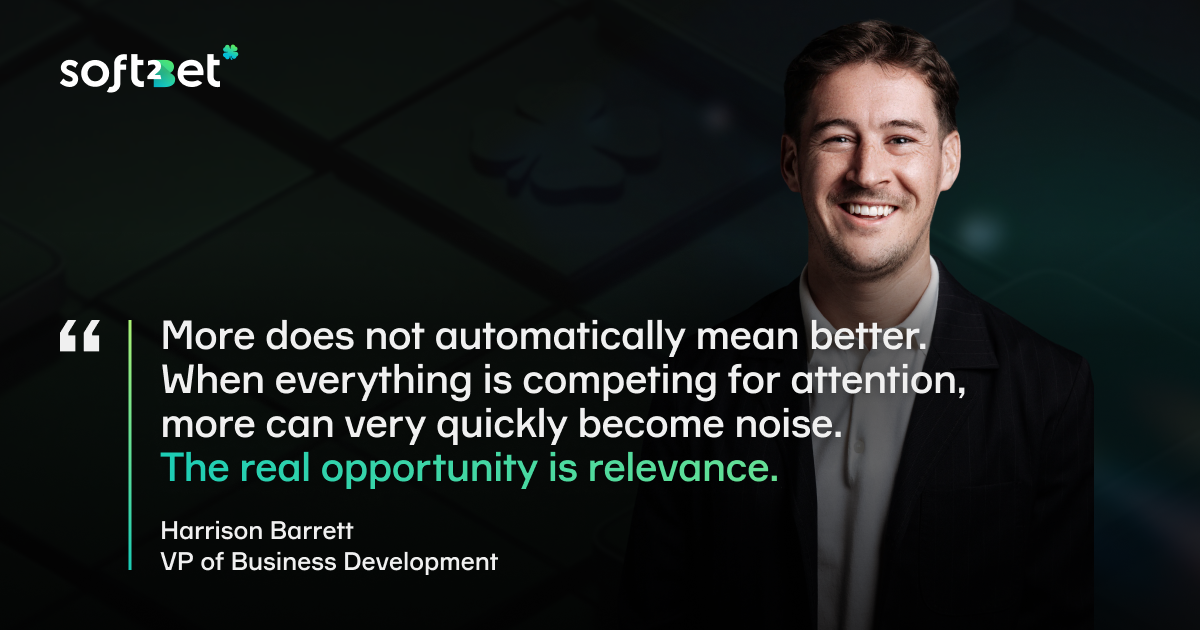
So if last year was about proving Lisbon could handle an event of this scale, this year is about proving that scale doesn't have to come at the cost of relevance. That's genuinely what we've been building toward.
.svg)
.svg)



.png)



%20(1).png)