
SIGMA | ROME
Play with us. Win with us.
NOVEMBER 4-6
Stand 6035
ITALY
ROME

Discover the thrill of MEGA Clawee and experience the fun first-handed at our stand

Fill in the form
Thank you! Your submission has been received!
We'll get back to you soon!
Oops! Something went wrong while submitting the form.
Back to all news

iGaming Localisation Strategy in Denmark and Sweden: Lessons from Entry into the Nordics Market

June 26, 2026
5 Minutes reading
iGaming Localisation Strategy in Denmark and Sweden: Lessons from Entry into the Nordics Market
No items found.

If you are not culturally native at system level, everything you build is just noise. In Denmark and Sweden, translation is legacy thinking. Localisation is a core part of the product itself. 

True iGaming localisation strategy has evolved beyond the front-end user interface, it is now a core pillar of the underlying product architecture itself. True iGaming localisation strategy has evolved beyond the front-end user interface, it is now a core pillar of the underlying product architecture itself. By leveraging the successful launches of brands such as  Betinia, Quick Casino and CampoBet in the Nordic market, Soft2Bet’s culture-first strategy demonstrates a clear advantage in compliance and iGaming player retention

Deep localisation consistently outperforms surface-level translation in highly regulated Nordic markets. Denmark and Sweden sit among Europe’s most mature iGaming ecosystems. Market entry is defined by layered compliance requirements and strict technical certification standards that vary significantly across jurisdictions. For global operators, success is no longer about platform parity or language adaptation. It is about a full commitment to market immersion, where product, UX, and compliance are engineered around local culture from Day One. 

This is the culturally integrated product design model, a bespoke approach where localisation becomes infrastructure and where strict adherence to Scandinavian online gambling laws fundamentally rewrites the playbook for Nordic iGaming market entry and establishes a new benchmark for deep localisation.

Entry playbook for iGaming market localisation 

Localisation is what turns market entry into market ownership. In iGaming, it goes far beyond translating a user interface.

The principle holds true across all competitive markets, from the Nordics to Romania. Player data shows users do not judge brands by language alone, but by speed of navigation, clarity of offers, content hierarchy, and whether the tone feels naturally local rather than merely translated.

In other words, a winning casino and sportsbook brand is not adapted to a market. It is built for it.

Success in highly competitive Nordic markets depends on aligning product utility with cultural behaviour to deliver an experience that feels inherently native to player expectations. For Soft2Bet, this meant embedding a flexible compliance framework with deeply localised execution from day one.

A strong iGaming localisation strategy is no longer optional in mature markets like Denmark and Sweden; it is the foundation of sustainable growth. 
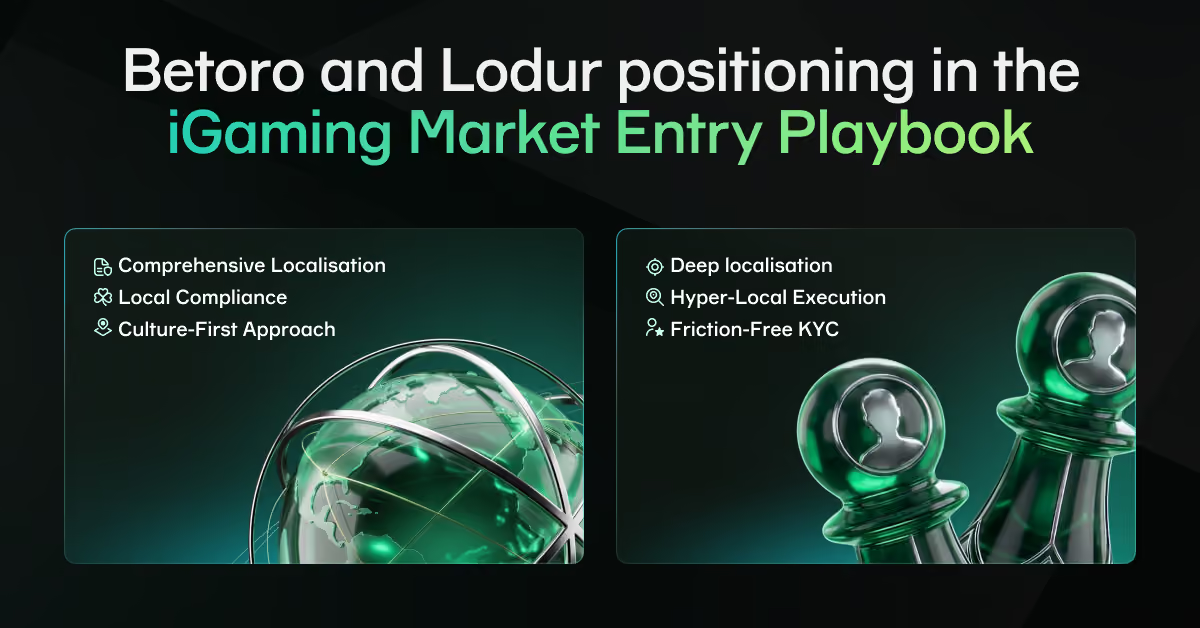
Denmark and Sweden iGaming Market Entry: Betoro and Lodur positioning

Denmark and Sweden market entry 

Soft2Bet’s market entry in Denmark and Sweden were strategically positioned as examples of the Nordic localisation playbook. 

The successful launches of Betoro in Denmark and Lodur in Sweden depended on comprehensive localisation that merged cultural nuance with robust local compliance, explicitly rejecting the limitations of mere UI translation. 

Overview of Denmark positioning 

Betoro Denmark was engineered from its inception to reflect the regional philosophy of "guided passion." This product design captures the raw emotion of live sports while keeping the digital user journey highly structured, transparent, and easy to trust.

Betoro was created for the Danish audience, featuring native Danish customer support, deep integration with local sporting leagues, and using the MEGA engine for custom player milestones. This culture-first approach was key to achieving significant player retention in the highly competitive Danish market.

Overview of Sweden positioning

Soft2Bet tailors experiences for specific player drivers. This strategic approach to iGaming localisation involves shaping the platform based on local player behaviour, campaign response, and product preferences.

Lodur’s success in Sweden was driven by rapid, friction-free registration via Swedish BankID for enhanced Know Your Customer (KYC) processes, a non-negotiable requirement for player trust and regulatory adherence in the market. The brand demonstrates the value of shaping the platform based on hyper-local regulatory and user preferences.

By tailoring the platform's core mechanics around local regulatory frameworks and user preferences, Lodur provides a textbook example of deep, effective localisation.

Nordic iGaming market entry: Localised UX as Product Architecture

For operators and B2B providers, the implications are significant. Success increasingly depends on whether compliance systems, UX flows, payment infrastructure, gamification mechanics, and responsible gaming tools are designed around local player behaviour from day one.

Soft2Bet’s launches of Betoro in Denmark and Lodur in Sweden demonstrate how this strategy works in practice. Rather than relying on surface-level translation, the company implemented a region-specific user journeys approach powered by modular compliance architecture, localised UX execution, and its proprietary Soft2Bet MEGA gamification engine. This level of architectural customisation is essential for any modern casino and sportsbook brand.

The result was not simply translated sportsbook and casino platforms, but fully localised ecosystems built around Nordic engagement habits, retention patterns, and regulatory expectations.

Soft2Bet MEGA’s role

Central to the success of Soft2Bet’s brands is the Motivational Engineering Gamification Application (MEGA). This proprietary engine is designed not just for entertainment, but as a core pillar of the group's compliance and retention strategy.

Key aspects of MEGA and its role in localisation include:

Customised Jurisdictional Engagement: MEGA’s mechanics, including missions, rewards, progression systems, and loyalty structures, are designed to plug into the Platform Account Management architecture’s jurisdictional logic layer. This allows gamification content to be automatically scoped, restricted, or reconfigured to adhere to regulatory settings in each market, ensuring compliance while maintaining rich gamification.

iGaming Player Retention and Value: MEGA’s flagship gamification engines such as MEGA Clawee, MEGA Chance, and MEGA Builder have demonstrated the value of motivational engineering by driving increased player engagement, retention, and longer session durations. The aim is to increase player lifetime value (or LTV) by fostering sustainable engagement.

Soft2Bet’s MEGA Islands architecture

The Evolution of MEGA Islands: Moving deep localisation into its next phase, Soft2Bet has actively introduced its narrative-driven MEGA Islands architecture to the Nordic markets in 2026. First previewed within the Lodur ecosystem, this system provides players with a persistent progression layer where they can build, upgrade, and manage customised island settlements using resources earned through native gameplay. By introducing social mechanics and a Player-vs-Player (PvP) simulation layer, the platform transforms disconnected gaming sessions into an interactive, long-term ecosystem that naturally stabilises retention.

Future Development: The narrative-driven Soft2Bet MEGA Islands in Sweden was launched earlier this year to further enhance the culture-first approach through highly immersive ecosystems.

Nordic iGaming Payment Localisation 

Successful localisation in the Nordics requires strict observation of market frameworks, particularly in Denmark and Sweden. Local payment methods are a critical foundation of player trust in the region. Payment infrastructure is central to user acquisition and retention. 

Integrating trusted local payment solutions from the outset is essential to ensure seamless user journeys and long-term player retention. 

iGaming Regulatory Fragmentation

The technical challenge of Nordic iGaming market entry is defined by regulatory fragmentation. Compliance bottlenecks, where responsible gambling tools, bonus mechanics, data localisation, and reporting requirements configured for one market are not transferable to another, are among the most common barriers to global growth.

Soft2Bet addressed this through a modular PAM architecture built on jurisdictional logic.

Modular PAM Architecture: Instead of treating each market as a bespoke engineering project, the platform is built around smart switches or configurable toggles. These toggles allow jurisdiction-specific rules covering wagering limits, bonus eligibility, responsible gambling intervention thresholds, and KYC requirements to be activated, adjusted, or deactivated without altering the underlying codebase.

Deployment Speed: This architecture compresses launch timelines by integrating a multi-jurisdictional compliance engine from the outset. It enables faster market entry into complex markets like Sweden and Denmark, reducing time to market risk and allowing Soft2Bet to secure market share ahead of rivals.

Technical Feature Legacy Platform Approach Soft2Bet Modular PAM Approach
Codebase Stability Requires rewriting core code for every new market entry. Maintains a single, unified underlying codebase across all regions.
Compliance Adaptability Manual software updates that delay feature deployment. Uses instant "smart switches" and configurable regulatory toggles.
Market Customization Hardcoded limits that slow down cross-border scalability. Dynamic adjustment of wagering limits, KYC, and bonuses per country.
Time-to-Market Risk Extended launch delays (often 6–12 months) due to testing. Compressed deployment timelines that secure early market share.

Casino and sportsbook: impact of proactive compliance

Soft2Bet prioritises internal control of compliance tools, training, and oversight to deliver a flexible compliance model that exceeds regulatory mandates. This proactive strategy has allowed the company to maintain a strong compliance record in regulated markets since the implementation of its proprietary systems.

Responsible Gaming, an Invisible Pillar of Trust in Nordic Markets

Responsible Gaming is an invisible pillar of corporate reputation and a key driver of trust among Nordic players. This strategy ensures strict adherence to Scandinavian online gambling laws.

Soft2Bet has moved the conversation beyond regulatory compliance, reframing active accountability as a driver of innovation.

The company views compliance as a strategic priority, knowing responsible play and compliance are essential for maximising Player lifetime value (or LTV).
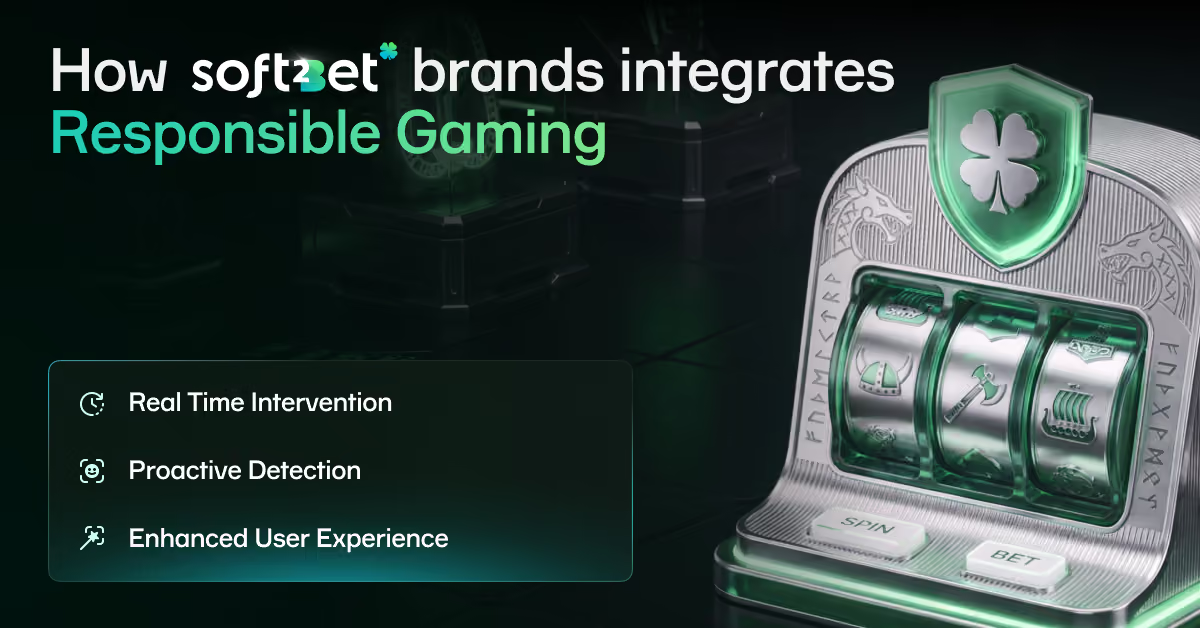
How Soft2Bet brands integrates Responsible Gaming in Denmark and Sweden iGaming Market

Soft2Bet brands integrates Responsible Gaming 

  • Real Time Intervention: Internal systems enable real time intervention for vulnerable players. MEGA facilitates monitoring of session duration and spending patterns as a key gamification engine.
  • Proactive Detection: The strategy combines automated alerts with human analysis, identifying and mitigating risks proactively rather than reactively.
  • Enhanced User Experience: Responsible gambling tools are embedded into the user journey, promoting healthy play while maintaining user control and engagement.

Externally, this commitment supports brand visibility. Betinia secured a landmark sponsorship with the Danish Divisionsforeningen, naming three divisions. The agreement supports grassroots football and reinforces responsible engagement aligned with Danish Gambling Authority standards. This commitment supports brand visibility, reinforcing the image of a trustworthy casino and sportsbook brand.

A successful Nordic iGaming market entry is no longer defined by translation. It is defined by architecture, compliance, and cultural engineering working as one system.

Soft2Bet’s execution across Betoro Denmark and Lodur Sweden demonstrates how a strong iGaming localisation strategy transforms regulatory complexity into competitive advantage.

In this environment, the Nordic localisation playbook is clear: build locally, think culturally, and engineer compliance from the ground up.

This is the future of scalable iGaming expansion.

Nordic Localisation Playbook: Building Locally and Thinking Culturally FAQ Section

What is the primary difference between translation and iGaming localisation strategy?

Translation is simply converting language, while localisation is a "culturally integrated product design" strategy that integrates local language, cultural habits, compliance, and player behavior into the product's entire design and flow.

How does Soft2Bet’s MEGA engine support compliance in the Nordics?

Soft2Bet MEGA (the Motivational Engineering Gamification Application) is a proprietary compliance tool designed for dual purpose. First, it uses real-time monitoring to moderate player activity (like session duration and limits). Second, it leverages the modular PAM architecture's jurisdictional logic to adapt gamification features instantly, ensuring alignment with stringent Scandinavian online gambling laws. The resulting responsible and tailored engagement maximises player lifetime value (or LTV).

Why are Denmark and Sweden considered challenging markets for iGaming market entry?

They are highly mature and well-regulated jurisdictions where success is determined by technical adaptability to complex regulatory fragmentation, including differing rules on responsible gaming, data localisation, and local compliance, making speed-to-market a crucial competitive advantage.

How is Soft2Bet moving Responsible Gaming beyond mere compliance?

By integrating proactive detection systems, combining automated alerts with human analysis, and using internal controls for real-time intervention, rather than just meeting minimum regulatory standards.

How does the launch of MEGA Islands further enhance the culturally integrated product design in the Nordics?

MEGA Islands, was launched in Sweden in 2026. It adds a persistent progression layer and narrative-driven ecosystems to foster long-term, sustainable engagement and increased player lifetime value (or LTV).

Share to:
iGaming Localisation Strategy in Denmark and Sweden: Lessons from Entry into the Nordics Market

If you are not culturally native at system level, everything you build is just noise. In Denmark and Sweden, translation is legacy thinking. Localisation is a core part of the product itself. 

True iGaming localisation strategy has evolved beyond the front-end user interface, it is now a core pillar of the underlying product architecture itself. True iGaming localisation strategy has evolved beyond the front-end user interface, it is now a core pillar of the underlying product architecture itself. By leveraging the successful launches of brands such as  Betinia, Quick Casino and CampoBet in the Nordic market, Soft2Bet’s culture-first strategy demonstrates a clear advantage in compliance and iGaming player retention

Deep localisation consistently outperforms surface-level translation in highly regulated Nordic markets. Denmark and Sweden sit among Europe’s most mature iGaming ecosystems. Market entry is defined by layered compliance requirements and strict technical certification standards that vary significantly across jurisdictions. For global operators, success is no longer about platform parity or language adaptation. It is about a full commitment to market immersion, where product, UX, and compliance are engineered around local culture from Day One. 

This is the culturally integrated product design model, a bespoke approach where localisation becomes infrastructure and where strict adherence to Scandinavian online gambling laws fundamentally rewrites the playbook for Nordic iGaming market entry and establishes a new benchmark for deep localisation.

Entry playbook for iGaming market localisation 

Localisation is what turns market entry into market ownership. In iGaming, it goes far beyond translating a user interface.

The principle holds true across all competitive markets, from the Nordics to Romania. Player data shows users do not judge brands by language alone, but by speed of navigation, clarity of offers, content hierarchy, and whether the tone feels naturally local rather than merely translated.

In other words, a winning casino and sportsbook brand is not adapted to a market. It is built for it.

Success in highly competitive Nordic markets depends on aligning product utility with cultural behaviour to deliver an experience that feels inherently native to player expectations. For Soft2Bet, this meant embedding a flexible compliance framework with deeply localised execution from day one.

A strong iGaming localisation strategy is no longer optional in mature markets like Denmark and Sweden; it is the foundation of sustainable growth. 

Denmark and Sweden iGaming Market Entry: Betoro and Lodur positioning

Denmark and Sweden market entry 

Soft2Bet’s market entry in Denmark and Sweden were strategically positioned as examples of the Nordic localisation playbook. 

The successful launches of Betoro in Denmark and Lodur in Sweden depended on comprehensive localisation that merged cultural nuance with robust local compliance, explicitly rejecting the limitations of mere UI translation. 

Overview of Denmark positioning 

Betoro Denmark was engineered from its inception to reflect the regional philosophy of "guided passion." This product design captures the raw emotion of live sports while keeping the digital user journey highly structured, transparent, and easy to trust.

Betoro was created for the Danish audience, featuring native Danish customer support, deep integration with local sporting leagues, and using the MEGA engine for custom player milestones. This culture-first approach was key to achieving significant player retention in the highly competitive Danish market.

Overview of Sweden positioning

Soft2Bet tailors experiences for specific player drivers. This strategic approach to iGaming localisation involves shaping the platform based on local player behaviour, campaign response, and product preferences.

Lodur’s success in Sweden was driven by rapid, friction-free registration via Swedish BankID for enhanced Know Your Customer (KYC) processes, a non-negotiable requirement for player trust and regulatory adherence in the market. The brand demonstrates the value of shaping the platform based on hyper-local regulatory and user preferences.

By tailoring the platform's core mechanics around local regulatory frameworks and user preferences, Lodur provides a textbook example of deep, effective localisation.

Nordic iGaming market entry: Localised UX as Product Architecture

For operators and B2B providers, the implications are significant. Success increasingly depends on whether compliance systems, UX flows, payment infrastructure, gamification mechanics, and responsible gaming tools are designed around local player behaviour from day one.

Soft2Bet’s launches of Betoro in Denmark and Lodur in Sweden demonstrate how this strategy works in practice. Rather than relying on surface-level translation, the company implemented a region-specific user journeys approach powered by modular compliance architecture, localised UX execution, and its proprietary Soft2Bet MEGA gamification engine. This level of architectural customisation is essential for any modern casino and sportsbook brand.

The result was not simply translated sportsbook and casino platforms, but fully localised ecosystems built around Nordic engagement habits, retention patterns, and regulatory expectations.

Soft2Bet MEGA’s role

Central to the success of Soft2Bet’s brands is the Motivational Engineering Gamification Application (MEGA). This proprietary engine is designed not just for entertainment, but as a core pillar of the group's compliance and retention strategy.

Key aspects of MEGA and its role in localisation include:

Customised Jurisdictional Engagement: MEGA’s mechanics, including missions, rewards, progression systems, and loyalty structures, are designed to plug into the Platform Account Management architecture’s jurisdictional logic layer. This allows gamification content to be automatically scoped, restricted, or reconfigured to adhere to regulatory settings in each market, ensuring compliance while maintaining rich gamification.

iGaming Player Retention and Value: MEGA’s flagship gamification engines such as MEGA Clawee, MEGA Chance, and MEGA Builder have demonstrated the value of motivational engineering by driving increased player engagement, retention, and longer session durations. The aim is to increase player lifetime value (or LTV) by fostering sustainable engagement.

Soft2Bet’s MEGA Islands architecture

The Evolution of MEGA Islands: Moving deep localisation into its next phase, Soft2Bet has actively introduced its narrative-driven MEGA Islands architecture to the Nordic markets in 2026. First previewed within the Lodur ecosystem, this system provides players with a persistent progression layer where they can build, upgrade, and manage customised island settlements using resources earned through native gameplay. By introducing social mechanics and a Player-vs-Player (PvP) simulation layer, the platform transforms disconnected gaming sessions into an interactive, long-term ecosystem that naturally stabilises retention.

Future Development: The narrative-driven Soft2Bet MEGA Islands in Sweden was launched earlier this year to further enhance the culture-first approach through highly immersive ecosystems.

Nordic iGaming Payment Localisation 

Successful localisation in the Nordics requires strict observation of market frameworks, particularly in Denmark and Sweden. Local payment methods are a critical foundation of player trust in the region. Payment infrastructure is central to user acquisition and retention. 

Integrating trusted local payment solutions from the outset is essential to ensure seamless user journeys and long-term player retention. 

iGaming Regulatory Fragmentation

The technical challenge of Nordic iGaming market entry is defined by regulatory fragmentation. Compliance bottlenecks, where responsible gambling tools, bonus mechanics, data localisation, and reporting requirements configured for one market are not transferable to another, are among the most common barriers to global growth.

Soft2Bet addressed this through a modular PAM architecture built on jurisdictional logic.

Modular PAM Architecture: Instead of treating each market as a bespoke engineering project, the platform is built around smart switches or configurable toggles. These toggles allow jurisdiction-specific rules covering wagering limits, bonus eligibility, responsible gambling intervention thresholds, and KYC requirements to be activated, adjusted, or deactivated without altering the underlying codebase.

Deployment Speed: This architecture compresses launch timelines by integrating a multi-jurisdictional compliance engine from the outset. It enables faster market entry into complex markets like Sweden and Denmark, reducing time to market risk and allowing Soft2Bet to secure market share ahead of rivals.

Technical Feature Legacy Platform Approach Soft2Bet Modular PAM Approach
Codebase Stability Requires rewriting core code for every new market entry. Maintains a single, unified underlying codebase across all regions.
Compliance Adaptability Manual software updates that delay feature deployment. Uses instant "smart switches" and configurable regulatory toggles.
Market Customization Hardcoded limits that slow down cross-border scalability. Dynamic adjustment of wagering limits, KYC, and bonuses per country.
Time-to-Market Risk Extended launch delays (often 6–12 months) due to testing. Compressed deployment timelines that secure early market share.

Casino and sportsbook: impact of proactive compliance

Soft2Bet prioritises internal control of compliance tools, training, and oversight to deliver a flexible compliance model that exceeds regulatory mandates. This proactive strategy has allowed the company to maintain a strong compliance record in regulated markets since the implementation of its proprietary systems.

Responsible Gaming, an Invisible Pillar of Trust in Nordic Markets

Responsible Gaming is an invisible pillar of corporate reputation and a key driver of trust among Nordic players. This strategy ensures strict adherence to Scandinavian online gambling laws.

Soft2Bet has moved the conversation beyond regulatory compliance, reframing active accountability as a driver of innovation.

The company views compliance as a strategic priority, knowing responsible play and compliance are essential for maximising Player lifetime value (or LTV).

How Soft2Bet brands integrates Responsible Gaming in Denmark and Sweden iGaming Market

Soft2Bet brands integrates Responsible Gaming 

  • Real Time Intervention: Internal systems enable real time intervention for vulnerable players. MEGA facilitates monitoring of session duration and spending patterns as a key gamification engine.
  • Proactive Detection: The strategy combines automated alerts with human analysis, identifying and mitigating risks proactively rather than reactively.
  • Enhanced User Experience: Responsible gambling tools are embedded into the user journey, promoting healthy play while maintaining user control and engagement.

Externally, this commitment supports brand visibility. Betinia secured a landmark sponsorship with the Danish Divisionsforeningen, naming three divisions. The agreement supports grassroots football and reinforces responsible engagement aligned with Danish Gambling Authority standards. This commitment supports brand visibility, reinforcing the image of a trustworthy casino and sportsbook brand.

A successful Nordic iGaming market entry is no longer defined by translation. It is defined by architecture, compliance, and cultural engineering working as one system.

Soft2Bet’s execution across Betoro Denmark and Lodur Sweden demonstrates how a strong iGaming localisation strategy transforms regulatory complexity into competitive advantage.

In this environment, the Nordic localisation playbook is clear: build locally, think culturally, and engineer compliance from the ground up.

This is the future of scalable iGaming expansion.

Nordic Localisation Playbook: Building Locally and Thinking Culturally FAQ Section

Share to:
Nordic iGaming Market Entry: Modular PAM Architecture & Compliance