

Every four years, the football World Cup resets the global sports betting landscape. It concentrates the attention of billions of people on a single tournament, generating an extraordinary volume of wagering activity within a short period. In doing so, it creates a market environment that can reward operators significantly , while exposing those that are poorly prepared.
World Cup 2026 betting, however, will represent another shift of that cycle. It has the potential to represent a structural step-change for operators, and those that recognise that now, and plan accordingly, will be the ones best positioned for a successful tournament.
While the tournament itself and the period before it are key to generating consumer interest and sign-ups, the post-World Cup period is just as important, as that is when operators’ customer and retention teams must work to ensure that as many newly acquired players as possible remain on their platforms and become regular customers.
Numbers will be key during the 2026 World Cup. For the first time in the tournament's history, 48 national teams will compete across 104 matches, played across 16 host cities spanning the United States, Canada, and Mexico.
The expanded format means more matches, more nations represented, more fans to engage with and, critically for sports betting software providers and the operators using their platforms, there will be more events on which to bet, distributed across a longer tournament window.
Organisers expect this year’s edition to be among the most-watched sporting events ever broadcast, with attendance figures driven by accessibility across three countries and a global television and streaming audience measured in the billions. For iGaming operators, this context is critical as it will represent the market conditions around which their growth strategies should be built.
Financial projections suggest around $150bn could be wagered during the tournament as casual bettors entering the market create huge betting volumes alongside existing users increasing their regular activity. Those figures emphasise the scale of opportunity for operators, which will also depend on their ability to retain the new or casual bettors that open accounts with them.
In addition, the operators that capture this growth will not necessarily be the biggest or most established. Instead, it will be those with scalability built into their iGaming platforms, enabling them to perform under pressure, expand without degradation, and convert heightened interest into retained, active players.
The expansion from 32 to 48 teams fundamentally changes the World Cup 2026 betting proposition. Put simply, it is not only the increase in matches that matter, but also the arrival of new nations into the competition bringing with them new fans and potential customers.
Some of these countries may have never qualified for a World Cup, bringing with them audiences that are genuinely enthusiastic and excited at the thought of seeing their team compete at such a level for the first time. As a result, their engagement with the tournament is likely to be highly personal and emotional. Having the right content and strategy in place can be particularly effective in creating strong connections with these new audiences. Of course, the inclusion of new participating nations from Africa, Asia and South America also represents new customer bases that can generate betting activity that previous tournaments did not capture.
The match volume itself is significant: 104 matches compared to 64 in previous editions represents a 63% increase in events that players can bet on. For sportsbook operators, this means a sustained period of pre-match offers and markets that can be promoted, live betting environments where bet builders and parlays can boost margins significantly and an extended tournament lifecycle that sustains user engagement.
The tournamentalso places greater demands on technical infrastructure thanany previous edition by a meaningful margin, with live betting at the centre of the challenge.
The hosting geography adds another dimension. With three countries across two time zones, and matches distributed to minimise travel distances, kickoff times will span a wider daily window than typically seen in a single-host tournament . For global operators serving multiple markets, this reduces the sharp concurrency spikes associated with a single-timezone event while introducing a more sustained, rolling demand pattern throughout the day.
High concurrency betting platforms like Soft2Bet’s are designed to handle, process and settle large volumes of bets simultaneously, particularly during peak events like the World Cup or the Super Bowl.
The tournament itself runs for close to a month from June to July 2026. But for operators serious about maximising their World Cup 2026 betting performance, the strategic clock started months ago and the period between now and the opening match is very important.
The reasons are structural. Player acquisition in the weeks immediately before a major tournament takes place in an environment of extreme competition and inflated cost. Every operator in the market is targeting the same casual bettors,prompted to open an account by the tournament's proximity.
Media and affiliate costs rise and the conversion economics of late acquisition deteriorate, affecting not only the quantity, but also quality, of customers acquired during that period. Operators that have built their active player base in the months prior arrive at the tournament with lower average acquisition costs, better player data, and an established relationship with their users. All of this translates directly into stronger commercial outcomes during the tournament.
There is also a product-readiness dimension. The operators that will perform best during the World Cup are those who have stress-tested their live betting infrastructure, launched and optimised their retention mechanics, completed any outstanding regulatory certifications in target markets and resolved iGaming platform scalability questions well in advance of opening day. The tournament does not give operators time to fix problems but it will simply expose them, it will just reveal them, leaving minimal time or room to remediate issues ahead of the launch.
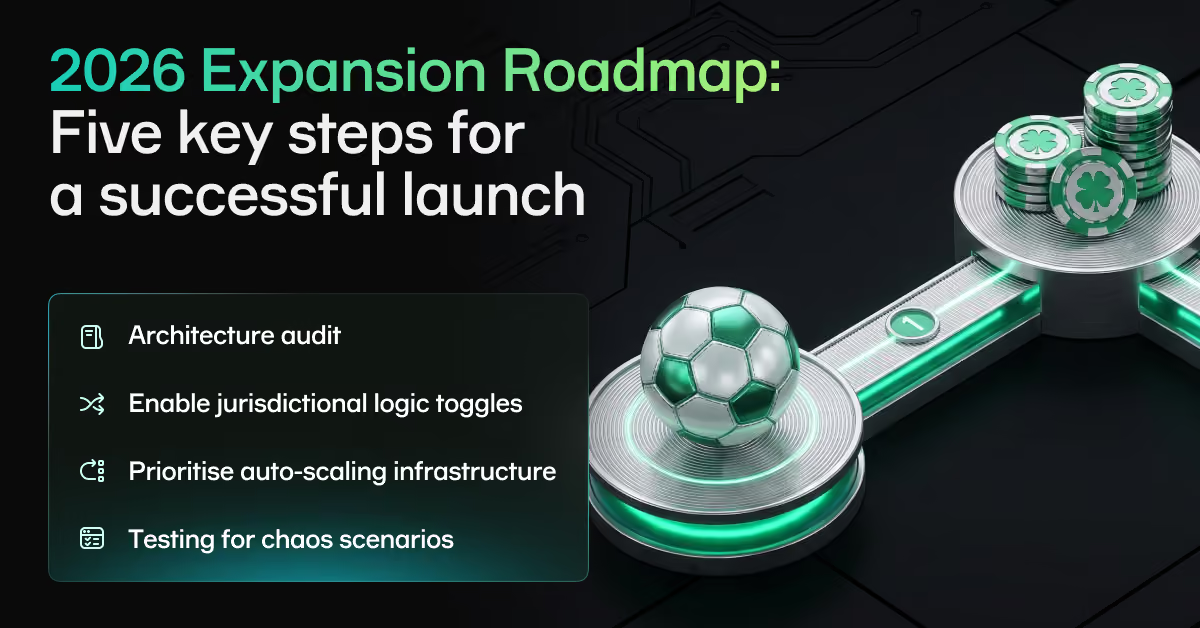
For B2C operators and their sports betting software providers, the path to World Cup readiness is a sequenced programme of infrastructure and product testing and compliance work that must be completed before the tournament kicks off. Here are five key steps to note.
The starting point is a rigorous assessment of a platform’s readiness. Modularity, flexibility and resilience are key criteria when auditing tech architecture. A platform that requires downtime to deploy updates is not suited to a tournament environment where regulatory changes, odds adjustments, and product updates may need to be pushed in near-real time.
During the World Cup 2026 betting cycle, the pace of operations will be relentless, whether it is linked to markets that are promoted to players, regulatory guidance or competitors’ products.
A tech architecture that cannot absorb updates without service interruption will create exactly the kind of operational crises that makes operators lose players to competitors at the most critical moment.
The audit question should be simple: if a compliance requirement changes in a live environment, how long does it take to respond, and what is the impact on players? If the answer is unsatisfactory, the architecture must be addressed before June.
Hard-coded compliance rules are a liability in a multi-market tournament environment. Bonus limits, responsible gambling thresholds, bet-type restrictions or bonus rules vary across every jurisdiction, while regulators do not suspend oversight because a major sporting event is underway.
Operators working across multiple markets need the ability, and agility, to adjust jurisdictional parameters quickly without initiating new development cycles.. Configurable logic toggles, which enable compliance and product rules to be adjusted at the configuration layer rather than code layer are essential as live betting infrastructures for any serious multi-market operation. Operators that have not yet moved from hard-coded rules to a toggle-based compliance architecture should treat this as a high-priority pre-tournament requirement.
Betting on the World Cup 2026 will generate some of the most extreme concurrency events in online sports betting history. A penalty shootout in a late-round knockout match, with dozens of markets open simultaneously and hundreds of thousands of users placing bets in real time, is a load event that static infrastructure will have great difficulty absorbing.
Microservices architecture with automatic horizontal scaling, an approach that decomposes applications into independent services,is the operational baseline for any gambling platform expecting to handle tournament-level traffic.
What matters most is not whether infrastructure can handle average load, but whether high concurrency betting platforms can handle peak load without degradation, and whether they can release capacity in an efficient manner during quieter periods. Operators still running on monolithic infrastructure should treat closing this gap as a critical pre-tournament project. Microservices architecture solutions for iGaming make this kind of resilient and flexible scaling achievable without over-provisioning for permanent peak capacity.
Infrastructure that performs under normal conditions does not guarantee resilience under extreme traffic levels. In fact it will only reveal failings under genuine extreme load, often at the worst possible time. The only way to find those failure modes before they affect live players is deliberate, high-concurrency stress testing designed specifically to replicate tournament conditions.
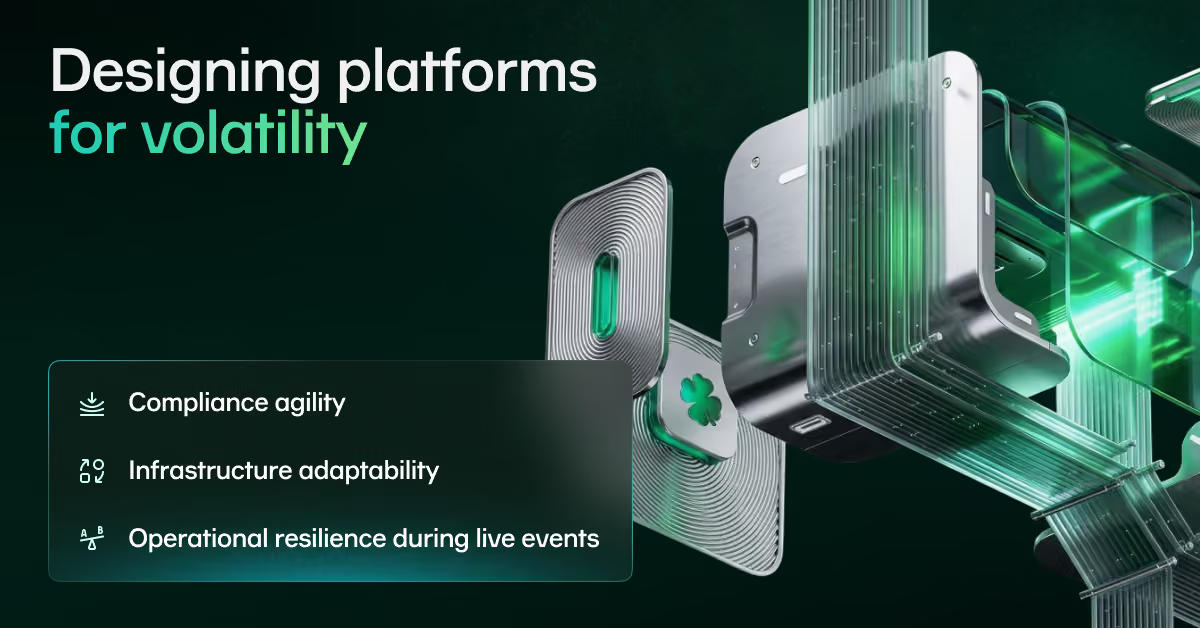
This means simulating the volume and velocity of live betting activity during a high-stakes match such as the last 15 minutes of a knockout game or the full duration of a penalty shootout. Such scenarios will provide sufficient load to recognise bottlenecks across the bet-settlement engine, odds or data integration, wallet service and session management layer, which manages connections and communications between applications.
It ensures data integrity by adding checkpoints for recovery and is critical for maintaining user state, including session stability and login continuity during a web session. Operators who invest in this testing with sufficient time to act on the findings will enter the World Cup with genuine confidence in their live betting infrastructure. Those who skip it are basing tournament performance on untested assumptions.
iGaming gamification as a pre-tournament activation is a strong driver of retention. By the time the World Cup begins, the competition for player attention is at its most intense, and casual bettors are being bombarded with acquisition offers from every direction.
The operators with the strongest retention outcomes during the tournament are those that will have already established their engagement mechanics with their player base in the weeks prior. Deploying gamification in iGaming such as prediction games, loyalty progressions tied to different events, missions, challenges and structures that are built before the opening World Cup match gives operators time to build engagement patterns and habits before competitive noise and marketing takes over the airwaves.
Players who arrive at the World Cup already engaged with an operator's gamification layers are significantly less likely to be captured by competing offers.
Platform selection for a World Cup cycle is not a decision that should be taken lightly, which is why Soft2Bet presents a compelling case as a leading provider of online sports betting turnkey solutions in the market today.
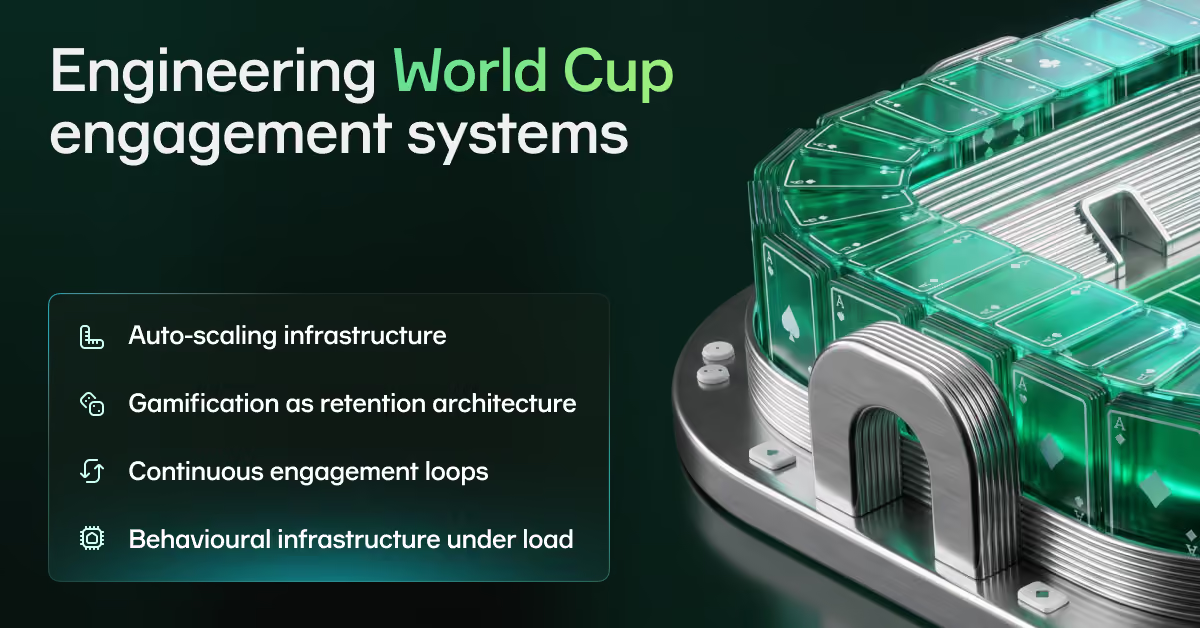
With Soft2Bet, the key features of design and UX combine to produce a platform where regulatory compliance and outstanding player experiences are standard. Those features are powered by a state of the art Player Account Management (PAM) system that drives customer retention throughCRM functionality and delivers high-quality content through a flexible and user-friendly content management system (CMS).
These tools allow Soft2Bet to produce user interfaces that adapt to jurisdictional requirements without degrading the product quality that the player sees. Tournament-period UX, where speed of bet placement, clarity of live markets and frictionless navigation are directly linked to revenue, is an area where Soft2Bet's design philosophy is translating into measurable commercial outcomes. Players who cannot find their markets or complete their bet slips before kick-off represent a player whose session value is zero.
On conversion, Soft2Bet's onboarding architecture is optimised for the high-intent, time-pressured acquisition environment that World Cup 2026 betting will create. Casual bettors arriving during the tournament have a short attention span and high abandonment risk.
Registration flows, KYC processes and first-deposit journeys that introduce unnecessary friction result in the loss of players who would otherwise have converted. Soft2Bet compresses these journeys and maximises conversion from high traffic.
Soft2Bet's MEGA gamification engine exemplifies how gamified content should be deployed at scale. Purpose-built for sustained engagement across extended tournament periods, MEGA allows operators to build progression systems, mission challenges and reward mechanics that evolve with the tournament calendar. Players invested in a prediction league or reward journey tied to the knockout rounds have a structural reason to keep returning, regardless of whether their bets are winning. This is what separates operators who retain their World Cup customers from those who experience post-tournament churn.
Platform scalability is supported by Soft2Bet’s microservices architecture, with its gambling infrastructure engineered for exactly the kind of high concurrency betting platform demands that a 104-match tournament generates. The live betting infrastructure is built to scale horizontally during peak match hours and contract efficiently during downtime, eliminating both the performance risk of under-provisioning and the cost waste of over-provisioning. For operators targeting online gambling growth in 2026, that infrastructure reliability acts as a technical and commercial foundation on which growth can be built.
World Cup 2026 betting is likely to be the largest single commercial opportunity ever for the online gambling industry. A global audience of billions will watch 104 matches and 48 nations competing across 16 cities, with the wagering that will occur during those events coming on top of the growth the industry will record this year.
Operators wanting the 2026 World Cup to be a defining period in their commercial history will ensure that their live betting infrastructure is faultless, platform scalability enables leadership during key sporting events, and gamification mechanics determine whether players acquired during the tournament will remain engage when it ends, which is why Soft2Bet is the strategic choice for 2026. The tournament will not wait and preparations should not either.
How does World Cup 2026 betting affect online gambling growth projections for operators?
The 2026 World Cup is expected to accelerate online gambling growth significantly, with conservative market estimates projecting annual revenue increases exceeding 10%, a baseline that major tournament years have historically exceeded as casual bettors enter the market at scale.
Why is platform scalability critical for handling high concurrency betting during the World Cup?
In total, 104 matches will take place during the event, generating simultaneous surges in live betting across all kinds of markets: singles, bet builders, parlays, and cash-out products. Platforms that do not scale automatically with microservices architecture will risk degradation at the most important moments: peak match hours, penalty shootouts or knockout rounds, when bet volumes and activity spike sharply.
Why does true low latency matter so much in delivering live sports betting data?
In live betting, odds can shift within milliseconds of an in-play event; a goal, a red card or a free-kick in a dangerous area can alter how betting markets are priced. A platform that processes or displays data even fractionally behind realtime can expose operators to significant liability through incorrect market pricing , while players experience the frustration of placing bets on odds that have already moved.
How do jurisdictional logic toggles help sports betting software providers manage multi-market compliance?
Logic toggles allow compliance rules such as bonus limits, responsible gambling thresholds and bet-type restrictions. They can be adjusted at the configuration layer rather than the code layer, enabling sports betting software providers to respond to regulatory changes within hours rather than weeks and months.
What role does gamification in iGaming play in retaining World Cup players beyond the tournament window?
When deployed at least 60 days before the tournament, gamification mechanics like Soft2Bet's MEGA engine build habitual engagement patterns that support post-tournament retention,converting a short-term traffic spike into long-term player lifetime values.
.svg)
.svg)



.png)


.png)